

Repository
egobabyvlm
Benchmarking Cross-Modal Learning from Naturalistic Egocentric Video Data
- Family
- Subgroups
- Vision
- Vision
- Language
- Language
- Component
- Path
Specs
- FamilySubgroups
- VisionVision
- LanguageLanguage
- ComponentPath
- DINOv2apps/baselines/dinov2/third_party/dinov2/
- Perception Encoderapps/alignment_scoring/third_party/perception_models/ (PE portion)
- Perception-LMapps/alignment_scoring/third_party/perception_models/ (PLM portion)
- LongTail-Swapapps/swapbench/third_party/lt_swap/
- LLaVA-derived codeapps/baselines/llava/
README



Challenge infrastructure accompanying the paper
Benchmarking Cross-Modal Learning from Naturalistic Egocentric Video
Data. Brought to you by researchers
at Meta, Stanford, ENS and UTokyo.
The challenge
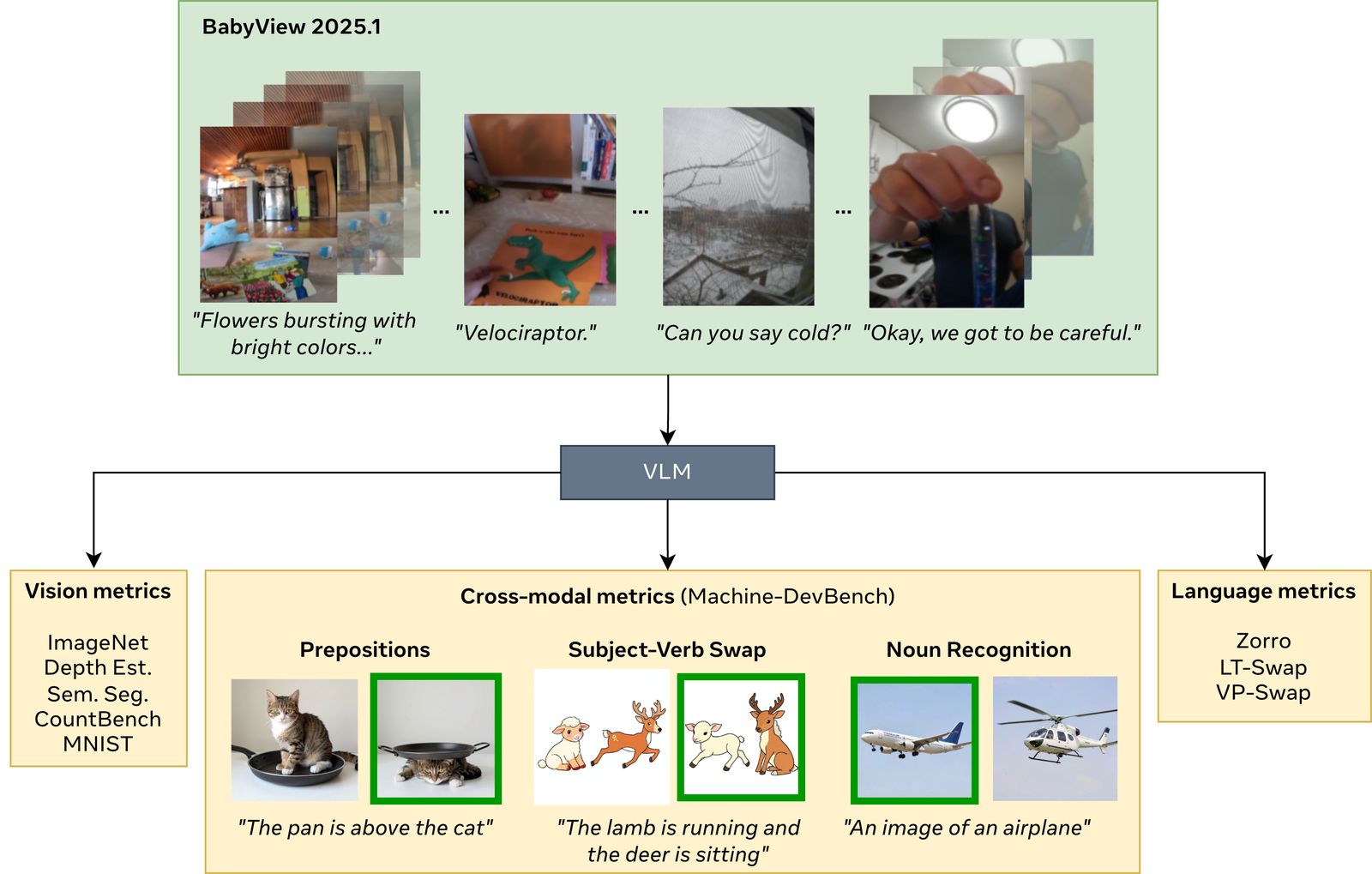
Train a VLM on the BabyView 2025.1
corpus (≈863 h of head-mounted-camera video from children, collected
by Stanford University and hosted on NYU Databrary) and nothing else —
no extra image, video, text or audio data may be used for any encoder
pretraining, fine-tuning or evaluation. The challenge is to beat the
baselines on a fixed evaluation suite and close the gap to web-scale
pretrained models.
Submissions are scored on three families of tasks, each with subgroup
aggregates and an overall:
| Family | Subgroups | Tasks |
|---|---|---|
| Cross-modal grounding (Machine-DevBench) | Lexical (2), Grammatical (8) | Noun + adjective recognition; subject-verb / subject-adjective binding; negation; word order; prepositions; comparatives; counting; embedded relatives. ~3,700 contrastive (image, caption) trials sampled from the model's own training vocabulary across log-frequency bins. |
| Vision | Object recognition (6), Visual properties (3) | ImageNet-1k (k-NN, linear, ABX); MNIST (linear, ABX); COCO-Stuff segmentation; NYUv2 depth; CountBench (linear, ABX). |
| Language | Syntax (3), Semantics (2) | Zorro; LongTail-Swap (Inflection, Agreement, Word); Visual-Property Swap (color, material, size, shape). |
The paper shows weakly-aligned naturalistic egocentric input drives
contrastive and generative reference baselines to near-chance on the
cross-modal probes, while curated captions (COCO) approach off-the-shelf
CLIP. The challenge is to close that gap to web-scale pretrained models
algorithmically, without changing the data.
Repository layout
Each directory under apps/ has a README with component-specific
usage.
<details>
<summary>Top-level tree</summary>
apps/
├── data_preprocessing/   # video → frames + WhisperX transcripts + train/val/test manifests
├── baselines/
│   ├── dinov2/           # DINOv2 SSL + ViT-B/14 feature extractor
│   ├── lm_training/      # BERT MLM and GPT-2 from-scratch trainers
│   ├── clip/             # CLIP+ contrastive trainer (4 modes: contrastive, +MLM, +DINOv2, triple)
│   └── llava/            # LLaVA-style generative VLM trainer
├── alignment_scoring/    # CLIP / VQA / STS / captioning pipelines for cross-modal alignment scoring
├── benchmark_creation/   # Machine-DevBench corpus-grounded benchmark generator
└── swapbench/            # LongTail-Swap + VP-Swap generators
core/                     # Protocols (FeatureExtractor, …), DDP / config / seed utils
evaluation/               # Hydra+Stopes eval pipeline (vision, text, multimodal task launchers)
docs/                     # Per-component design notes
scripts/eval_data/        # Eval-dataset download helpers
tests/                    # Unit + opt-in integration tests
</details>
Submitting
A submission is leaderboard scores plus, ideally, the training code that
produced them. The minimum end-to-end path:
- Cache the eval datasets — see
docs/eval_data.md. The download scripts handle
the open-access ones automatically; only ImageNet and NYUv2 need a
one-time manual prep documented inline. - Validate the eval setup on an off-the-shelf model — point the
evaluation/eval_launcheratmodel=dino/model=clip_image/
model=bert_baseto sanity-check that the three eval families run
on your machine and reproduce numbers in the same ballpark as the
leaderboard's off-the-shelf rows. - Train your own model on BabyView — any architecture, any
objective, as long as the training data comes only from BabyView
2025.1 (no extra image / video / text / audio data for pretraining,
fine-tuning or evaluation). - Score your model with
evaluation/eval_launcherover the three
families. - Open a PR against the leaderboard repo with a JSON file
containing your scores and a link to the training code so the
submission can be reproduced. See the
leaderboard submission page
for the JSON schema and PR template.
[!IMPORTANT]
Submissions linking to runnable training code are marked reproducible.
Organizers don't rerun the code — the mark just signals anyone could.
Leaderboard-only submissions (paper or report without runnable code) are
welcome but unmarked.
[!TIP]
For validation and method exploration we recommend training on
Ego4D rather than BabyView. Ego4D is
naturalistic egocentric video too — just not developmentally
plausible — and is faster to iterate on (more shards, fewer access
hoops). Then re-train your final submission on BabyView 2025.1.
Reference baselines
The apps/baselines/ trees ship the four trainers we used in the paper,
along with apps/data_preprocessing/ for the BabyView → manifest
pipeline they consume. Useful as starting points, sanity checks, or
warm-starts for your own approach — but bring your own trainer if you
prefer; the challenge encourages alternative architectures, objectives
and curricula.
<details>
<summary>What's shipped + how to plug in an alternative architecture</summary>
apps/baselines/dinov2/— DINOv2 SSL (ViT-B/14).apps/baselines/lm_training/— BERT MLM and GPT-2 from-scratch.apps/baselines/clip/— CLIP+ contrastive trainer with four modes
(contrastive, +MLM, +DINOv2, triple).apps/baselines/llava/— LLaVA-style generative VLM trainer.apps/data_preprocessing/— video → frames + WhisperX transcripts →
(frame, utterance)manifests.
Plugging in an alternative architecture. The eval launcher
dispatches to whatever model class your config _target_ points at.
Make your model compatible by implementing one of the protocols in
core/protocols/feature_extractor.py:
ImageFeatureExtractor— vision tasks (ImageNet, MNIST, depth,
segmentation, CountBench).TextFeatureExtractor— language tasks (Zorro, LT-Swap, VP-Swap).MultiModalFeatureExtractor— cross-modal grounding
(Machine-DevBench).VideoFeatureExtractor— video extractors (not on the default
evaluation path, but supported by the launcher).
The protocols are runtime_checkable, so the launcher fails fast at
startup if a method is missing. Once your class implements the relevant
protocol, drop evaluation/configs/model/<your_name>.yaml with
_target_: path.to.YourExtractor and pass model=<your_name> to
eval_launcher. The existing evaluation/configs/model/*.yaml files
(dino.yaml, clip_image.yaml, llava_vision.yaml, …) are working
references.
</details>
[!NOTE]
apps/alignment_scoring/,apps/benchmark_creation/and
apps/swapbench/are toolkits used to produce the paper's analyses
and benchmarks. Not on the critical path for a submission, but
useful for re-running those experiments or generating benchmarks for
a new training corpus.
Install
The full environment is pinned in pixi.toml (Python 3.12,
PyTorch 2.8 + CUDA 12.6).
# install pixi: https://pixi.sh/latest/installation/
pixi install -e dev
This produces installable CLI entry points. The most commonly used:
egobabyvlm-train-contrastive              # apps/baselines/clip/training
egobabyvlm-extract-frames                 # apps/data_preprocessing/frames
egobabyvlm-transcribe-whisperx            # apps/data_preprocessing/transcription
egobabyvlm-build-clip-manifest            # apps/data_preprocessing/manifests
<details>
<summary>All installed CLI entry points</summary>
egobabyvlm-extract-frames                 # apps/data_preprocessing/frames
egobabyvlm-transcribe-whisperx            # apps/data_preprocessing/transcription
egobabyvlm-filter-vtc                     # apps/data_preprocessing/transcription (BabyView KCHI)
egobabyvlm-build-clip-manifest            # apps/data_preprocessing/manifests
egobabyvlm-train-contrastive              # apps/baselines/clip/training
egobabyvlm-export-text-encoder-to-hf      # apps/baselines/clip/scripts (BERT → HF for lm_eval)
egobabyvlm-swapbench-build-word-lists     # apps/swapbench (LongTail-Swap + VP-Swap)
egobabyvlm-swapbench-lt-swap              # apps/swapbench
egobabyvlm-swapbench-vp-swap              # apps/swapbench
alignment-{clip,sts,vqa}-scoring          # apps/alignment_scoring
alignment-captioning                      # apps/alignment_scoring
alignment-finetune-lora                   # apps/alignment_scoring (LoRA finetune)
alignment-create-shuffled-manifest        # apps/alignment_scoring
DINOv2, LLaVA, BERT, GPT-2, Machine-DevBench generation and the
evaluation launcher are invoked via pixi run -e dev python -m apps.<…>
or pixi run -e dev python -m evaluation.…. See the corresponding
component READMEs.
</details>
Quickstart
Run an evaluation
Download the eval datasets once (see
docs/eval_data.md), then point the launcher at
your model:
# All vision tasks
pixi run -e dev python -m evaluation.eval_launcher \
    eval=vision/vision_pipeline \
    model=dino \
    name=my_run

# All Machine-DevBench tasks (realistic + cartoon styles)
pixi run -e dev python -m evaluation.eval_launcher \
    eval=multimodal/machine_devbench_pipeline \
    model=clip_image \
    name=my_run

# All text tasks
pixi run -e dev python -m evaluation.eval_launcher \
    eval=text/text_pipeline \
    model=bert_base \
    name=my_run
Override model=… to swap encoders or any individual task YAML in
evaluation/configs/eval/. Off-the-shelf model configs (dino,
clip_image, bert_base, …) are useful for sanity-checking the eval
setup before plugging in your own.
Train a reference baseline (optional)
The shipped baselines reproduce paper numbers and can serve as starting
points.
<details>
<summary>CLIP+ (contrastive) — triple mode on Ego4D</summary>
pixi run -e dev torchrun --standalone --nproc-per-node=4 \
    -m apps.baselines.clip.training.train \
    name=babyview_clip mode=triple data=ego4d \
    data.train_dataset.manifest_path=/path/to/manifests/train.json \
    data.train_dataset.image_root=/path/to/frames \
    data.val_dataset.manifest_path=/path/to/manifests/val.json \
    +text_only_data=default text_only_data.train_file=/path/to/utterances.txt \
    +dinov2=vitb14_coco
data=ego4d selects the multi-frame-per-utterance loader used for
BabyView, Ego4D and HowTo. For COCO use data=coco. See
apps/baselines/clip/README.md for
the other modes and the single-GPU recipe.
</details>
<details>
<summary>LLaVA-style generative VLM — Phase 1 + Phase 2</summary>
sbatch apps/baselines/llava/scripts/phase1_pretrain.sh
sbatch apps/baselines/llava/scripts/phase2_finetune.sh
See apps/baselines/llava/README.md
for the three-phase recipe (GPT-2 from scratch → projector → joint
fine-tune).
</details>
Tests
pixi run -e dev ci # ruff check + format + typos + pytestGPU- and integration-marked tests are excluded by default; opt in with
pytest -m gpu or pytest -m integration.
Citing our work
If you use our benchmark or find our work useful in your research,
please consider citing:
@article{lin2026egobabyvlm,
  title   = {EgoBabyVLM: Benchmarking Cross-Modal Learning from Naturalistic Egocentric Video Data},
  author  = {Lin, Dongyan and Rust, Phillip and Villar-Corrales, Angel and Tan, Alvin W. M.
             and Luthra, Mahi and Saint-James, Charles-{\'E}ric and Moritz, Rashel
             and Krogh-Jespersen, Sheila and Stark, Vanessa and Parimi, Surya
             and Shen, Jiayi and Benchekroun, Youssef and Higuchi, Yosuke
             and Gleize, Martin and Fizycki, Tom and Hamilakis, Nicolas
             and Khentout, Manel and Tsuji, Sho and K{\'e}gl, Bal{\'a}zs
             and Pino, Juan and Frank, Michael C. and Dupoux, Emmanuel},
  journal = {arXiv preprint},
  year    = {2026},
  url     = {https://arxiv.org/abs/2605.19130},
}
Licenses
The majority of this code is licensed under CC-BY-NC 4.0,
with the following exceptions:
| Component | Path | License |
|---|---|---|
| DINOv2 | apps/baselines/dinov2/third_party/dinov2/ |
Apache License 2.0 (per-file headers) |
| Perception Encoder | apps/alignment_scoring/third_party/perception_models/ (PE portion) |
Apache License 2.0 |
| Perception-LM | apps/alignment_scoring/third_party/perception_models/ (PLM portion) |
FAIR Noncommercial Research License |
| LongTail-Swap | apps/swapbench/third_party/lt_swap/ |
CC-BY-NC 4.0 |
| LLaVA-derived code | apps/baselines/llava/ |
Apache License 2.0 (per-file headers) |
Please retain all upstream copyright notices and license headers when
reusing files from these directories.
The released data is CC-BY-NC and intended for benchmarking only.
Some annotations are outputs of Llama 3.1 and subject to its license
(Llama 3.1 license;
Llama 4 model card).
Third-party content pulled from other locations is subject to its own
licenses, and you may have other legal obligations governing your use of
that content.