

- Capability
- V1 status
- Dense vectors, exact metrics, casts, and aggregates
- Stable
- Registered-table exact search and metadata filtering
- Stable
- Collections, scroll, count, facets, and grouping
- Stable
Specs
- CapabilityV1 status
- Dense vectors, exact metrics, casts, and aggregatesStable
- Registered-table exact search and metadata filteringStable
- Collections, scroll, count, facets, and groupingStable
- Dense plus PostgreSQL full-text hybrid retrievalStable
- Dense L2, inner-product, cosine, and L1 HNSWImplemented; performance-qualified on PostgreSQL 17
- Metadata-filtered ANNImplemented with iterative and adaptive masked paths
- halfvec , sparsevec , and bitvec wrappers/opclassesPartial, experimental
- PostgreSQL 17 and 18Supported; release images build and verify on amd64 and arm64
- pgContext V1pgvector
- Authoritative dataOrdinary PostgreSQL tables
- Exact dense searchYes
- HNSWDense, page-native
- IVFFlatNot implemented
- Metadata filteringRegistered PostgreSQL fields/JSONB
- Drop-in pgvector compatibilityNo
README
<h1 align="center">pgContext <a href="docs/index.md">
<img src="https://img.shields.io/badge/docs-pgContext-0ea5e9?style=flat-square" alt="pgContext documentation">
</a></h1>
A full AI search engine, built into Postgres.
Hybrid dense + full-text retrieval, filter-aware ANN, and exact, MVCC-visible re-scoring: a dedicated vector engine's feature set, as a PostgreSQL 17 and 18 extension.
Built by Evokoa · Fully-managed hosting at Polygres







pgContext is an Apache-2.0 PostgreSQL 17 and 18 extension that turns Postgres into a
full AI search engine: dense vector search, metadata-filtered approximate search,
and hybrid (dense + full-text) retrieval, all inside the database you already run.
Most retrieval stacks add a second service, copy your application data into it,
and create a separate authorization, backup, and recovery boundary to keep in
sync. pgContext keeps retrieval next to the data it searches: your ordinary
PostgreSQL tables stay the source of truth for vectors, metadata, MVCC, ACL/RLS,
backup, and replication. HNSW and other acceleration state are derived,
rebuildable indexes (never a second copy that can drift), and every approximate
result is re-scored exactly against the live row before it is returned, so a fast
answer is still a correct, permission-safe answer.
At a glance: exact and persisted HNSW search · L2, inner-product, cosine, and
L1 metrics · filters over registered columns and JSONB paths · MVCC/ACL/RLS and
exact-score rechecks · collections, scroll, count, facets, and grouping · dense +
full-text hybrid retrieval with reciprocal-rank fusion.
[!TIP]
Looking for a managed version? We have launched a managed version of pgContext on polygres.com for full high performance AI Retrieval on Postgres.
Live demos
See pgContext's retrieval in action (hosted on Polygres):
- Wikipedia hybrid search: query a Wikipedia-scale dataset with live semantic + keyword hybrid retrieval.
- Memory demo: an interactive hybrid-retrieval playground with adjustable fusion weights across retrieval channels.
Vector search
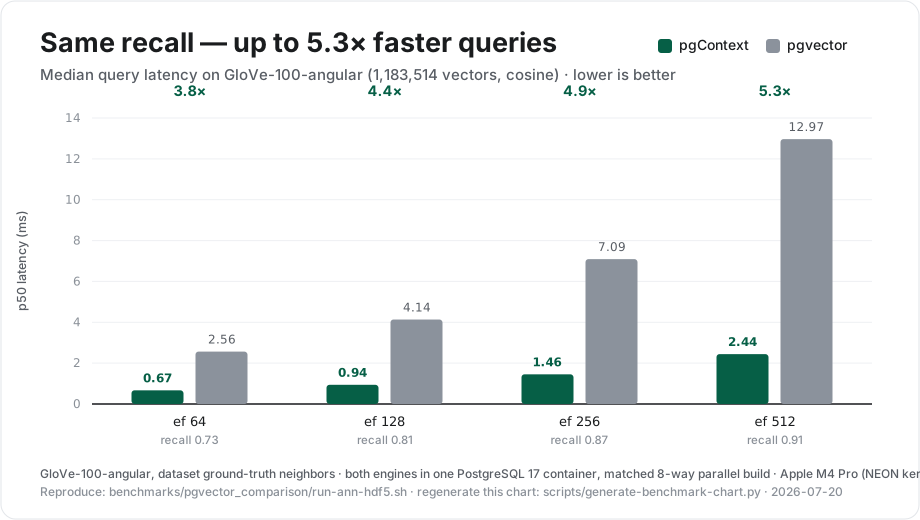
Standard GloVe-100-angular benchmark (1.18M vectors, cosine), both engines in one PostgreSQL 17 container with the same parallel build budget, scored against the dataset's own ground-truth neighbors. Full report →
pgContext serves persisted, page-native HNSW straight from durable PostgreSQL
index pages. An HNSW plan never substitutes fixture candidates or silently
exact-scans the whole collection. On the standard GloVe-100-angular benchmark
(1,183,514 vectors, cosine), with pgContext and pgvector in the same PostgreSQL 17
container and built with the same parallel budget:
- Faster at the same recall. pgContext matches pgvector's recall at every
search setting while answering each query 3.8-5.3× faster (for example,
0.910 recall@10 at 2.4 ms versus 13.0 ms atef_search512), and the
advantage widens as you raise the recall target. - Higher recall for the same latency. Read the other way, that speed is
quality: given roughly 2.5 ms per query, pgContext reaches 0.91
recall@10 where pgvector reaches 0.75, because it can afford far more search
effort in the same time. - Every answer is re-checked exactly. ANN candidates are resolved back to the
live row and re-scored exactly, under PostgreSQL MVCC visibility, ACL/RLS, and
SQL predicates: a fast answer is still a correct, permission-safe answer. - Hybrid retrieval is built in. Dense vector search fused with PostgreSQL
full-text ranking (reciprocal-rank fusion) ships in the extension, not as
application glue.
All figures above are Apple M4 Pro (NEON). See the
pgContext vs pgvector report
for the full latency and recall curves, the
three-system comparison
that adds Qdrant (a strong, mature peer that leads at very high recall through
per-query segment parallelism), and docs/benchmarks/pgvector.md
for every lane.
Metadata filtering
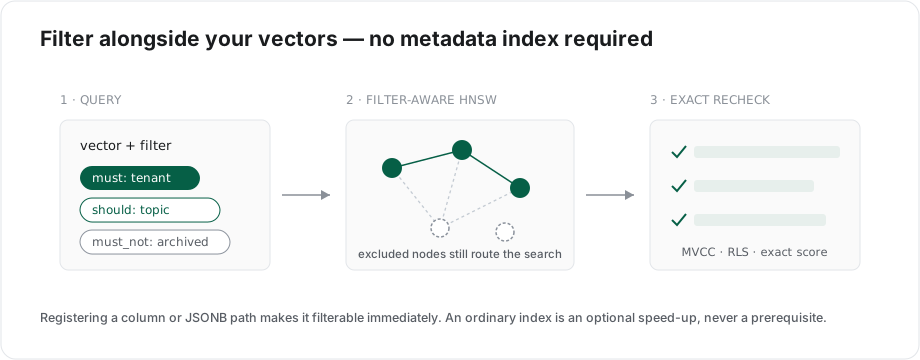
Filtering is where vector search usually breaks: bolt a WHERE clause onto an
approximate search and recall quietly collapses as the filter gets selective.
pgContext treats filtering as part of the search, not an afterthought.
Write Qdrant-style filters over your registered PostgreSQL columns and JSONB
paths: must / should / must_not, equality, any / except, numeric and
datetime ranges, is_null / is_empty:
SELECT source_key, score
FROM pgcontext.search(
    'docs', '[ ... ]'::pgcontext.vector,
    '{
       "must":     [{"key": "tenant_id", "match": "acme"},
                    {"key": "price", "range": {"gte": 10, "lt": 20}}],
       "should":   [{"key": "metadata.topic", "match": {"value": "billing"}}],
       "must_not": [{"key": "archived", "match": true}]
     }'::jsonb,
    10
);
What sets it apart:
- No filter index to build or maintain. Registering a column or JSONB path
makes it filterable immediately; pgContext plans and runs the filtered search
for you, no extra index required. Add an ordinary index (say, a btree on the
column) later only when you want to speed a specific filter up; it's an
optimization, not a prerequisite. - Filter-aware ANN, not post-filtering. Below a selectivity crossover
pgContext scores exactly; above it, it pushes a single reusable mask through
the persisted HNSW graph while excluded nodes still act as connectors, so
recall holds up even when the filter is highly selective. - One grammar for search, count, and facets. The same filter drives
filtered search, counts, and facet aggregation: a cohesive retrieval API,
not hand-assembled SQL per query. - Safe and governed by PostgreSQL. Filters compile to a typed AST with
bound parameters over registered fields only (no SQL injection, no mutating
unregistered columns), and every result is re-checked against MVCC visibility
and RLS/ACL before it is returned.
See Filters for the full grammar and field
semantics.
Roadmap
pgContext 0.2.0 extends the V1 foundation with the first complete advanced
retrieval pipeline. It now includes:
- Broader vector indexing. First-class non-dense HNSW opclasses, named
sparse ANN, and scalar/product/binary quantized traversal with exact rerank. - Composable retrieval. Typed dense, filtered, sparse, full-text,
quantized, recommendation, lookup, and late-interaction branches with
weighted or reciprocal-rank fusion. - Owned serving infrastructure. Internally maintained late-interaction
tokens, immutable mapped HNSW generations, and automatic bounded execution
telemetry. - pgvector migration. A certified PostgreSQL 17 bridge, preflight and
adoption tooling, and lossless resumable conversion for the supported
profile without requiring a new application vector column. - Graph-augmented retrieval. We plan to bring graph capabilities from our
sister extension pgGraph into
pgContext, so vector results can expand and re-rank along the relationships in
your data (the pattern behind GraphRAG), without leaving Postgres or copying
data between systems.
The remaining work includes IVFFlat, measured x86 performance claims, broader
PostgreSQL-major certification, and full unqualified pgvector-name
compatibility. See the known limitations,
product roadmap, and full roadmap.
Quickstart
Like pgvector, pgContext is one CREATE EXTENSION away once PostgreSQL can see
it:
CREATE EXTENSION pgcontext;Pick whichever install path fits your setup: Docker (zero build),
Homebrew, PGXN, or source. The fastest cross-platform option is the
pre-built Docker image; it is multi-arch (linux/amd64 and linux/arm64) and
runs on Linux or through Docker Desktop's Linux-container support on macOS and
Windows. Choose the matching pgMAJOR-vVERSION tag; unqualified version tags
continue to select PostgreSQL 17.
docker pull ghcr.io/evokoa/pgcontext:pg17-v0.2.0
docker run -d --rm \
  --name pgcontext \
  -e POSTGRES_PASSWORD=postgres \
  -e POSTGRES_DB=pgcontext \
  -p 5432:5432 \
  ghcr.io/evokoa/pgcontext:pg17-v0.2.0
Wait for PostgreSQL to accept connections, then verify the extension is loaded
(this uses psql inside the container, so you do not need a local PostgreSQL
client):
for i in $(seq 1 30); do
  docker exec pgcontext pg_isready -U postgres -d pgcontext && break
  sleep 1
done
docker exec pgcontext psql -U postgres -d pgcontext \
  -c "SELECT extname, extversion FROM pg_extension WHERE extname = 'pgcontext';"
If you have psql installed locally you can also connect directly:
psql -h localhost -U postgres -d pgcontextBuild from Source
For a checkout or downloaded archive:
make install PG_CONFIG=/path/to/postgresql-17/bin/pg_config
psql -d postgres -c 'CREATE EXTENSION pgcontext;'
You need Rust 1.96.0, cargo-pgrx 0.19.1, PostgreSQL 17 or 18, its server development
headers, and a matching pg_config. See the complete
installation guide for Linux/macOS/Windows
shell support, verification, uninstall, cleanup, and troubleshooting.
Package Registries
Homebrew
The Evokoa Homebrew tap installs
pgContext 0.2.0 for Homebrew postgresql@17. The formula builds from source
and installs PostgreSQL extension files; it does not add a pgcontext command
to your shell.
brew update
brew install Evokoa/tap/pgcontext
brew services start postgresql@17
Enable pgContext in each database that should use it (replace postgres with
the target database name):
psql -X -v -d postgres \
  -c 'CREATE EXTENSION IF NOT EXISTS pgcontext;'
PGXN
pgContext 0.2.0 is available from
PGXN. With PostgreSQL 17 or 18,
its matching server development headers, Rust 1.96.0, and cargo-pgrx 0.19.1
installed:
pgxn install pgContextInstalling with an AI Agent
If you are an AI coding agent (or driving one) setting pgContext up in a fresh
environment, follow AGENTS.md: it gives a deterministic,
non-interactive install-and-verify recipe (Docker or source), the exact version
pins, a copy-paste smoke test, and a short explanation of what the extension
does so you can wire it into an application correctly.
Minimal Packaged Example
CREATE EXTENSION pgcontext;

CREATE TABLE docs (
    id text PRIMARY KEY,
    embedding pgcontext.vector(3) NOT NULL,
    category text NOT NULL,
    metadata jsonb NOT NULL
);

INSERT INTO docs VALUES
    ('postgres', '[1,0,0]', 'database', '{"language":"sql"}'),
    ('rust', '[0.8,0.2,0]', 'systems', '{"language":"rust"}'),
    ('vectors', '[0.7,0.1,0.2]', 'database', '{"language":"sql"}');

SELECT * FROM pgcontext.create_collection('docs', 'public.docs');
SELECT pgcontext.register_vector('docs', 'embedding', 'embedding', 3, 'cosine');
SELECT pgcontext.register_filter_column('docs', 'category', 'category');
SELECT pgcontext.upsert_points('docs', ARRAY['postgres', 'rust', 'vectors']);

SELECT source_key, score
FROM pgcontext.search(
    'docs', '[1,0,0]'::pgcontext.vector,
    '{"must":[{"key":"category","match":"database"}]}'::jsonb,
    3
);

CREATE INDEX docs_embedding_hnsw
ON docs USING pgcontext_hnsw (
    embedding pgcontext.vector_hnsw_cosine_ops
);

SELECT id, embedding OPERATOR(pgcontext.<=>) '[1,0,0]'::pgcontext.vector AS distance
FROM docs
ORDER BY embedding OPERATOR(pgcontext.<=>) '[1,0,0]'::pgcontext.vector
LIMIT 3;
The runnable, output-checked form is playground/demo.sql.
How It Works
pgContext registers application-owned tables and filterable fields in extension
catalogs. Exact search is the correctness oracle. The pgcontext_hnsw access
method stores metric-bound graph records on PostgreSQL index pages and returns a
bounded candidate set. Every candidate is resolved back to the live source row,
checked against PostgreSQL visibility and filters, and scored exactly before it
is returned. Acceleration state is rebuildable; application data never moves
out of PostgreSQL.
Feature Status
| Capability | V1 status |
|---|---|
| Dense vectors, exact metrics, casts, and aggregates | Stable |
| Registered-table exact search and metadata filtering | Stable |
| Collections, scroll, count, facets, and grouping | Stable |
| Dense plus PostgreSQL full-text hybrid retrieval | Stable |
| Dense L2, inner-product, cosine, and L1 HNSW | Implemented; performance-qualified on PostgreSQL 17 |
| Metadata-filtered ANN | Implemented with iterative and adaptive masked paths |
halfvec, sparsevec, and bitvec wrappers/opclasses |
Partial, experimental |
| PostgreSQL 17 and 18 | Supported; release images build and verify on amd64 and arm64 |
Comparison and Fit
| pgContext V1 | pgvector | Separate vector service | |
|---|---|---|---|
| Authoritative data | Ordinary PostgreSQL tables | PostgreSQL columns | Usually copied externally |
| Exact dense search | Yes | Yes | Usually |
| HNSW | Dense, page-native | Mature | Common |
| IVFFlat | Not implemented | Yes | Product-dependent |
| Metadata filtering | Registered PostgreSQL fields/JSONB | SQL predicates | Product-specific filters |
| Drop-in pgvector compatibility | No | Native | No |
For a detailed capability-by-capability view, including where pgvector or Qdrant
is the better fit, see pgvector migration,
the parity matrix, and the full
three-way comparison.
Focused V1 Scope
V1 builds and verifies PostgreSQL 17 and 18 release images on amd64 and arm64, with exact retrieval,
page-native dense HNSW, filtered ANN, and backend-local packed generations.
Additional vector types are available for evaluation and controlled rollout.
The roadmap grows that foundation with deeper lifecycle certification, quantized
navigation, broader non-dense ANN, and more packaging options. See
Known Issues and the roadmap for
precise adoption guidance.
Documentation
PostgreSQL Authority, Community, and Security
PostgreSQL owns durability, transactions, visibility, roles, RLS, backups, and
replication. Treat pgContext HNSW and other acceleration artifacts as
rebuildable indexes, not an independent database.
Contributions and independent workload testing are welcome. Read
CONTRIBUTING.md and the
Code of Conduct. Use GitHub issues for public bugs and
support questions. Do not disclose vulnerabilities publicly; follow
SECURITY.md or email
[email protected].
pgContext is built by Evokoa, the team behind
pgGraph.