

- GPU
- cuTile kernels
- A100 (sm_80)
- CUDA 13.2+
- H100 (sm_90)
- not yet (tileiras)
- RTX 4090 (sm_89)
- CUDA 13.2+
Specs
- GPUcuTile kernels
- A100 (sm_80)CUDA 13.2+
- H100 (sm_90)not yet (tileiras)
- RTX 4090 (sm_89)CUDA 13.2+
- B200 (sm_100)CUDA 13.0+
- Any other CUDA GPUdepends on tileiras
- kernelwhat it does
- compress_kv_3bitfused K+V compression in one launch
- compress_keyskey-only: normalize, rotate, Lloyd-Max, QJL
- compress_valuesvalue-only: normalize, rotate, Lloyd-Max
- decompress_valuesdequantize, un-rotate, rescale
- fused_attentionscores + online softmax + V accumulation
- notebookwhat it does
- quickstart.ipynbinstall, load model, generate, auto-tune
- kernel_analysis.ipynbNsight profiling, NVTX markers, quality comparison vs MXFP4/NVFP4
README
TurboQuant-GPU
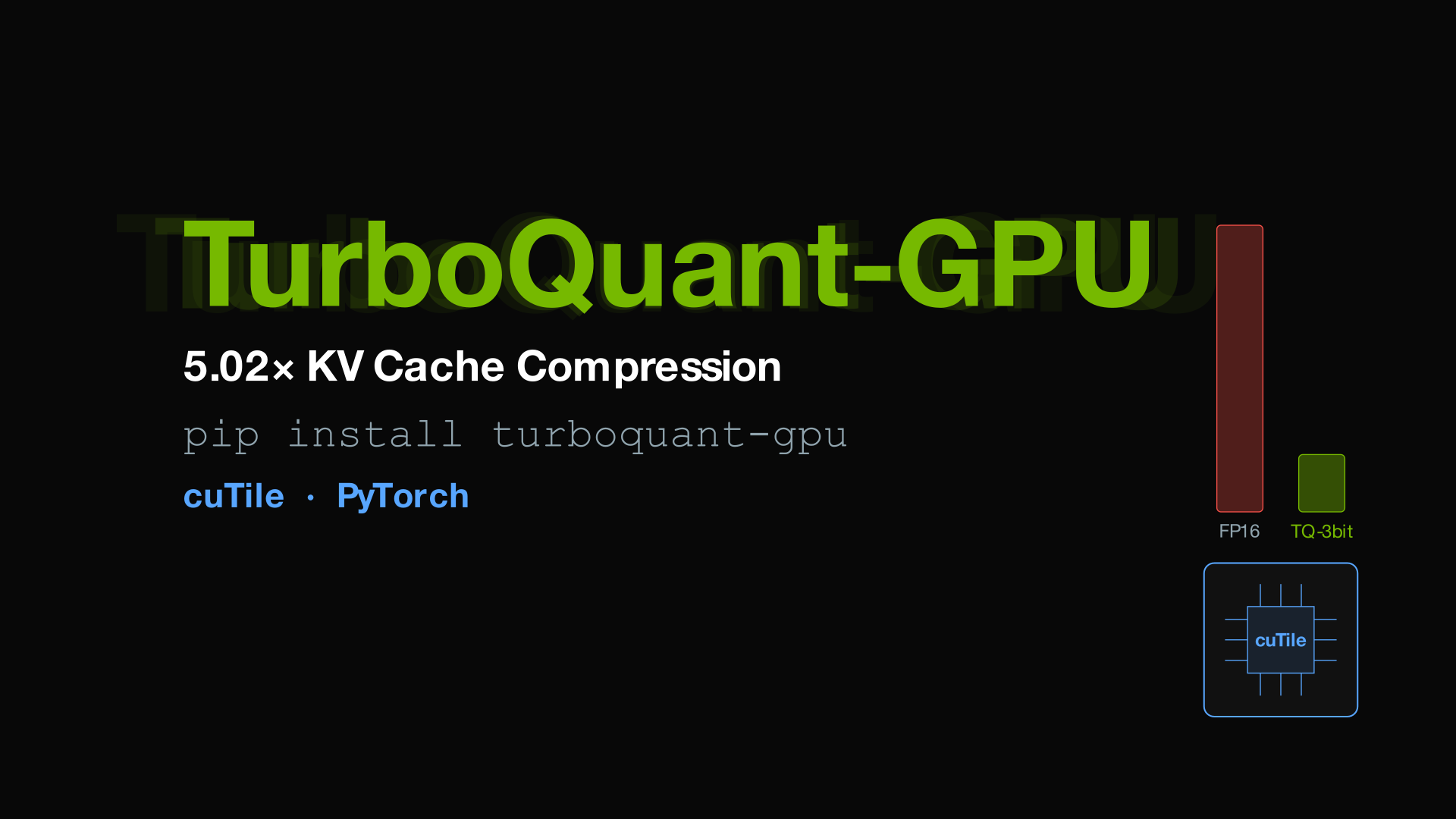
5.02x KV cache compression for LLM inference. Works on any NVIDIA GPU. cuTile kernels with automatic PyTorch fallback.
pip install turboquant-gpuCheck out the PyPi package
quickstart
from transformers import AutoModelForCausalLM, AutoTokenizer
from turboquant_gpu import TurboQuantEngine
import torch

model_id = "mistralai/Mistral-7B-v0.1"
model = AutoModelForCausalLM.from_pretrained(model_id, torch_dtype=torch.float16, device_map="cuda")
tok   = AutoTokenizer.from_pretrained(model_id)

engine = TurboQuantEngine(head_dim=128, total_bits=3, device="cuda")
result = engine.generate(model, tok, "The University of Waterloo is known for ")

print(result["text"])
print(f"{result['tokens']} tokens | {result['stats']['ratio']:.2f}x compression")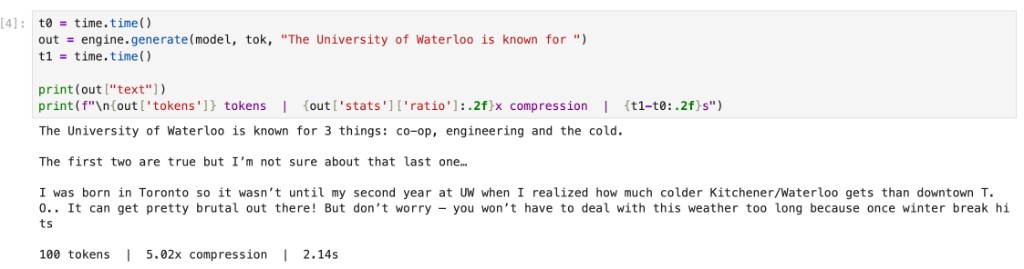
how it works
Random orthogonal rotation makes each KV cache coordinate approximately Gaussian. Lloyd-Max quantization is then optimal for that distribution, giving 3 bits per element with 0.98 cosine similarity.
Keys get 2-bit MSE quantization + 1-bit QJL bias correction. Values get 3-bit MSE quantization. Both are compressed in a single fused kernel launch per attention head.
vs NVIDIA FP4
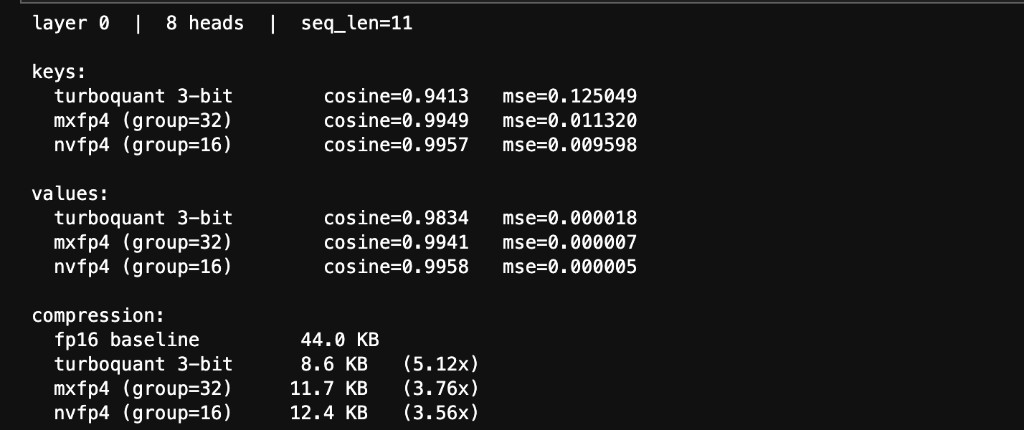
TurboQuant achieves 5.02x compression compared to 3.76x (MXFP4) and 3.56x (NVFP4) because it exploits the post-rotation Gaussian structure specific to KV caches, rather than using a general-purpose FP4 format.
install
pip install turboquant-gpuFor cuTile GPU kernel acceleration (optional, requires CUDA 13.0+ driver):
pip install cuda-tile[tileiras] --extra-index-url https://pypi.nvidia.comIf cuda-tile isn't available or your driver is older, everything still works via PyTorch.
API
engine = TurboQuantEngine(head_dim=128, total_bits=3, device="cuda")

# one-call generation
result = engine.generate(model, tokenizer, "your prompt")

# step-by-step
compressed = engine.compress_kv_cache(out.past_key_values)
cache      = engine.build_cache(compressed)
stats      = engine.compression_stats(out.past_key_values)

# auto-tune for your GPU (benchmarks cutile vs pytorch, 2-bit vs 3-bit)
engine.auto_tune(seq_len=512)
GPU support
Uses cuTile for cross-architecture kernel portability. Falls back to PyTorch automatically.
| GPU | cuTile kernels | PyTorch fallback |
|---|---|---|
| A100 (sm_80) | CUDA 13.2+ | always works |
| H100 (sm_90) | not yet (tileiras) | always works |
| RTX 4090 (sm_89) | CUDA 13.2+ | always works |
| B200 (sm_100) | CUDA 13.0+ | always works |
| Any other CUDA GPU | depends on tileiras | always works |
kernels
| kernel | what it does |
|---|---|
compress_kv_3bit |
fused K+V compression in one launch |
compress_keys |
key-only: normalize, rotate, Lloyd-Max, QJL |
compress_values |
value-only: normalize, rotate, Lloyd-Max |
decompress_values |
dequantize, un-rotate, rescale |
fused_attention |
scores + online softmax + V accumulation |
notebooks
| notebook | what it does |
|---|---|
| quickstart.ipynb | install, load model, generate, auto-tune |
| kernel_analysis.ipynb | Nsight profiling, NVTX markers, quality comparison vs MXFP4/NVFP4 |
license
MIT