

README
Seg4Diff: Unveiling Open-Vocabulary Segmentation in Text-to-Image Diffusion Transformers [NeurIPS 2025]
<a href="https://arxiv.org/abs/2509.18096">

</a>
<a href="https://cvlab-kaist.github.io/Seg4Diff">

</a>
This is the official implementation of Seg4Diff.
<br>
by Chaehyun Kim<sup>1</sup>,
Heeseong Shin<sup>1</sup>,
Eunbeen Hong<sup>1</sup>,
Heeji Yoon<sup>1</sup>,
Anurag Arnab,
Paul Hongsuck Seo<sup>2</sup>,
Sunghwan Hong<sup>3,†</sup>,
Seungryong Kim<sup>1,†</sup> <br>
<sup>1</sup> KAIST AI, <sup>2</sup> Korea University, <sup>3</sup> ETH Zürich <br>
(<sup>†</sup>Co-Corresponding Author)
Introduction
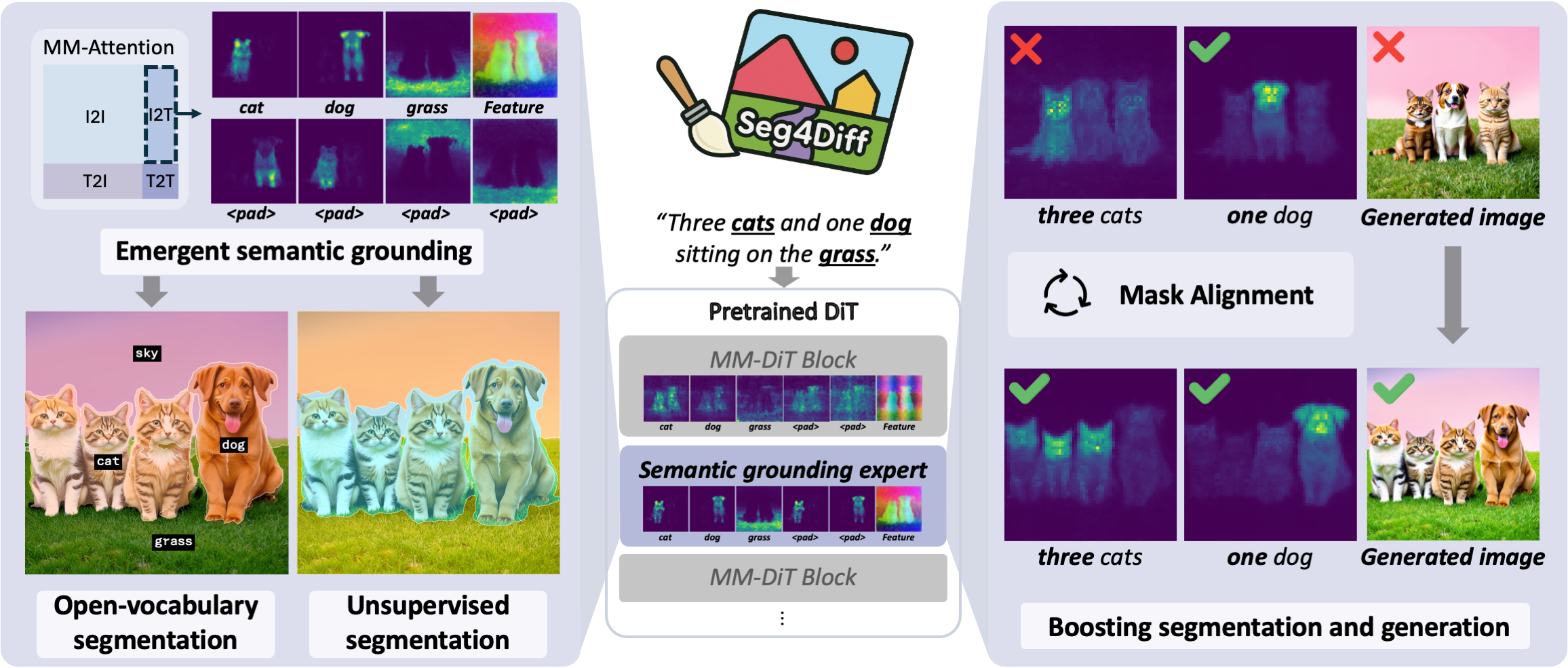
Seg4Diff is a systematic framework that analyzes and enhances the emergent semantic grounding capabilities of multi-modal diffusion transformers (MM-DiTs). We discover that specific intermediate layers, which we term semantic grounding expert layers, naturally produce high-quality zero-shot segmentation masks by aligning text tokens with corresponding image regions. Building on this insight, we introduce a lightweight LoRA fine-tuning method, Mask Alignment for Segmentation and Generation (MAGNET), to further refine this alignment, simultaneously improving both open-vocabulary segmentation and text-to-image generation quality.
For further details and visualization results, please check out our [paper]() and our project page.
Installation
Please follow installation.
Data Preparation
We largely follow PixelCLIP's dataset preparation procedure. Please refer to dataset preperation.
Zero-shot Evaluation
eval_*.sh automatically evaluates the model following our evaluation protocol, with pre-trained Stable Diffusion 3 (SD3) by default. To use different models like Stable Diffusion 3.5 or Flux.1-dev, add options to specify the backbone. The weights will be downloaded automatically in the first execution.
Evaluation script
sh eval_*.sh [CONFIG] [NUM_GPUS] [OUTPUT_DIR] [OPTS]

# Open-vocabulary semantic segmentation
sh eval_ovss.sh ./configs/eval_ovss.yaml 1 ./output/ovss
# Unsupervised segmentation
sh eval_unsup.sh ./configs/eval_unsup.yaml 1 ./output/unsup
Training
run.py trains the model in default configuration and evaluates the model after training, which is executed by run.sh. We provide generated captions for 10k sampled subset of SA-1B and COCO, which can be found in datasets/captions.
To train or evaluate the model in different environments, modify the given shell script and config files accordingly.
Training script
sh run.sh [CONFIG] [NUM_GPUS] [OUTPUT_DIR] [OPTS]

# With SA-1B masks and captions
sh run.sh configs/train_sa1b.yaml 2 output/
# With COCO masks and captions
sh run.sh configs/train_coco.yaml 2 output/
Pretrained weights
We provide SA-1B-trained and COCO-trained lora weights for Stable Diffusion 3 (SD3). Download the .pth model weights to your desired directory (from the Hugging Face Hub):
from huggingface_hub import hf_hub_download

# Download COCO-trained lora weights
LORA_PATH_COCO = hf_hub_download(
    repo_id="chyun/seg4diff-coco-lora",
    filename="lora_weights.pth",
    cache_dir="/path/to/save/coco",
)
print("Downloaded to: ", LORA_PATH_COCO)

# Download SA1B-trained lora weights
LORA_PATH_SA1B = hf_hub_download(
    repo_id="chyun/seg4diff-coco-lora",
    filename="lora_weights.pth",
    cache_dir="/path/to/save/coco",
)
print("Downloaded to: ", LORA_PATH_SA1B)
To run the evaluation script with lora weights, specify the model weights like following:
# Evaluate COCO-trained model
sh eval_ovss.sh ./configs/eval_ovss.yaml 1 ./output/ovss MODEL.WEIGHTS LORA_PATH_COCO

# Evaluate SA1B-trained model
sh eval_ovss.sh ./configs/eval_ovss.yaml 1 ./output/ovss MODEL.WEIGHTS LORA_PATH_SA1B
Citing Seg4Diff
@misc{kim2025seg4diffunveilingopenvocabularysegmentation,
      title={Seg4Diff: Unveiling Open-Vocabulary Segmentation in Text-to-Image Diffusion Transformers},
      author={Chaehyun Kim and Heeseong Shin and Eunbeen Hong and Heeji Yoon and Anurag Arnab and Paul Hongsuck Seo and Sunghwan Hong and Seungryong Kim},
      year={2025},
      eprint={2509.18096},
      archivePrefix={arXiv},
      primaryClass={cs.CV},
      url={https://arxiv.org/abs/2509.18096},
}