

Repository
ml-ui-jepa
UI-JEPA: Towards Active Perception of User Intent through Onscreen User Activity
README
UI-JEPA: Towards Active Perception of User Intent through Onscreen User Activity
This repository releases the dataset created as part of the UI-JEPA project, to push the boundaries of UI Understanding.
-
UI-JEPA:
UI-JEPA: Towards Active Perception of User Intent through Onscreen User Activity[BibTeX]Yicheng Fu, Raviteja Anantha, Prabal Vashisht, Jianpeng Cheng, Etai Littwin
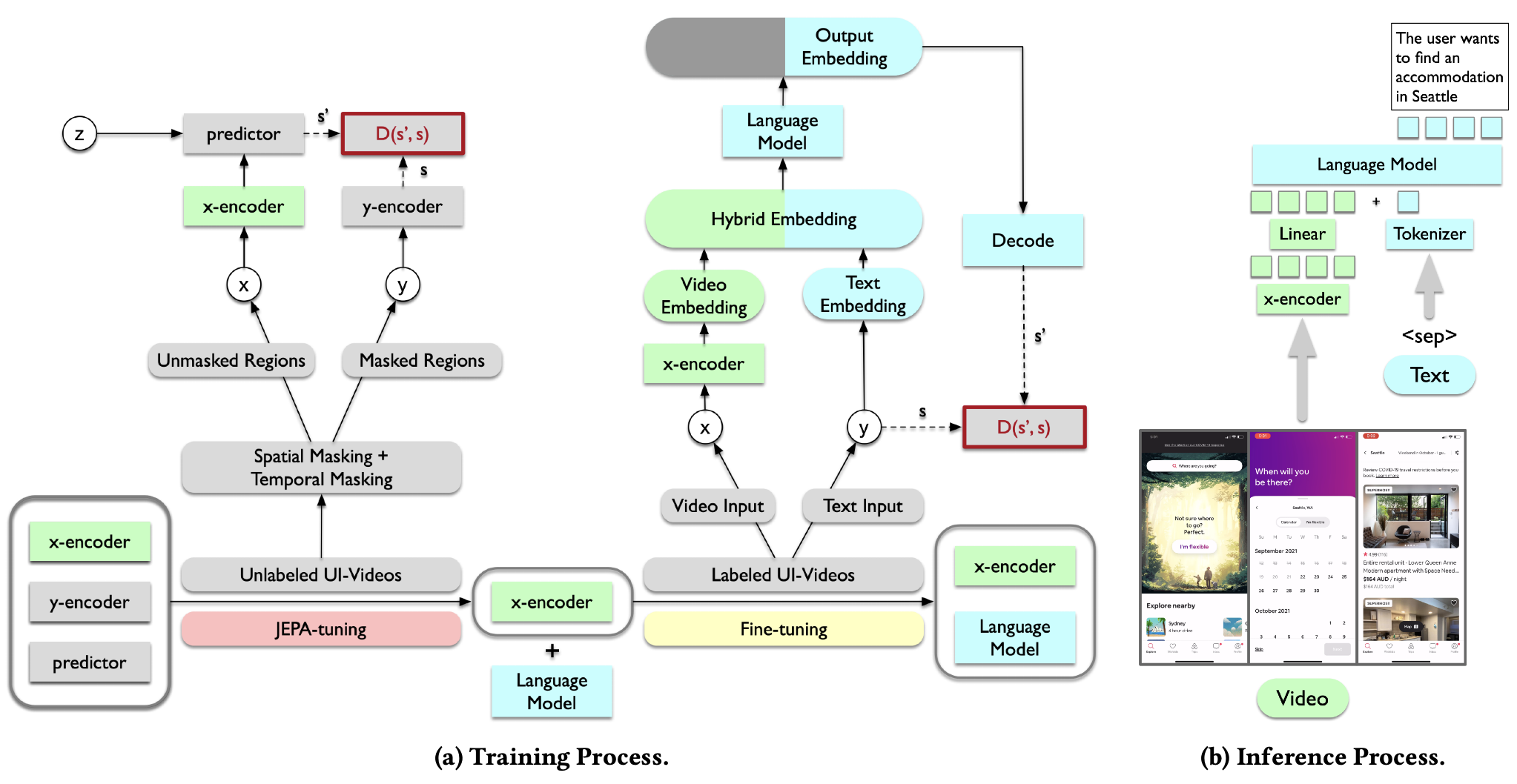
Overview of UI-JEPA
Our contributions in the paper are highlighted below,
- Benchmarks: We introduce two new benchmarks, Intent in the Wild (IIW) and Intent in the Tame (IIT) for UI Understanding. The task is to generate a natural language description of user intent given a recording of UI interactions. The dataset is released in this reposiotry.
- Framework: We propose UI-JEPA, a novel framework that employs various masking strategies to learn abstract UI embeddings from unlabeled data through SSL.
- Model: We present a lightweight JEPA-tuned MLLM (JEPA-based video encoder + fine-tuned auto-regressive head) designed to generate user intent from UI action sequences, showcasing the integration of JEPA with LLM decoders for user intent prediction. The models are NOT released as a part of this repository.
- Comparison: We compare our lightweight model against state-of-the-art MLLMs, demonstrating that our approach achieves parity while using only a fraction of the data, time, and computational resources.
Dataset
As a part of our work, we are releasing two benchmarks, Intent in the Wild (IIW) and Intent in the Tame (IIT) for UI Understanding.
Intent in the Tame (IIT)
In its first version, IIT dataset consists of 914 labeled videos spanning across 10 intent categories (e.g. sending message, calling a person, etc.). The data is structured as follows,
- train/
- val/
- test/
Each directory has .mov recordings along with annotations.csv.
Intent in the Wild (IIW)
The IIW dataset consists of 219 intent categories, with 135 in the few-shot split and 84 in the zero-shot split. In total, the dataset contains 1.6K videos, each averaging 749 frames and approximately ∼25 seconds in duration. The data is structured as follows,
- train/
- val/
- test/
Each directory has .mov recordings along with annotations.csv.
Accessing the Dataset
You can access and download the dataset using one of the following methods:
🔗 Direct Download
Unzip it using:
unzip raw.zipUsing python
Clone the repository, create a python virtual environment and install requests module,
python -m venv venv
source venv/bin/activate
pip install requests
Run the dataset_download.py as follows,
python dataset_download.py --type [iit/iiw] --output_dir [output directory]Unzip the file using bash.
License
This project's code is released under the Apple Sample Code License (see LICENSE). This project's data is released under the CC-BY-NC-ND license (see LICENSE_DATA).
Citation
If you find our work useful, please consider citing us as:
@inproceedings{10.1145/3699682.3728327,
author = {Fu, Yicheng and Anantha, Raviteja and Vashisht, Prabal and Cheng, Jianpeng and Littwin, Etai},
title = {UI-JEPA: Towards Active Perception of User Intent through Onscreen User Activity},
year = {2025},
isbn = {9798400713132},
publisher = {Association for Computing Machinery},
address = {New York, NY, USA},
url = {https://doi.org/10.1145/3699682.3728327},
doi = {10.1145/3699682.3728327},
booktitle = {Proceedings of the 33rd ACM Conference on User Modeling, Adaptation and Personalization},
location = {New York City, NY, USA},
series = {UMAP '25}
note = {Accepted for publication}
}