

README

<h2 align="center">4DAnyone: Create Anyone in 4D from a Casual Monocular Video</h2>
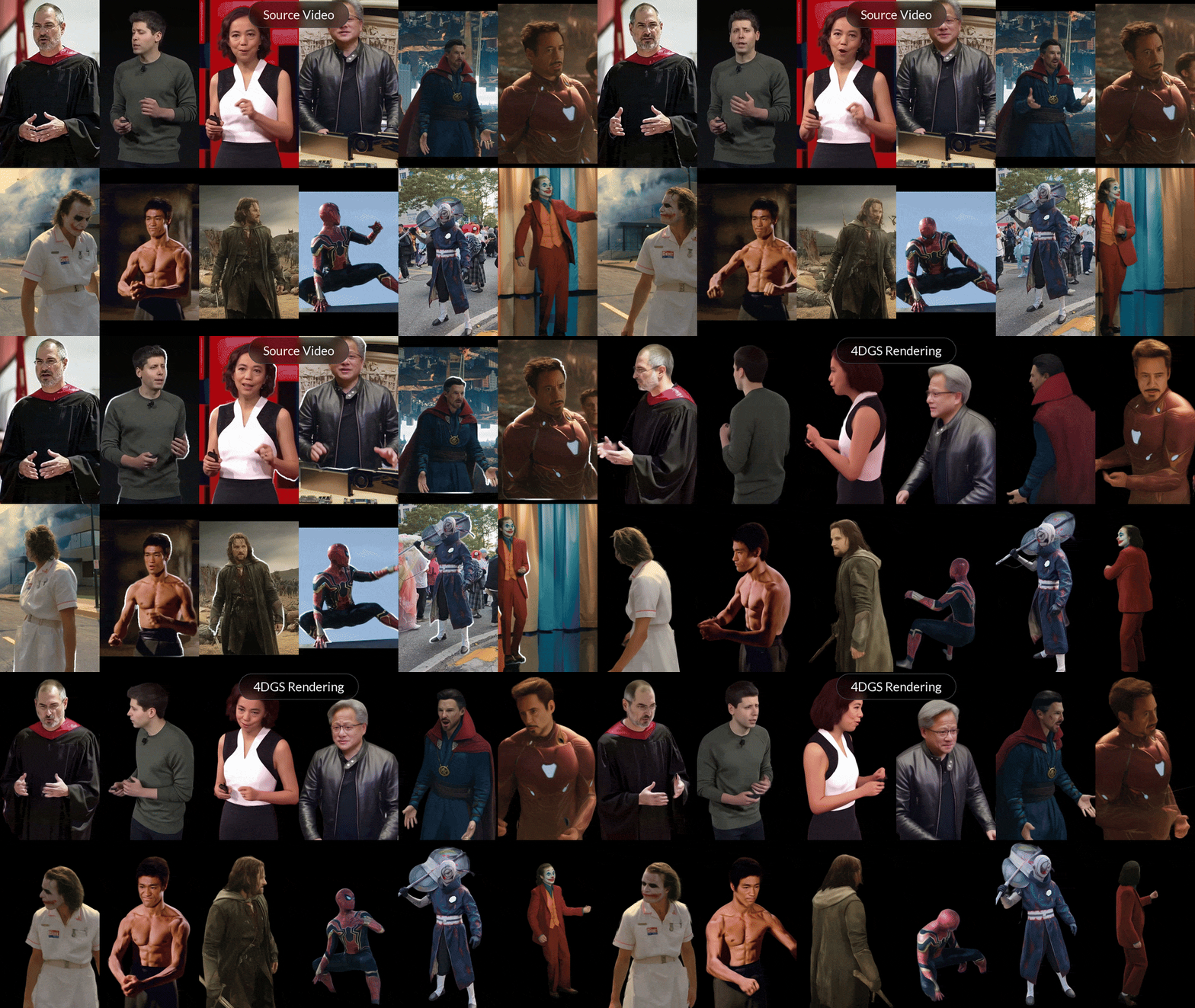
4DAnyone turns a casual monocular video into multi-view videos, enabling downstream 4DGS reconstruction.
Installation
git clone https://github.com/ant-research/4DAnyone.git
cd 4DAnyone
git submodule update --init third_party/GVHMR

conda create -n 4danyone python=3.11 -y
conda activate 4danyone
pip install -r requirements.txt
For faster inference, optionally install FlashAttention-3 or SageAttention.
Missing models and examples are downloaded automatically on first use. You can also download them manually:
python scripts/download_smplx.py
python scripts/download_model.py
python scripts/download_example.py
Inference
Generate target views
# Generate 6 evenly spaced views around the subject
python inference.py \
    --video_path "data/source/pexels/10331522-uhd_2160_4096_25fps.mp4" \
    --views_per_layer 6

# Generate 24 evenly spaced views around the subject
python inference.py \
    --video_path "data/source/pexels/10331522-uhd_2160_4096_25fps.mp4" \
    --views_per_layer 24

# Generate 48 views with 3 pitch layers and 16 views per layer
python inference.py \
    --video_path "data/source/pexels/10331522-uhd_2160_4096_25fps.mp4" \
    --views_per_layer 16 --layer_pitches '[-10,15,35]'

# Generate 8 views over the frontal 180-degree arc
python inference.py \
    --video_path "data/source/pexels/10331522-uhd_2160_4096_25fps.mp4" \
    --views_per_layer 8 --start_yaw -90 --yaw_span 180

# Generate one view at pitch 15° and yaw 60°
python inference.py \
    --video_path "data/source/pexels/10331522-uhd_2160_4096_25fps.mp4" \
    --views_per_layer 1 --layer_pitches '[15]' --start_yaw 60
Camera layout options:
layer_pitches: pitch angle of each camera layer, in degrees; positive values place the cameras above the person.views_per_layer: number of evenly spaced views in each camera layer. Total views areviews_per_layer × len(layer_pitches).start_yaw: horizontal angle of the first view, in degrees; yaw0is the front view.yaw_span: horizontal range covered by each camera layer, in degrees.
Run python inference.py --help to see all inference options.
Output
With the default --data_dir data, results follow this layout. See the output documentation for the complete format.
data/
├── gvhmr/results/<clip>/          # reusable motion-recovery result
└── fdanyone/<clip>/
    ├── metadata.json              # run settings, timings, resources
    ├── cameras.json               # the final N-camera rig
    ├── skeletons/00.mp4 ... <N-1>.mp4
    └── videos/
        ├── sparse/{00,04,09,12,14,19}.mp4  # default 24-view RCP proposals
        └── dense/00.mp4 ... <N-1>.mp4       # generated target views
Custom data
Use a handheld-like video that:
- has a portrait 9:16 aspect ratio;
- shows one person, either full body or upper body;
- contains at least 121 frames;
- has only mild camera movement.
3DGS Reconstruction
Install Nerfstudio before running ns-train.
# Export frame 0 across all generated views
python scripts/export_nerfstudio.py \
    --result_dir data/fdanyone/<clip> \
    --frame_index 0

# Train foreground-only 3DGS
ns-train splatfacto \
    --data data/nerfstudio/<clip>/frame_000 \
    --pipeline.model.background-color random
Todos
- [ ] Low-memory inference (<32 GB)
- [ ] Faster inference with TensorRT and sparse attention
- [ ] Support 4DGS reconstruction with an open-source method
Citation
If you find 4DAnyone useful or interesting, please cite our work and consider giving the repository a star ⭐:
@article{jin2026fdanyone,
  title={4DAnyone: Create Anyone in 4D from a Casual Monocular Video},
  author={Jin, Yudong and Xie, Tao and Zhang, Qihang and Shen, Zehong and Xu, Zhen and Shen, Yujun and Bao, Hujun and Zhou, Xiaowei and Xu, Yinghao},
  journal={arXiv preprint arXiv:2608.20335},
  year={2026},
  url={https://arxiv.org/abs/2608.20335}
}