

Repository
aacr-bench
An Alibaba open-source multi-language benchmark for evaluating LLMs in repository-level automatic code review, featuring an AI-assisted and expert-verified dataset.
- 1️⃣ Multi-language Evaluation (10 Languages)
- Multi-language Evaluation
- 3️⃣ Issue Classification Evaluation (4 Categories)
- 3️⃣ Issue Classification Evaluation (4 Categories)
- Metric
- Description
- Precision
- Precision
Specs
- 1️⃣ Multi-language Evaluation (10 Languages)Multi-language Evaluation
- 3️⃣ Issue Classification Evaluation (4 Categories)3️⃣ Issue Classification Evaluation (4 Categories)
- MetricDescription
- PrecisionPrecision
- RecallRecall
- Line PrecisionLine Precision
- Noise RateNoise Rate
- NameGitHub
- Zhengfeng Li@lizhengfeng
- Boge Wang@wangboge
- Lei Zhang@zhanglei
- Yongda Yu@yuyongda
- Xinxin Guo@guoxinxin
- Minghui Yu@yuminghui
- Zhengqi Zhuang@zhuangzhengqi
README
📋 Introduction
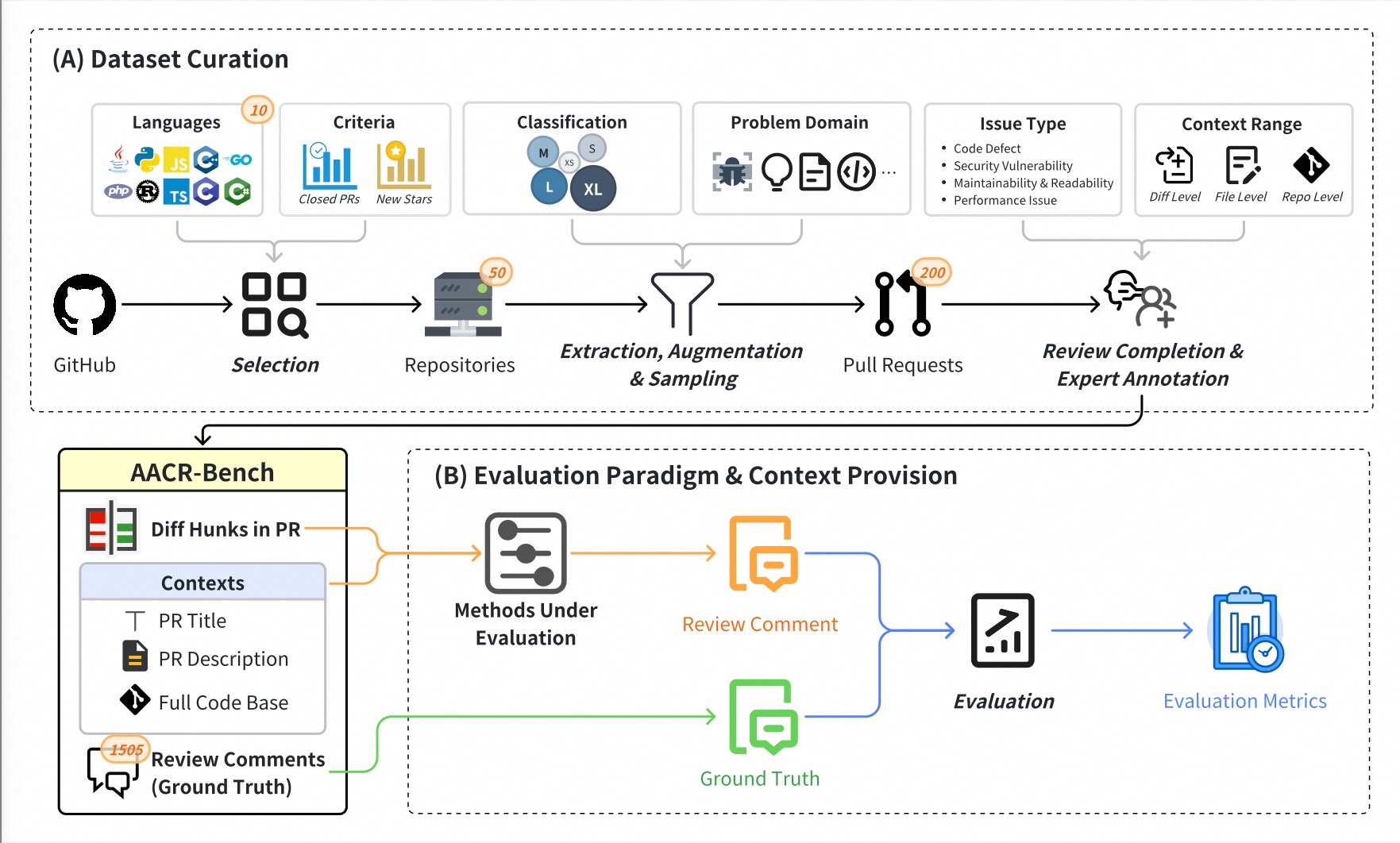
AACR-Bench is the industry's first multilingual, repository-level context-aware code review evaluation dataset, designed to assess the performance of large language models in automated code review tasks. The dataset comprises 200 real Pull Requests from 50 active open-source projects, covering 10 mainstream programming languages. Each instance includes not only code changes but also preserves complete repository context, authentically reproducing the entire code review process. Through human-LLM collaborative review combined with multi-round expert annotation, we ensure high quality and comprehensiveness of the data.
✨ Core Features
🌍 Multi-language Coverage
Covers 10 mainstream programming languages used in projects:
- System-level languages: C++, Rust, Go
- Enterprise languages: Java, C#, TypeScript
- Scripting languages: Python, JavaScript, Ruby, PHP
📁 Repository-level Context
- Preserves complete project structure
- Supports cross-file references and inter-module interaction analysis
- Includes PR metadata (description, title, comments, etc.)
🤖 Human Expert + LLM Enhanced Annotation
Professional Annotation Team
- 80+ senior software engineers with 2+ years of experience
- Covers frontend, backend, architecture, and other domains
- Three rounds of cross-validation
LLM Intelligent Enhancement
- Systematic issue discovery
- Comprehensive defect identification
- Improvement suggestion generation
Quality Assurance Process: GitHub human comments → LLM enhancement → Expert multi-round cross-annotation → Consistency validation
🎯 Evaluation Capabilities and Applications
AACR-Bench provides systematic evaluation capabilities across four core dimensions, supporting diverse research and application scenarios:
Evaluation Dimension System
| 1️⃣ Multi-language Evaluation (10 Languages) | 2️⃣ Positioning Accuracy Evaluation (Line-level) |
|---|---|
| • Cross-language performance comparison: Identify model strengths and weaknesses across languages<br>• Language-specific optimization: Improve model capabilities for specific languages<br>• Generalization assessment: Test model's language transfer effectiveness | • Precise positioning: Assess single-line/multi-line issue location accuracy<br>• Cross-file tracking: Test cross-file reference identification capability<br>• Context boundaries: Verify issue scope judgment accuracy |
| 3️⃣ Issue Classification Evaluation (4 Categories) | 4️⃣ Context Understanding Evaluation (3 Levels) |
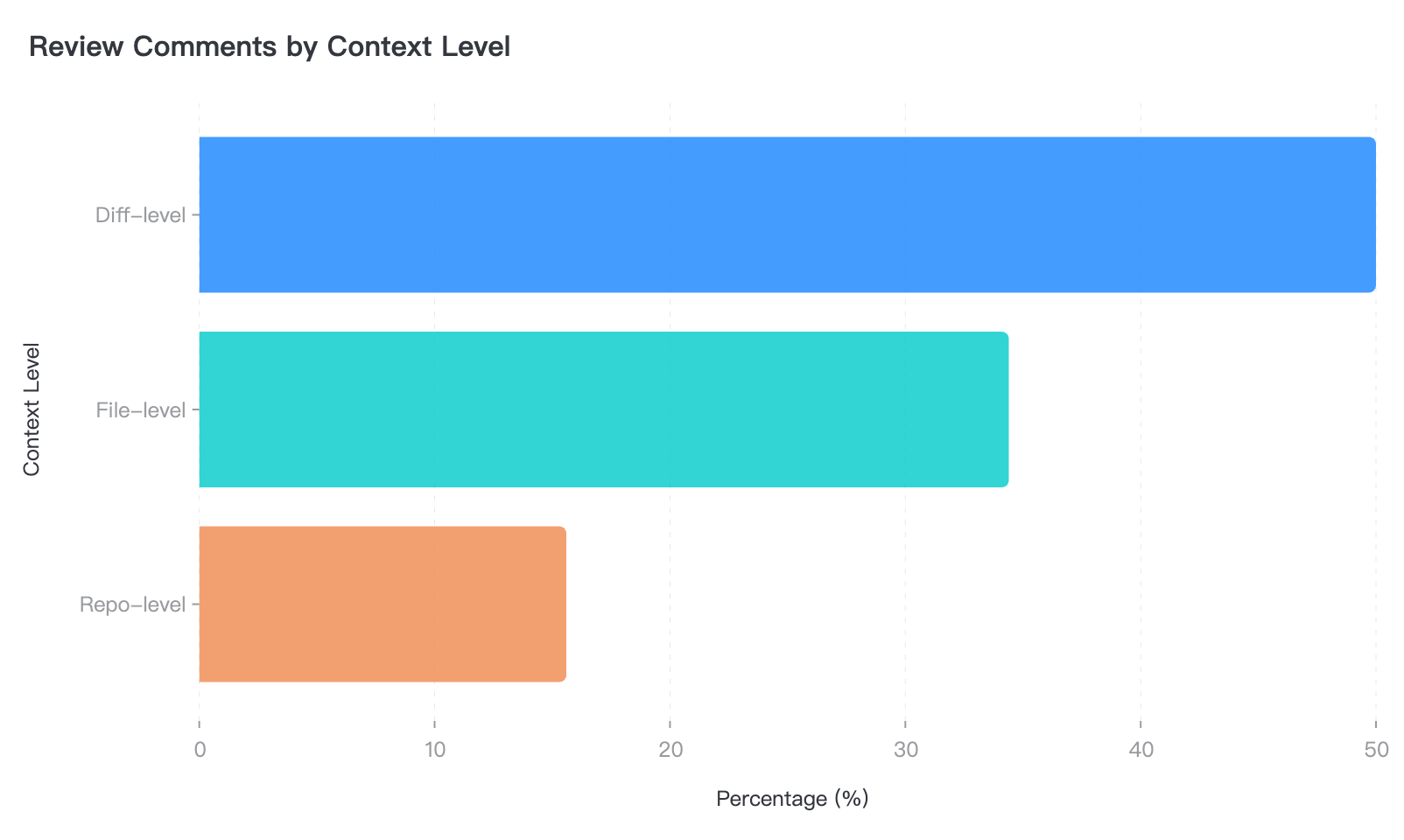
| • Classification accuracy: Assess issue type identification capability<br>• Severity assessment: Test issue priority judgment<br>• Specialized capabilities: Analyze detection rates for specific issue types | • Diff-level understanding: Basic code change analysis<br>• File-level understanding: Complete file logic comprehension<br>• Repo-level understanding: Project-wide dependency analysis |
Typical Application Scenarios
Model Development
- Performance benchmarking: Evaluate new models' code review capabilities using unified standards
- Weakness analysis: Discover model shortcomings through fine-grained metrics (e.g., low recall in certain languages)
- Iterative optimization validation: Quantify improvement effects, guide continuous model optimization
Academic Research
- Comparative studies: Fair comparison of different model architectures/training methods
- Ablation experiments: Analyze the impact of different context levels on review quality
- New method validation: Provide standardized evaluation environment for innovative algorithms
Engineering Practice
- Model selection: Help teams choose review models suitable for project characteristics
- Pre-deployment validation: Ensure model reliability in production environments
- Continuous monitoring: Track model performance changes in actual use
🚀 Quick Start
Clone Repository and Download Dataset
git clone https://github.com/alibaba/aacr-bench.git
cd aacr-bench
Install Dependencies
pip install -r requirements.txtConfigure Claude CLI
Edit configs/config.json and set the Claude CLI installation path:
{
  "cli_path": "your_path_to_claude.cmd",
  "data_path": "your_path_to_positive_samples.json"
}
Configure Evaluation Environment Variables
Create a .env file in the evaluator_runner/utils/ directory:
LLM_MODEL_URL="your_llm_model_url"
LLM_MODEL="your_llm_model"
LLM_API_KEY="your_llm_api_key"

EMBEDDING_MODEL_URL="your_embedding_model_url"
EMBEDDING_MODEL="your_embedding_model"
EMBEDDING_API_KEY="your_embedding_api_key"
Prepare Dataset
For the first run, you need to convert the raw data to task format. Uncomment and run in main.py:
if __name__ == "__main__":
    load_data_as_task()  # First run: generate task file
This will:
- Read the raw dataset (specified by
data_path) - Add
finishflag to each PR for progress tracking - Generate
tmp_data.jsontask file
Run Code Review
cd claude-code-demo
python main.py
Run Evaluation
import asyncio
from evaluator_runner import (
    get_evaluator_ans_from_json,
    load_generated_comments_from_file,
    EvaluatorConfig
)

async def main():
    # Load AI-generated comments to evaluate
    generated_comments = load_generated_comments_from_file("path/to/comments.txt")

    # Reference comments (load from positive_samples.json)
    reference_comments = [...]

    # Run evaluation
    result = await get_evaluator_ans_from_json(
        github_pr_url="https://github.com/owner/repo/pull/123",
        generated_comments=generated_comments,
        good_comments=reference_comments
    )

    print(f"Location Match Rate: {result['positive_line_match_rate']}")
    print(f"Semantic Match Rate: {result['positive_match_rate']}")

asyncio.run(main())
Batch Evaluation
# Configure parameters in evaluator_runner/example_test.py, then run:
python evaluator_runner/example_test.py
📈 Data Overview
Dataset Scale
200
Pull Requests10
Programming Languages50
Source Projects2,145
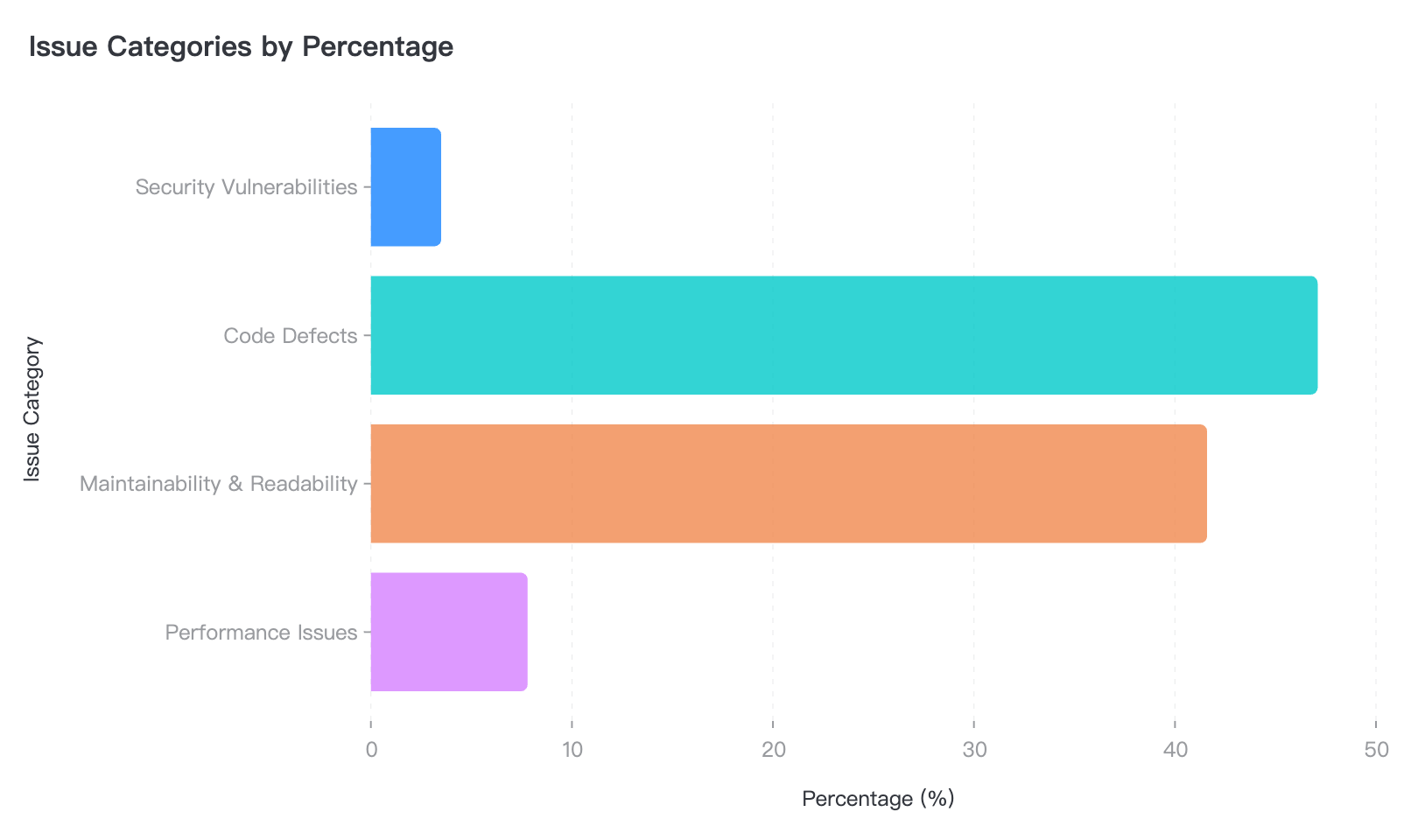
Review CommentsClassification Statistics
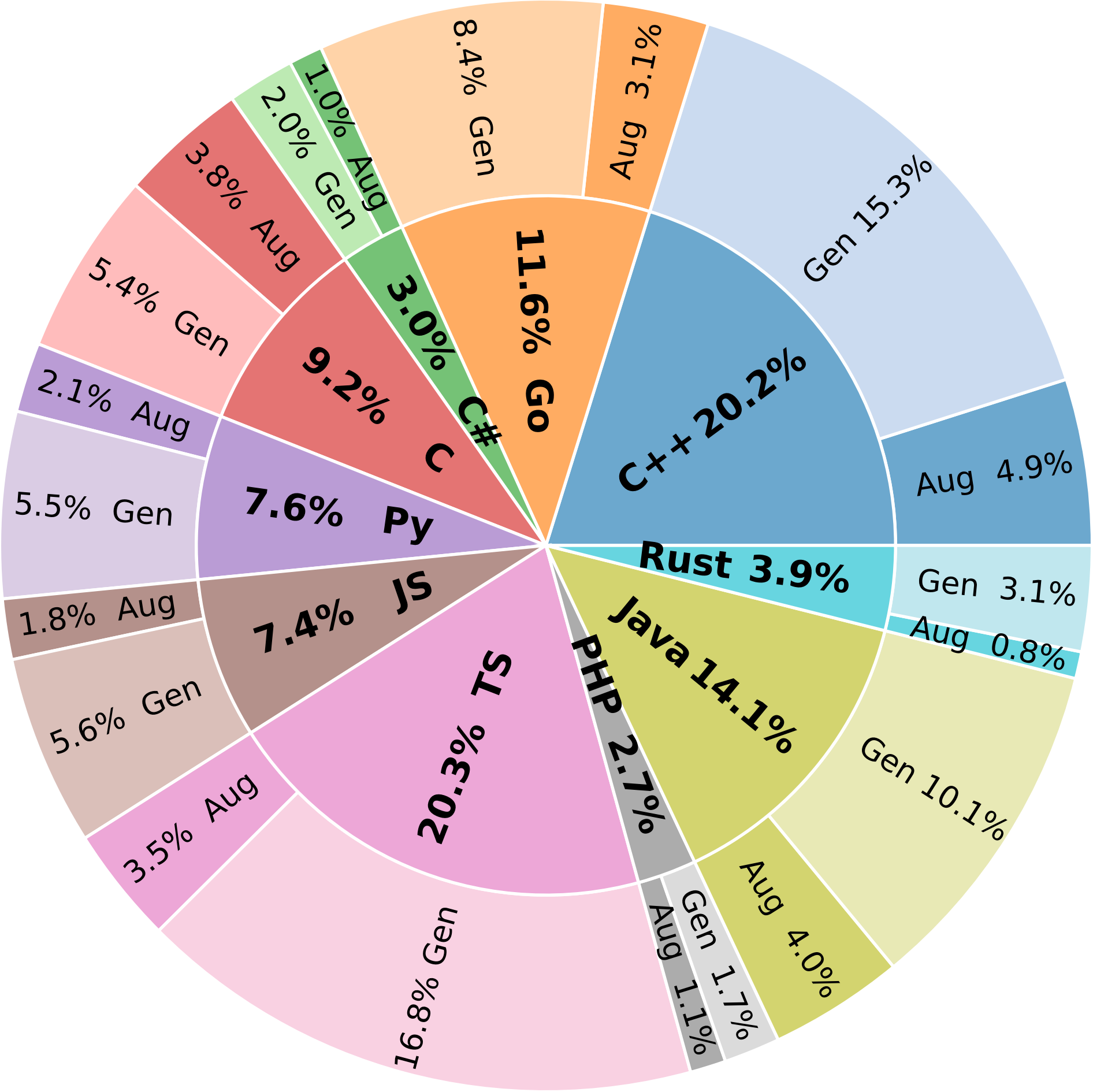
Language Distribution
Data Format
{
  "type": "array",
  "item": {
    "change_line_count": {"type": "integer", "description": "Number of changed lines"},
    "project_main_language": {"type": "string", "description": "Project main language"},
    "source_commit": {"type": "string", "description": "Source commit"},
    "target_commit": {"type": "string", "description": "Target commit"},
    "githubPrUrl": {"type": "string", "description": "GitHub PR URL"},
    "comments": {
      "is_ai_comment": {"type": "boolean", "description": "Whether it's an AI comment"},
      "note": {"type": "string", "description": "Comment content"},
      "path": {"type": "string", "description": "File path"},
      "side": {"type": "string", "description": "Comment anchor position"},
      "source_model": {"type": "string", "description": "Source model"},
      "from_line": {"type": "integer", "description": "Start line number"},
      "to_line": {"type": "integer", "description": "End line number"},
      "category": {"type": "string", "description": "Issue category: Security/Defect/Maintainability/Performance"},
      "context": {"type": "string", "description": "Comment scope: diff/file/repo level"}
    }
  }
}
📏 Evaluation Metrics
We employ a multidimensional metric system to comprehensively evaluate code review model performance. For complete metric definitions, calculation methods, and language-specific statistics, please refer to metrics.md.
Core Metrics
| Metric | Description | Formula |
|---|---|---|
| Precision | Proportion of valid comments generated | Valid matches / Total generated |
| Recall | Ability to discover annotated issues | Valid matches / Dataset valid count |
| Line Precision | Ability to precisely locate code lines | Line matches / Total generated |
| Noise Rate | Proportion of invalid or incorrect comments | Unmatched / Total generated |
🤝 Contributing
We welcome community contributions! If you want to contribute to AACR-Bench, please follow these steps:
- Fork this repository
- Create feature branch (
git checkout -b feat/add-new-prs) - Commit changes (
git commit -m 'feat: add new PRs') - Push to branch (
git push origin feat/add-new-prs) - Create Pull Request
For detailed contribution guidelines, please refer to CONTRIBUTING.md
👥 Authors and Maintainers
| Name | GitHub | Domain | Responsibilities |
|---|---|---|---|
| Zhengfeng Li | @lizhengfeng | Project Lead | Overall architecture design, technical direction |
| Boge Wang | @wangboge | Technical Consultant | Technical Solution Review, technical Guidance |
| Lei Zhang | @zhanglei | Data Architecture | Evaluation framework, metric system, performance optimization |
| Yongda Yu | @yuyongda | Evaluation System | Data schema design, evaluation protocol, quality standards |
| Xinxin Guo | @guoxinxin | Annotation Platform | Annotation system development, workflow design, quality assurance |
| Minghui Yu | @yuminghui | AI Enhancement | LLM annotation pipeline, model selection, prompt optimization |
| Zhengqi Zhuang | @zhuangzhengqi | Engineering | CI/CD pipeline, automated testing, deployment scripts |
📄 License
This project is licensed under the Apache License 2.0. For details, please see the LICENSE file.
📚 Citation
If you use AACR-Bench in your research, please cite our paper:
@misc{zhang2026aacrbenchevaluatingautomaticcode,
      title={AACR-Bench: Evaluating Automatic Code Review with Holistic Repository-Level Context},
      author={Lei Zhang and Yongda Yu and Minghui Yu and Xinxin Guo and Zhengqi Zhuang and Guoping Rong and Dong Shao and Haifeng Shen and Hongyu Kuang and Zhengfeng Li and Boge Wang and Guoan Zhang and Bangyu Xiang and Xiaobin Xu},
      year={2026},
      eprint={2601.19494},
      archivePrefix={arXiv},
      primaryClass={cs.SE},
      url={https://arxiv.org/abs/2601.19494},
}
🗺️ Roadmap
- [x] v1.0 (2026.01): Initial release - 200 PRs, 10 languages
🌟 Acknowledgments
- Thanks to all contributors who participated in data annotation, especially core contributors who completed 15+ valid annotations. Full list in CONTRIBUTORS.md.
- Thanks to open-source project maintainers for providing original PR data.