

README

💻 HomePage   |   🤗 Model   |   🤖 Demo

<br><br>

Updates
- [2026/03/09] We release the Logics-Parsing-Omni. For more details, please check our Technical Report.
- [2026/02/13] 🚀🚀🚀🚀🚀 We release Logics-Parsing-v2 Model.
- [2025/09/25] 🚀🚀🚀We release Logics-Parsing Model.
Introduction
Logics-Parsing-v2 is an advanced evolution of the previously proposed Logics-Parsing (v1). It inherits all the core capabilities of v1 model, while demonstrating more powerful capabilities on handling complex documents. Furthermore, it extends support for Parsing-2.0 scenarios, enabling structured parsing of musical sheets, flowcharts, as well as code/pseudocode blocks.

Key Features
<details>
<summary><strong>v1</strong></summary>
-
Effortless End-to-End Processing
- Our single-model architecture eliminates the need for complex, multi-stage pipelines. Deployment and inference are straightforward, going directly from a document image to structured output.
- It demonstrates exceptional performance on documents with challenging layouts.
-
Advanced Content Recognition
- It accurately recognizes and structures difficult content, including intricate scientific formulas.
- Chemical structures are intelligently identified and can be represented in the standard SMILES format.
-
Rich, Structured HTML Output
- The model generates a clean HTML representation of the document, preserving its logical structure.
- Each content block (e.g., paragraph, table, figure, formula) is tagged with its category, bounding box coordinates, and OCR text.
- It automatically identifies and filters out irrelevant elements like headers and footers, focusing only on the core content.
-
State-of-the-Art Performance
- Logics-Parsing achieves the best performance on our in-house benchmark, which is specifically designed to comprehensively evaluate a model’s parsing capability on complex-layout documents and STEM content.
</details>
- Logics-Parsing achieves the best performance on our in-house benchmark, which is specifically designed to comprehensively evaluate a model’s parsing capability on complex-layout documents and STEM content.
v2
-
Effortless End-to-End Processing
- End-to-end recognition and parsing for various kinds of document elements within a single model.
- Handles complex-layout and text-dense documents such as newspapers and magazines with exceptional precision and ease;
-
Advanced Content Recognition
- Smaller in size, greater in performance, delivering more accurate and structured parsing of tables and scientific formulas.
- Introducing Parsing-2.0: natively supports parsing of diverse structured content, including flowcharts, music sheets and pseudocode blocks.
-
Rich, Structured HTML Output
- Transforms documents into concise HTML -- capturing not just content, but also element types, spatial layouts, and semantic hierarchy.
- More scientific and intuitive formats for structured elements -- such as Mermaid for flowcharts and ABC notation for musical scores.
-
State-of-the-Art Performance
- SOTA across the board: Logics-Parsing-v2 sets top records on both our in-house benchmark (overall score: 82.16) and the renowned public benchmark OmniDocBench-v1.5 (overall score: 93.23).
Benchmark
<details>
<summary><strong>v1</strong></summary>
Existing document-parsing benchmarks often provide limited coverage of complex layouts and STEM content. To address this, we constructed an in-house benchmark comprising 1,078 page-level images across nine major categories and over twenty sub-categories. Our model achieves the best performance on this benchmark.
<div align="center">
<img src="imgs/BenchCls.png">
</div>
<table>
<tr>
<td rowspan="2">Model Type</td>
<td rowspan="2">Methods</td>
<td colspan="2">Overall <sup>Edit</sup> ↓</td>
<td colspan="2">Text Edit <sup>Edit</sup> ↓</td>
<td colspan="2">Formula <sup>Edit</sup> ↓</td>
<td colspan="2">Table <sup>TEDS</sup> ↑</td>
<td colspan="2">Table <sup>Edit</sup> ↓</td>
<td colspan="2">ReadOrder<sup>Edit</sup> ↓</td>
<td rowspan="1">Chemistry<sup>Edit</sup> ↓</td>
<td rowspan="1">HandWriting<sup>Edit</sup> ↓</td>
</tr>
<tr>
<td>EN</td>
<td>ZH</td>
<td>EN</td>
<td>ZH</td>
<td>EN</td>
<td>ZH</td>
<td>EN</td>
<td>ZH</td>
<td>EN</td>
<td>ZH</td>
<td>EN</td>
<td>ZH</td>
<td>ALL</td>
<td>ALL</td>
</tr>
<tr>
<td rowspan="7">Pipeline Tools</td>
<td>doc2x</td>
<td>0.209</td>
<td>0.188</td>
<td>0.128</td>
<td>0.194</td>
<td>0.377</td>
<td>0.321</td>
<td>81.1</td>
<td>85.3</td>
<td><ins>0.148</ins></td>
<td><ins>0.115</ins></td>
<td>0.146</td>
<td>0.122</td>
<td>1.0</td>
<td>0.307</td>
</tr>
<tr>
<td>Textin</td>
<td>0.153</td>
<td>0.158</td>
<td>0.132</td>
<td>0.190</td>
<td>0.185</td>
<td>0.223</td>
<td>76.7</td>
<td><ins>86.3</ins></td>
<td>0.176</td>
<td><b>0.113</b></td>
<td><b>0.118</b></td>
<td><b>0.104</b></td>
<td>1.0</td>
<td>0.344</td>
</tr>
<tr>
<td>mathpix<sup>*</sup></td>
<td><ins>0.128</ins></td>
<td><ins>0.146</ins></td>
<td>0.128</td>
<td><ins>0.152</ins></td>
<td><b>0.06</b></td>
<td><b>0.142</b></td>
<td><b>86.2</b></td>
<td><b>86.6</b></td>
<td><b>0.120</b></td>
<td>0.127</td>
<td>0.204</td>
<td>0.164</td>
<td>0.552</td>
<td>0.263</td>
</tr>
<tr>
<td>PP_StructureV3</td>
<td>0.220</td>
<td>0.226</td>
<td>0.172</td>
<td>0.29</td>
<td>0.272</td>
<td>0.276</td>
<td>66</td>
<td>71.5</td>
<td>0.237</td>
<td>0.193</td>
<td>0.201</td>
<td>0.143</td>
<td>1.0</td>
<td>0.382</td>
</tr>
<tr>
<td>Mineru2</td>
<td>0.212</td>
<td>0.245</td>
<td>0.134</td>
<td>0.195</td>
<td>0.280</td>
<td>0.407</td>
<td>67.5</td>
<td>71.8</td>
<td>0.228</td>
<td>0.203</td>
<td>0.205</td>
<td>0.177</td>
<td>1.0</td>
<td>0.387</td>
</tr>
<tr>
<td>Marker</td>
<td>0.324</td>
<td>0.409</td>
<td>0.188</td>
<td>0.289</td>
<td>0.285</td>
<td>0.383</td>
<td>65.5</td>
<td>50.4</td>
<td>0.593</td>
<td>0.702</td>
<td>0.23</td>
<td>0.262</td>
<td>1.0</td>
<td>0.50</td>
</tr>
<tr>
<td>Pix2text</td>
<td>0.447</td>
<td>0.547</td>
<td>0.485</td>
<td>0.577</td>
<td>0.312</td>
<td>0.465</td>
<td>64.7</td>
<td>63.0</td>
<td>0.566</td>
<td>0.613</td>
<td>0.424</td>
<td>0.534</td>
<td>1.0</td>
<td>0.95</td>
</tr>
<tr>
<td rowspan="8">Expert VLMs</td>
<td>Dolphin</td>
<td>0.208</td>
<td>0.256</td>
<td>0.149</td>
<td>0.189</td>
<td>0.334</td>
<td>0.346</td>
<td>72.9</td>
<td>60.1</td>
<td>0.192</td>
<td>0.35</td>
<td>0.160</td>
<td>0.139</td>
<td>0.984</td>
<td>0.433</td>
</tr>
<tr>
<td>dots.ocr</td>
<td>0.186</td>
<td>0.198</td>
<td><ins>0.115</ins></td>
<td>0.169</td>
<td>0.291</td>
<td>0.358</td>
<td>79.5</td>
<td>82.5</td>
<td>0.172</td>
<td>0.141</td>
<td>0.165</td>
<td>0.123</td>
<td>1.0</td>
<td><ins>0.255</ins></td>
</tr>
<tr>
<td>MonkeyOcr</td>
<td>0.193</td>
<td>0.259</td>
<td>0.127</td>
<td>0.236</td>
<td>0.262</td>
<td>0.325</td>
<td>78.4</td>
<td>74.7</td>
<td>0.186</td>
<td>0.294</td>
<td>0.197</td>
<td>0.180</td>
<td>1.0</td>
<td>0.623</td>
</tr>
<tr>
<td>OCRFlux</td>
<td>0.252</td>
<td>0.254</td>
<td>0.134</td>
<td>0.195</td>
<td>0.326</td>
<td>0.405</td>
<td>58.3</td>
<td>70.2</td>
<td>0.358</td>
<td>0.260</td>
<td>0.191</td>
<td>0.156</td>
<td>1.0</td>
<td>0.284</td>
</tr>
<tr>
<td>Gotocr</td>
<td>0.247</td>
<td>0.249</td>
<td>0.181</td>
<td>0.213</td>
<td>0.231</td>
<td>0.318</td>
<td>59.5</td>
<td>74.7</td>
<td>0.38</td>
<td>0.299</td>
<td>0.195</td>
<td>0.164</td>
<td>0.969</td>
<td>0.446</td>
</tr>
<tr>
<td>Olmocr</td>
<td>0.341</td>
<td>0.382</td>
<td>0.125</td>
<td>0.205</td>
<td>0.719</td>
<td>0.766</td>
<td>57.1</td>
<td>56.6</td>
<td>0.327</td>
<td>0.389</td>
<td>0.191</td>
<td>0.169</td>
<td>1.0</td>
<td>0.294</td>
</tr>
<tr>
<td>SmolDocling</td>
<td>0.657</td>
<td>0.895</td>
<td>0.486</td>
<td>0.932</td>
<td>0.859</td>
<td>0.972</td>
<td>18.5</td>
<td>1.5</td>
<td>0.86</td>
<td>0.98</td>
<td>0.413</td>
<td>0.695</td>
<td>1.0</td>
<td>0.927</td>
</tr>
<tr>
<td><b>Logics-Parsing</b></td>
<td><b>0.124</b></td>
<td><b>0.145</b></td>
<td><b>0.089</b></td>
<td><b>0.139</b></td>
<td><ins>0.106</ins></td>
<td><ins>0.165</ins></td>
<td>76.6</td>
<td>79.5</td>
<td>0.165</td>
<td>0.166</td>
<td><ins>0.136</ins></td>
<td><ins>0.113</ins></td>
<td><b>0.519</b></td>
<td><b>0.252</b></td>
</tr>
<tr>
<td rowspan="5">General VLMs</td>
<td>Qwen2VL-72B</td>
<td>0.298</td>
<td>0.342</td>
<td>0.142</td>
<td>0.244</td>
<td>0.431</td>
<td>0.363</td>
<td>64.2</td>
<td>55.5</td>
<td>0.425</td>
<td>0.581</td>
<td>0.193</td>
<td>0.182</td>
<td>0.792</td>
<td>0.359</td>
</tr>
<tr>
<td>Qwen2.5VL-72B</td>
<td>0.233</td>
<td>0.263</td>
<td>0.162</td>
<td>0.24</td>
<td>0.251</td>
<td>0.257</td>
<td>69.6</td>
<td>67</td>
<td>0.313</td>
<td>0.353</td>
<td>0.205</td>
<td>0.204</td>
<td>0.597</td>
<td>0.349</td>
</tr>
<tr>
<td>Doubao-1.6</td>
<td>0.188</td>
<td>0.248</td>
<td>0.129</td>
<td>0.219</td>
<td>0.273</td>
<td>0.336</td>
<td>74.9</td>
<td>69.7</td>
<td>0.180</td>
<td>0.288</td>
<td>0.171</td>
<td>0.148</td>
<td>0.601</td>
<td>0.317</td>
</tr>
<tr>
<td>GPT-5</td>
<td>0.242</td>
<td>0.373</td>
<td>0.119</td>
<td>0.36</td>
<td>0.398</td>
<td>0.456</td>
<td>67.9</td>
<td>55.8</td>
<td>0.26</td>
<td>0.397</td>
<td>0.191</td>
<td>0.28</td>
<td>0.88</td>
<td>0.46</td>
</tr>
<tr>
<td>Gemini2.5 pro</td>
<td>0.185</td>
<td>0.20</td>
<td><ins>0.115</ins></td>
<td>0.155</td>
<td>0.288</td>
<td>0.326</td>
<td><ins>82.6</ins></td>
<td>80.3</td>
<td>0.154</td>
<td>0.182</td>
<td>0.181</td>
<td>0.136</td>
<td><ins>0.535</ins></td>
<td>0.26</td>
</tr>
</table>
<tr>
  <td colspan="5">
    <sup>*</sup> Tested on the v3/PDF Conversion API (August 2025 deployment).
  </td>
</tr>
</details>
Comparisons on LogicsDocBench
We introduce LogicsDocBench, a new comprehensive evaluation benchmark comprising 900 carefully selected PDF pages, covering both traditional document Parsing-1.0 tasks and the newly introduced Parsing-2.0 scenarios. This benchmark is designed to better assess models’ capabilities in complex and diverse real-world documents parsing. The dataset is organized into three core document subsets:
-
STEM Documents (218 pages):
Focuses on high-difficulty academic and educational content, spanning over ten domains including physics, mathematics, engineering, and interdisciplinary sciences. This subset evaluates deep understanding of mathematical formulas, technical terminology, and structured knowledge representation.
-
Complex Layouts (459 pages):
Includes challenging real-world layouts such as multi-column text, cross-page tables, vertical writing, and mixed text-image arrangements. This subset comprehensively evaluate a model’s layout analysis abilities.
-
Parsing-2.0 Content (223 pages):
Targets modern digital and semi-structured content that poses significant challenges for traditional OCR systems, including:
- Chemical Molecular formulas
- Musical sheets
- Code and pseudo-code block
- Flowcharts and mind maps
For Parsing-1.0 tasks, we adopt the same evaluation protocols as OmniDocBench-v1.5 to ensure fairness and consistency across benchmarks. For Parsing-2.0, we report fine-grained results using edit distance for each subcategory, and compute an overall score as follows:
$$\small \text{Overall} = \frac{Parsing1.0^{Overall} \times 3 + (1-{Chemistry}^{Edit})\times 100 + (1-{Code}^{Edit})\times 100 + (1-{Chart}^{Edit})\times 100 + (1-{Music}^{Edit})\times 100}{7}$$
Comprehensive evaluation of document parsing on LogicsDocBench is listed as follows:

The histogram below provides a more intuitive visualization of the advantages of our Logics-Parsing-v2 model in both Parsing-1.0 and 2.0 scenarios.

<br>
Comparisons on OmniDocBench_v1.5
We also provide the experimental results of our newly proposed Logics-Parsing-v2 model on the widely recognized open-source benchmark OmniDocBench-v1.5. As shown in the table below, Logics-Parsing-v2 achieves highly competitive performance.
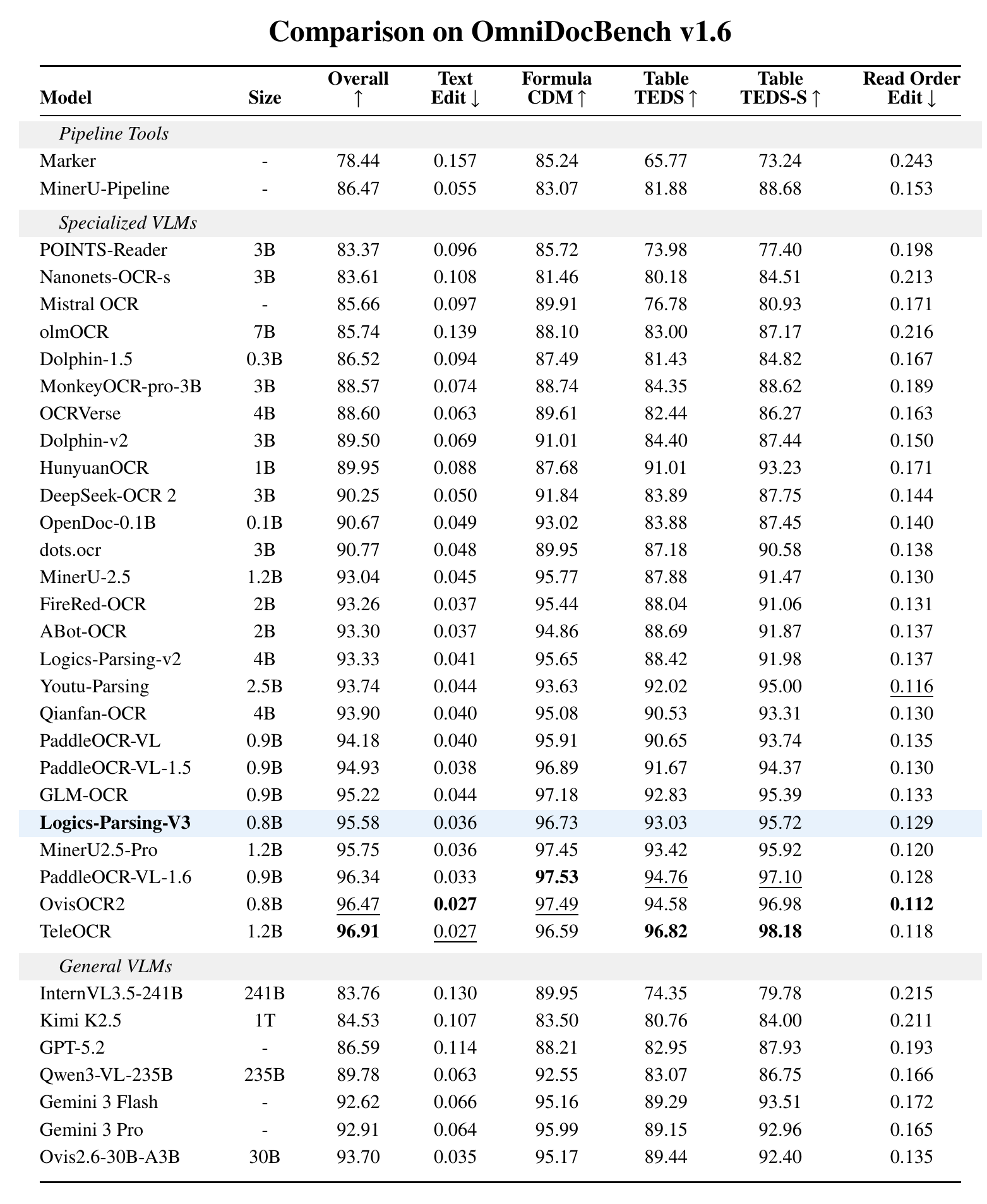
* The model results in the table are sourced from the official OmniDocBench website.
Quick Start
<details>
<summary><strong>v1</strong></summary>
1. Installation
conda create -n logis-parsing python=3.10
conda activate logis-parsing
pip install -r requirement.txt
2. Download Model Weights
# Download our model from Modelscope.
pip install modelscope
python download_model.py -t modelscope
# Download our model from huggingface.
pip install huggingface_hub
python download_model.py -t huggingface
3. Inference
python3 inference.py --image_path PATH_TO_INPUT_IMG --output_path PATH_TO_OUTPUT --model_path PATH_TO_MODEL</details>
1. Installation
conda create -n logis-parsing-v2 python=3.10
conda activate logis-parsing-v2

pip install -r requirements.txt
2. Download Model Weights
# Download our model from Modelscope.
pip install modelscope
python download_model_v2.py -t modelscope

# Download our model from huggingface.
pip install huggingface_hub
python download_model_v2.py -t huggingface
3. Inference
python3 inference_v2.py --image_path PATH_TO_INPUT_IMG --output_path PATH_TO_OUTPUT --model_path PATH_TO_MODELShowcases


Acknowledgments
We would like to acknowledge the following open-source projects that provided inspiration and reference for this work: