

Repository
360CityArena
[ECCV2026] 360CityArena · ★ 30 · License unknown · C# · Updated 2026-08-28
- Stars
- 30
- License
- Unknown
- Language
- C#
- Updated
- 2026-08-28
README
360CityArena: A Realistic Virtual Urban Navigation Benchmark for Embodied Agents [ECCV 2026]
Kenta Watanabe Atsuyuki Miyai Mizuki Takenawa Kiyoharu Aizawa Toshihiko Yamasaki
The University of Tokyo
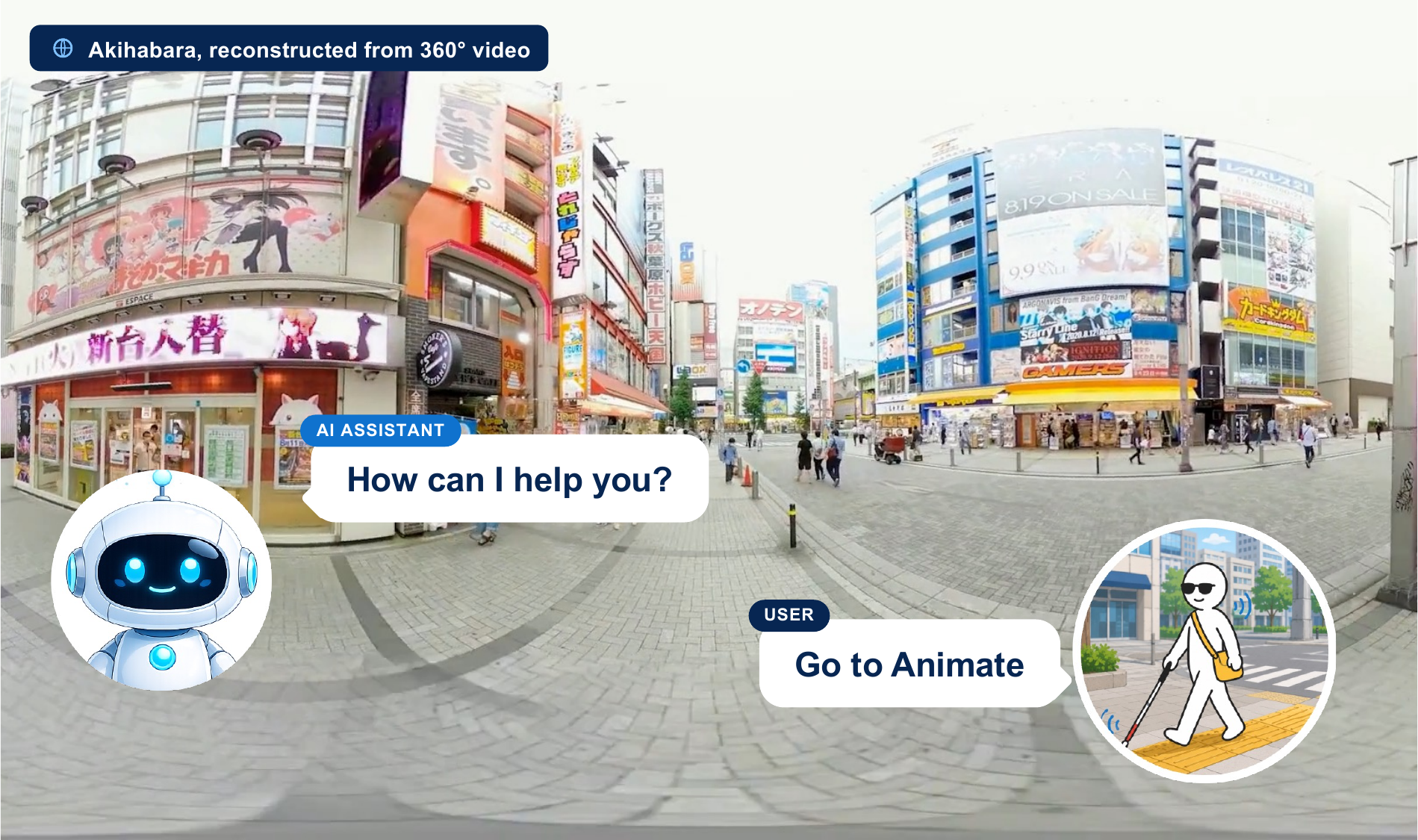
360CityArena is a Unity-based embodied navigation and visual reasoning benchmark for multimodal large language models. It couples a 360-degree city-view Unity environment with a Python runner that sends camera and map observations to MLLM APIs, executes task sequences, and records reproducible result summaries.
This repository does not include previous experiment results. New runs write public summaries under outputs/<run_id>/.
Benchmark Contents
The public benchmark release contains 175 tasks: 25 tasks in each of seven
families. Each task is defined by a CSV row under benchmark/tasks/ and, when
needed, a task reference image under benchmark/assets/.
localization.csv: infer the initial grid cell from exploration and a grid map.landmark_search_language.csv: navigate to a named landmark.landmark_search_image.csv: navigate to a landmark shown in a reference image.counting.csv: count specified objects within a constrained area.map_navigation.csv: navigate from a start marker to a goal marker on a map.language_guided_navigation.csv: follow natural-language directions.relational_spatial_reasoning.csv: identify a nearby landmark from a spatial relation.
Release inventories are recorded in benchmark/manifests/. See
docs/task_taxonomy.md for task definitions and benchmark/tasks/README.md for
the public task catalog.
Repository Layout
benchmark/: public benchmark data.benchmark/tasks/: CSV task definitions.benchmark/assets/: reference images used by benchmark tasks.benchmark/manifests/: release manifests for task and asset inventory.unity/: Unity project and environment.python/: Python package, runner, and model clients.scripts/: convenience run scripts.docs/: benchmark protocol, schema, and model documentation.examples/configs/: environment variable examples for model providers.
Setup
- Install Unity 6.5 (
6000.5.0f1, the version recorded in
unity/ProjectSettings/ProjectVersion.txt) and openunity/from Unity Hub. - Install
uvfor Python dependency management. - Install Python dependencies:
cd python
uv sync- Configure API keys by exporting environment variables or by adapting the examples under
examples/configs/. Do not commit real secrets.
Running
Run one task:
cd python
OPENAI_API_KEY=... MODEL_NAME=gpt-5 ./models/openai.sh --task-id 5001
Run all tasks:
cd python
OPENAI_API_KEY=... MODEL_NAME=gpt-5 \
LLM_VALIDATION_MODEL=gpt-5 LLM_VALIDATION_PROVIDER=openai \
./models/openai.sh --all
Direct runner invocation:
cd python
PYTHONPATH=src uv run python -m cityarena run \
  --all \
  --model gpt-5 \
  --provider openai \
  --validation-model gpt-5 \
  --validation-provider openai \
  --experiment-id openai-gpt-5-public-run \
  --output-root ../outputs
Package entrypoint:
cd python
PYTHONPATH=src uv run python -m cityarena run --task-id 5001 --model gpt-5 --provider openai
Task IDs can be selected individually, as comma-separated lists, ranges, task
types, or --all.
By default, the runner saves only:
outputs/<run_id>/results.csvoutputs/<run_id>/run_metadata.json
When a run exits, the runner also prints a benchmark summary derived from
results.csv: official scored_success accuracy, per-task-type success rates,
and a task-by-task result table.
--experiment-id is a label recorded in metadata. Unless --run-id is set explicitly, the runner creates a timestamped run_id to avoid mixing results from separate executions. If you intentionally want to append to an existing results.csv, pass --append-results.
Use --save-debug-artifacts only when you need per-step traces, prompt context, images, or log files for debugging. Debug artifacts can be large and may include raw model inputs.
Evaluation Protocol
The official score is accuracy over scored_success in
outputs/<run_id>/results.csv. A task is counted as successful only when the
model explicitly ends with ANSWER and the validator marks the final answer or
final position correct. is_correct is diagnostic and can be true for some
non-ANSWER terminations; it is not the official score.
Public task runs use a 50-action limit per task. Runs may also stop with
STAGNATION when the agent repeats the same action without changing position
for 20 consecutive requests. Map Navigation additionally stops with
AWAY_FROM_GOAL after five consecutive movement steps away from the goal.
Most task families are validated with exact, grid-coordinate, count, or
distance-threshold checks. Relational Spatial Reasoning uses an LLM judge for
fuzzy answer matching, so runs that include this family require
LLM_VALIDATION_MODEL and LLM_VALIDATION_PROVIDER or the corresponding
--validation-model and --validation-provider arguments. See
docs/evaluation_protocol.md and docs/results_schema.md for details.
Model Wrappers
Wrapper scripts are provided under python/models/:
openai.sh: OpenAIclaude.sh: Anthropicgemini.sh: Google Geminiqwen2.5-vl.sh: OpenAI-compatible local/server endpointinternvl3.5.sh: OpenAI-compatible local/server endpointazure-openai.sh: Azure OpenAI
All wrappers read secrets and model names from environment variables. MODEL_NAME is required for provider wrappers. Direct runner use requires both --model and --provider unless MODEL_NAME/LLM_MODEL and PROVIDER/LLM_PROVIDER are set. The Azure wrapper requires AZURE_OPENAI_API_KEY, AZURE_OPENAI_ENDPOINT, AZURE_OPENAI_DEPLOYMENT, and AZURE_OPENAI_API_VERSION unless equivalent LLM_* variables are set.
Results
Existing experiment results, logs, prompt HTML/JSON, PDFs, and analysis outputs are intentionally not included. Runtime outputs are ignored by Git. See docs/results_schema.md for the result file format.
Licenses
Code is licensed under Apache-2.0. Dataset and benchmark assets are distributed under CC BY-NC 4.0; see DATA_LICENSE and NOTICE.
Map-derived assets include OpenStreetMap data; cite OpenStreetMap contributors
and follow the Open Database License terms for derived map data.
Citation
360CityArena
@inproceedings{watanabe2026360cityarena,
  title     = {360CityArena: A Realistic Virtual Urban Navigation Benchmark for Embodied Agents},
  author    = {Watanabe, Kenta and Miyai, Atsuyuki and Takenawa, Mizuki and Aizawa, Kiyoharu and Yamasaki, Toshihiko},
  booktitle = {Proceedings of the European Conference on Computer Vision (ECCV)},
  year      = {2026}
}
Underlying Virtual Environment
@article{takenawa2026building,
  author  = {Mizuki Takenawa and Naoki Sugimoto and Leslie W{\"o}hler
             and Satoshi Ikehata and Kiyoharu Aizawa},
  title   = {Building and Evaluating a Realistic Virtual World for
             Large Scale Urban Exploration from 360° Videos},
  journal = {Multimedia Tools and Applications},
  volume  = {85},
  number  = {2},
  pages   = {149},
  year    = {2026}
}