

Avatars 2026 Rank: #1975
Spatius ✓
Real-time AI avatars at a fraction of the cost.
Verdict
A quick read before you dig into the full page.
- Best if
- Real-time AI avatars at a fraction of the cost
- Skip if
- Requires real-time audio input, not text alone
- Pick this when
- Real-time interaction infrastructure
Considering Real Fake Photos instead? Compare side by side
Overview

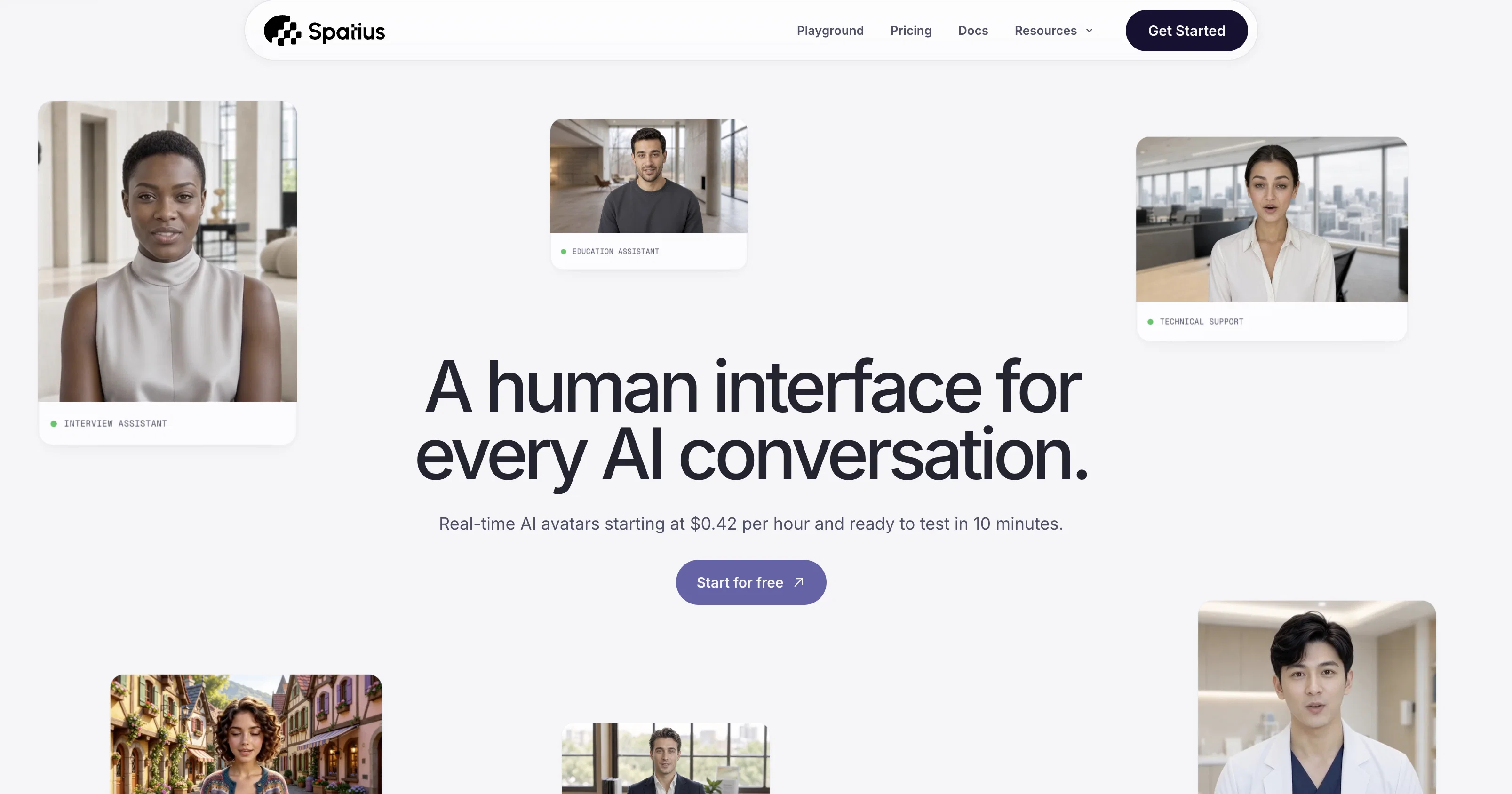
Spatius is an AI tool built to power the next generation of digital avatars. It works by providing a low-bandwidth, real-time interaction infrastructure that renders on-device.
Support is provided across multiple major platforms, including Web, iOS, and Android, with SDKs to aid in the implementation process. Unique to Spatius is the use of cloud-edge hybrid technology which replaces traditional heavy cloud rendering with a lightweight stream, directly rendering on the edge and significantly reducing infrastructure overhead.
This tool finds its application across various industries, facilitating progress by providing a platform for conversational language tutors with stable voice-driven avatars, HR technology, mental health companions, in-vehicle and kiosk solutions, and AI hardware.
Key features include accepting audio streams via standard protocols to output real-time 3D facial animations synced with the audio, a deploy anywhere architecture, and runs smoothly even on entry-level chipsets without dedicated GPUs.
Furthermore, Spatius supports the deployment of both stock and custom-trained 3D models, with beta access currently provided for custom avatar integration.
- On-device Avatar Rendering
- Real-time Audio-to-avatar Motion
- Web Sdk
- Low-bandwidth Motion Streaming
- Livekit Integration
- Agora Integration
- Custom Avatar Creation (beta)
- Stock Avatars
Access & connections
Where you can use Spatius.
Capabilities
What this tool accepts, produces, and is strongest at.
Input
- Image
- Audio
Output
- 3D
- Tabular
Highlights
- API
Supported features
- API
Pros & cons
Pros
- Real-time interaction infrastructure
- Low-bandwidth requirement
- On-device rendering
- Cross-platform support (Web, iOS, Android)
- SDKs provided
- Cloud-edge hybrid technology
- Infrastructure overhead reduction
- Useful in various industries
Show 22 more
- Supports conversational language tutors
- HR technology applications
- Supports mental health companions
- In-vehicle solutions
- Kiosk solutions
- Real-time 3D facial animations
- Accepts standard audio streams
- Deploy anywhere architecture
- Runs on entry-level chipsets
- Stock and custom 3D models
- Custom avatar integration provided
- Significantly reduced infrastructure costs
- Reduced bandwidth load
- Highly scalable solution
- Supports 3D facial animations
- Phone, monitor, laptop deployment
- Achieves 1080p on entry-level chipsets
- Low compute overhead
- Payload redundancy during network jitter
- Beta access provides custom avatar
- Single photo custom avatar integration
- Resilient against network drops
Cons
- Requires real-time audio input, not text alone
- You bring your own ASR, LLM, and TTS stack
Compare alternatives
Similar tools in the catalog — with a clear reason to open each one.

Real Fake Photos ✓
PaidTurn your selfies into professional headshots
Why look Typically cheaper
Full comparison
Artguru ✓
FreemiumCreate unique AI avatars in trendy styles
Why look Typically cheaper
Full comparison
1photoai
PaidAI photo generator for professional headshots, avatars, and image enhancement.
Why look Typically cheaper
Full comparison
daisy | Labubufy ✓
FreeTurn anyone into a Labubu in seconds! 🎁
Why look Fully free option
Full comparison
ProfilePicture.ai ✓
PaidGenerate perfect AI profile pictures that capture you.
Why look Typically cheaper
Full comparisonReleases 1
FAQ 12
What is Spatius?
How does Spatius work?
What platforms does Spatius support?
What is the cloud-edge hybrid technology used in Spatius?
What industries can benefit from Spatius?
How does Spatius facilitate conversational language tutors?
Can Spatius be used for HR technology?
Can Spatius be used for in-vehicle and kiosk solutions?
How is Spatius applied in AI hardware?
What are the key features of Spatius?
How does the 'deploy anywhere' architecture of Spatius work?
Does Spatius work with entry-level chipsets without dedicated GPUs?
Related tools
Recommended

Scenova AI ✓
FreemiumCreate consistent AI influencers with locked identity.

MagicSlides.app AI PPT Maker ✓
FreemiumCreate Stunning PPTs in Seconds with the AI PPT Maker

GetLogit ✓
FreemiumArtificial intelligence, available for everyone.

ChatGPT ✓
FreemiumAsk anything, create anything, and move from idea to action.

Automateed ✓
Free TrialCreate eBooks effortlessly with Automateed, the AI-powered writing tool.

Kin - Personal AI Advisors ✓
FreePrivacy-first & designed your for mind, and life at work