Agent

Roark

QA and observability platform for reliable Voice AI agents.

Source rating 5.0 (99) 7.2k views 7.2k/mo traffic 0 saves Paid
More categories (9)

Verdict

A quick read before you dig into the full page.

Best if
You are voice AI teams and need: Monitor live voice interactions for performance, sentiment, and compliance
Skip if
You need a free plan with no credit card
Pick this when
Paid · From $500 / month

Overview

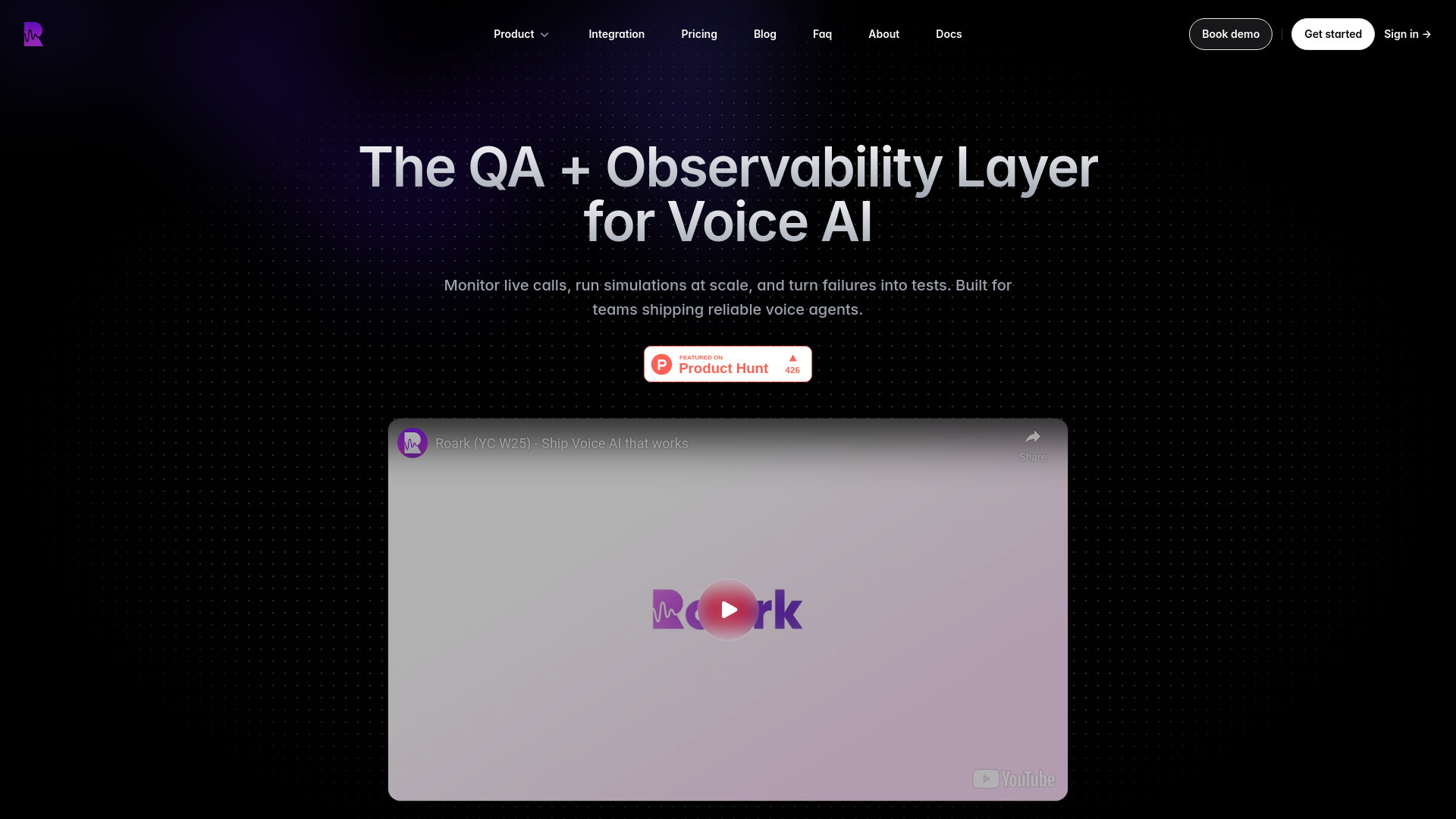
Roark is a QA + Observability Layer for Voice AI, designed to help teams ship reliable voice agents. It provides comprehensive tools for monitoring live calls, running simulations at scale, and transforming call failures into repeatable tests. Roark tracks over 40 built-in call metrics, offers multi-speaker analysis, and enables on-demand or automated evaluations. For pre-deployment, it allows stress-testing agents with simulated callers across various accents, languages, and speaking styles, using graph-based scenarios and configurable personas. Roark also features one-click native integrations with popular voice platforms like VAPI, Retell, LiveKit, and Pipecat Cloud.

Roark screenshot

Best for

Short scenarios where Roark tends to shine.

  • Monitor live voice interactions for performance, sentiment, and compliance.

    Best for Voice AI teams

  • Stress-test voice agents with simulated callers across diverse scenarios before deployment.

    Best for Developers

  • Automatically generate test cases from failed production calls to prevent regressions.

    Best for QA Engineers

  • Ensure HIPAA compliance and instruction-following for voice agents.

    Best for Product Managers (for voice agents)

  • Track and analyze key call metrics like latency, repetition, and custom events in real-time.

    Best for Organizations with high-volume voice operations

Example outputs 1

Sample generations and before/after results for Roark.

Access & connections

Where you can use Roark.

Platforms

Web

Capabilities

What this tool accepts, produces, and is strongest at.

Highlights

  • Monitoring & Evaluation (40+ metrics, multi-speaker analysis, evaluators)
  • Simulations & Testing (end-to-end testing, graph-based conversations, configurable personas)
  • One-Click Native Integrations

People also view

Tools that often show up alongside Roark in collections and comparisons.

In the news

Launch coverage and community mentions for Roark.

FAQ 7

What is Roark?
Roark is a QA + Observability Layer for Voice AI, designed to help teams ship reliable voice agents. It provides comprehensive tools for monitoring live calls, running simulations at scale, and transforming call failures into repeatable tests. Roark tracks over 40 built-in call metrics, offers multi-speaker analysis, and enables on-demand or automated evaluations. For pre-deployment, it allows stress-testing agents with simulated callers across various accents, languages, and speaking styles, using graph-based scenarios and configurable personas. Roark also features one-click native integrations with popular voice platforms like VAPI, Retell, LiveKit, and Pipecat Cloud.
How to use Roark?
Users integrate Roark with their voice platforms using one-click setups or SDKs to automatically capture call data. They can then monitor live calls, track 40+ metrics, analyze multi-speaker conversations, and run evaluators for compliance or instruction-following. For testing, users define conversation flows with a graph editor, configure diverse personas, and run end-to-end simulations. Failed production calls can be automatically converted into new test cases to ensure continuous improvement.
What does Roark do?
Roark is the QA + Observability Layer for Voice AI, helping teams monitor live calls, run simulations at scale, and turn failures into tests to ship reliable voice agents.
How difficult is it to integrate Roark?
Roark offers one-click native integrations for platforms like VAPI, Retell, LiveKit, and Pipecat, and first-class SDKs in Node & Python, with setup taking less than 60 seconds.
How do simulations work?
Simulations involve running end-to-end tests on agents over phone or WebSocket, defining conversation flows with a graph editor, and configuring personas with various attributes like gender, language, accent, and emotion. Tests can be auto-generated from failed production calls.
What are metrics and evaluators?
Metrics are built-in (e.g., latency, repetition, sentiment) or custom measurements tracked during calls. Evaluators are comprehensive assessments run on-demand or automatically to check for compliance, instruction-following, and correct tool calls.
What kind of sentiment analysis does Roark offer?
Roark includes sentiment detection as one of its 40+ built-in metrics, along with emotion models and vocal cue detection.
Roark From $500 / month