

MusicLM by Google ✓
5.5k expert music captions for AI training
Verdict
A quick read before you dig into the full page.
- Best if
- 5.5k expert music captions for AI training
- Skip if
- Limited dataset size
- Pick this when
- Large dataset size
Considering Suno instead? Compare side by side
Overview
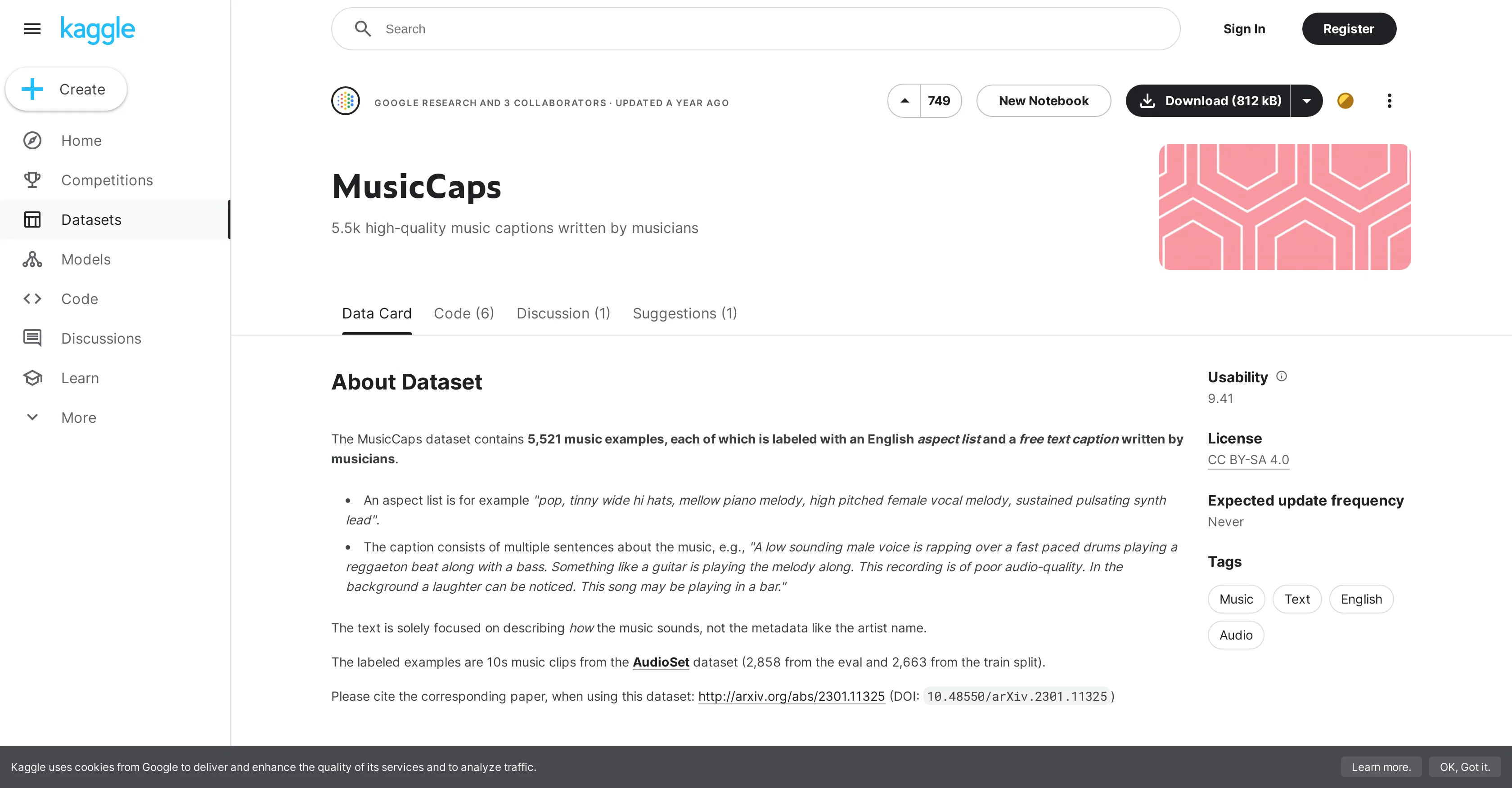
MusicCaps is an innovative tool, also featured on Kaggle, skilled in generating high-quality music captions. Primarily developed and utilized by musicians, this tool excels in providing informative and contextually accurate descriptions of various music pieces.
The core uniqueness of MusicCaps revolves around its ability to not merely generate generic statements, but focus on creating well-informed captions, thereby reflecting the depth of the music with a higher degree of precision and artistic perception.
The tool's application spans across a broad spectrum, be it for educational purposes to understand music better, or enhance the user's experience on digital music platforms by providing captivating descriptions.
Its ease of use and comprehensive functionality make MusicCaps an excellent asset for anyone seeking to heighten their musical experience or work.
Best for
Short scenarios where MusicLM by Google tends to shine.
-
5.5k expert music captions for AI training
Example outputs 1
Sample generations and before/after results for MusicLM by Google.
Access & connections
Where you can use MusicLM by Google, and what it plugs into.
Platforms
Integrations
Capabilities
What this tool accepts, produces, and is strongest at.
Input
- Text
Output
- Text
Pros & cons
Pros
- Large dataset size
- Categorized by aspects
- Detailed free-text captions
- Sourced from AudioSet
- Eval and train split
- Creative Commons BY-SA 4.0 license
- Labelled with metadata
- YouTube video link feature
Show 14 more
- Instruments and mood details
- Written by musicians
- Suitable for music description tasks
- High-quality music captions
- Provides contextual descriptions
- In-depth music analysis
- Educational purposes
- Can enhance user experience
- Accessible on Kaggle
- Distinct from generic tools
- Captivating music descriptions
- Can work with subsets
- Suitable for music interpretation
- Useful for music analytics
Cons
- Limited dataset size
- Only 10-second music clips
- Reliance on YouTube metadata
- Requires Creative Commons licensing
- Potential bias towards author's perspective
- Fixed aspect list criteria
- No real-time captioning
- Lack of multi-language support
Show 1 more
- Description dependent on musicians' input
Compare alternatives
Similar tools in the catalog — with a clear reason to open each one.

Tunee ✓
FreemiumChat with AI to create music and music video in minutes.
Why look Offers a public API
Full comparison
AirMusic ✓
Free TrialAI music generator and music video creator in one platform.
Free + from $11.9/mo
Full comparisonPeople also view
Tools that often show up alongside MusicLM by Google in collections and comparisons.
Tunee ✓
FreemiumChat with AI to create music and music video in minutes.

Suno ✓
FreemiumMake music at the speed of your ideas.

Singify ✓
PaidSingify Your World – Create, Cover, Inspire

MusicStar.ai ✓
Free TrialPersonalized music with automated genre and lyrics.

MakeBestMusic-Al Song Generator ✓
Free TrialTurn Ideas into Original Music – Your AI Songmaker
AirMusic ✓
Free TrialAI music generator and music video creator in one platform.

RaoMusic ✓
FreemiumAI Music Generator with Pay-as-you-go Credits

MeloLetter ✓
PaidTurn real memories into personalised song gifts.
Releases 1
FAQ 12
What is MusicLM by Google MusicCaps?
How many clips does the MusicLM by Google MusicCaps contain?
What is the duration of each clip in the MusicLM dataset?
What is an aspect list in the context of MusicLM?
What does a free-text caption in MusicLM refer to?
Is there a difference between the aspect list and free-text caption in the MusicLM data?
Where is the MusicLM database sourced from?
How is the MusicLM dataset split?
What license is the MusicLM database licensed under?
What metadata is each clip in the MusicLM database labeled with?
What is the purpose of the YT ID label in MusicLM database?
What does 'is balanced subset' mean in MusicLM's metadata?
Related tools
Recommended

MusicLM ✓
UnknownExperience and shape Google's latest AI innovations

Musicfy ✓
PaidCreate AI covers of your favorite songs instantly.

Ecrett Music ✓
FreemiumCreate royalty-free music with AI

Riffusion ✓
FreemiumReal-time AI music generation from text prompts

CassetteAI ✓
FreemiumAI-powered music creation at your fingertips.

LearningStudioAI ✓
Free TrialAI-powered authoring tool for effortless online course creation.