What is Mindgard?
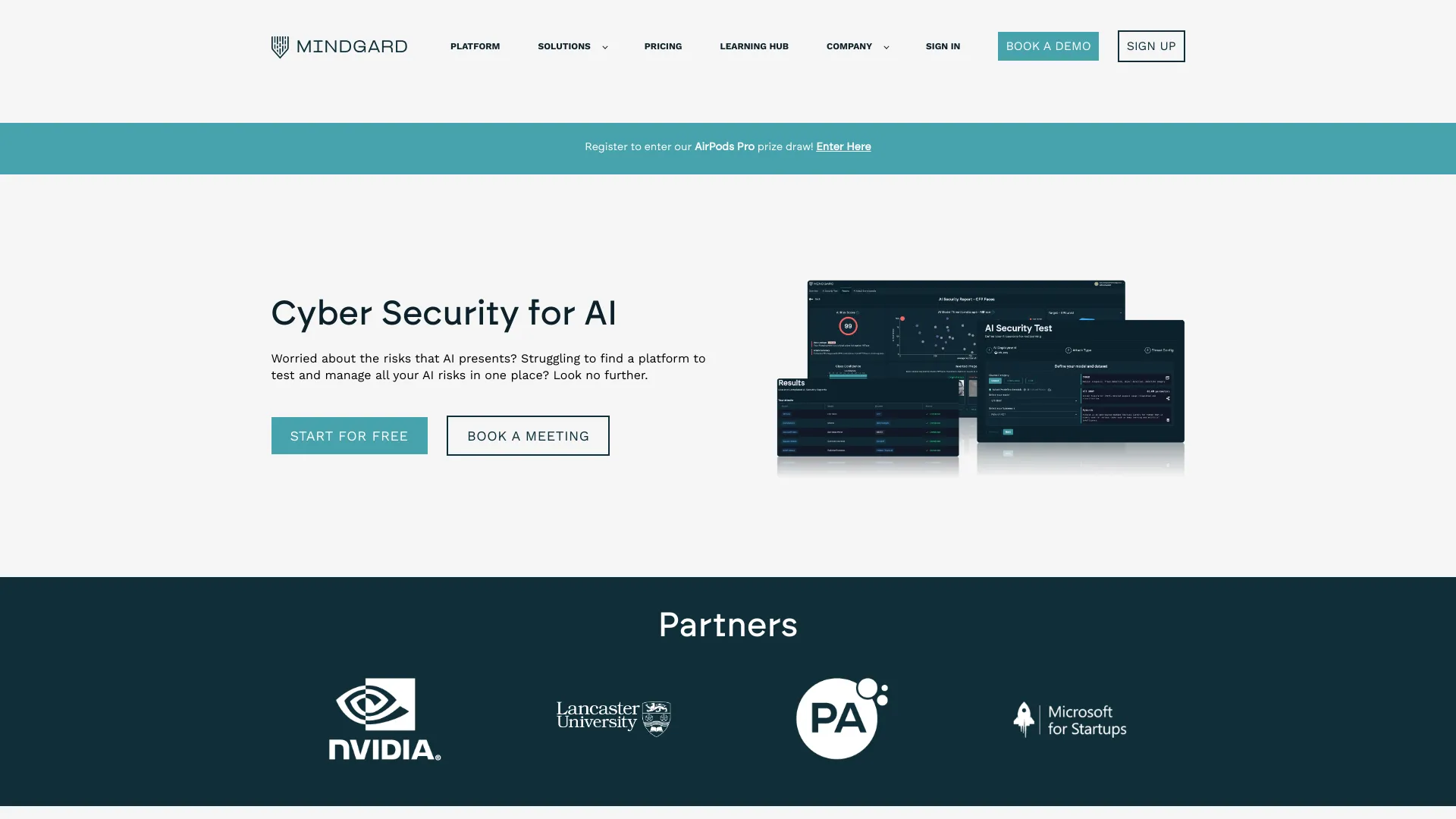
Mindgard is an AI security company that provides automated AI red teaming and security testing solutions. It helps organizations secure their AI/ML models, including LLMs and GenAI, throughout their lifecycle across both in-house and 3rd party solutions. Mindgard's platform offers automated security testing, remediation, threat detection, and a market-leading AI threat library to uncover and mitigate AI vulnerabilities, enabling developers to build secure, trustworthy systems.
How to use Mindgard?
Mindgard integrates into existing CI/CD automation and all SDLC stages, requiring only an inference or API endpoint for model integration. Users can book a demo to learn how to use the platform to secure their AI systems.
What makes Mindgard stand out from other AI security companies?
Founded in a leading UK university lab, Mindgard boasts over 10 years of rigorous research in AI security, with public and private partnerships that ensure access to the latest advancements and the most qualified talent in the field.
Can Mindgard handle different kinds of AI models?
Yes, Mindgard is neural network agnostic and supports a wide range of AI models, including Generative AI, LLMs, Natural Language Processing (NLP), audio, image, and multi-modal systems. This versatility allows it to address security concerns across various AI applications.
How does Mindgard ensure data security and privacy?
Mindgard follows industry best practices for secure software development and operation, including use of our own platform for testing AI components. We are GDPR compliant and expect ISO 27001 certification in early 2025.
Can Mindgard work with the LLMs I use today?
Absolutely. Mindgard is designed to secure AI, Generative AI, and LLMs, including popular models like ChatGPT. It enables continuous testing and minimisation of security threats to your AI models and applications, ensuring they operate securely.
What types of organisations use Mindgard?
Mindgard serves a diverse range of organisations, including those in financial services, healthcare, manufacturing, and cybersecurity. Any enterprise deploying AI technologies can benefit from Mindgard's platform to secure their AI assets and mitigate potential risks.
Why don't traditional AppSec tools work for AI models?
The deployment and use of AI introduces new risks, creating a complex security landscape that traditional tools cannot address. As a result, many AI products are being launched without adequate security assurances, leaving organisations vulnerable—an issue underscored by a Gartner finding that 29% of enterprises deploying AI systems have reported security breaches, and only 10% of internal auditors have visibility into AI risk. Many of these new risks such as LLM prompt injection and jailbreaks exploit the probabilistic and opaque nature of AI systems, which only manifest at runtime. Securing these risks, unique to AI models and their toolchains, requires a fundamentally new approach.
What is automated red teaming?
Automated red teaming involves using automated tools and techniques to simulate attacks on AI systems, identifying vulnerabilities without manual intervention. This approach allows for continuous, efficient, and comprehensive security assessments, ensuring AI models are robust against potential threats.
What are the types of risks Mindgard uncovers?
Mindgard identifies various AI security risks, including:- Jailbreaking: Manipulating inputs to make AI systems perform unintended actions.- Extraction: Reconstructing AI models to expose sensitive information.- Evasion: Altering inputs to deceive AI models into incorrect outputs.- Inversion: Reverse-engineering models to uncover training data.- Poisoning: Tampering with training data to manipulate model behaviour.- Prompt Injection: Inserting malicious inputs to trick AI systems into unintended responses.
Why is it important to test instantiated AI models?
Testing instantiated models is crucial because it ensures that AI systems function securely in real-world scenarios. Even if an AI system performs well in development, deployment can introduce new vulnerabilities. Continuous testing helps identify and mitigate these risks, maintaining the integrity and reliability of AI applications.