

Knowledge bases 2026 Rank: #1556
Mantle ✓
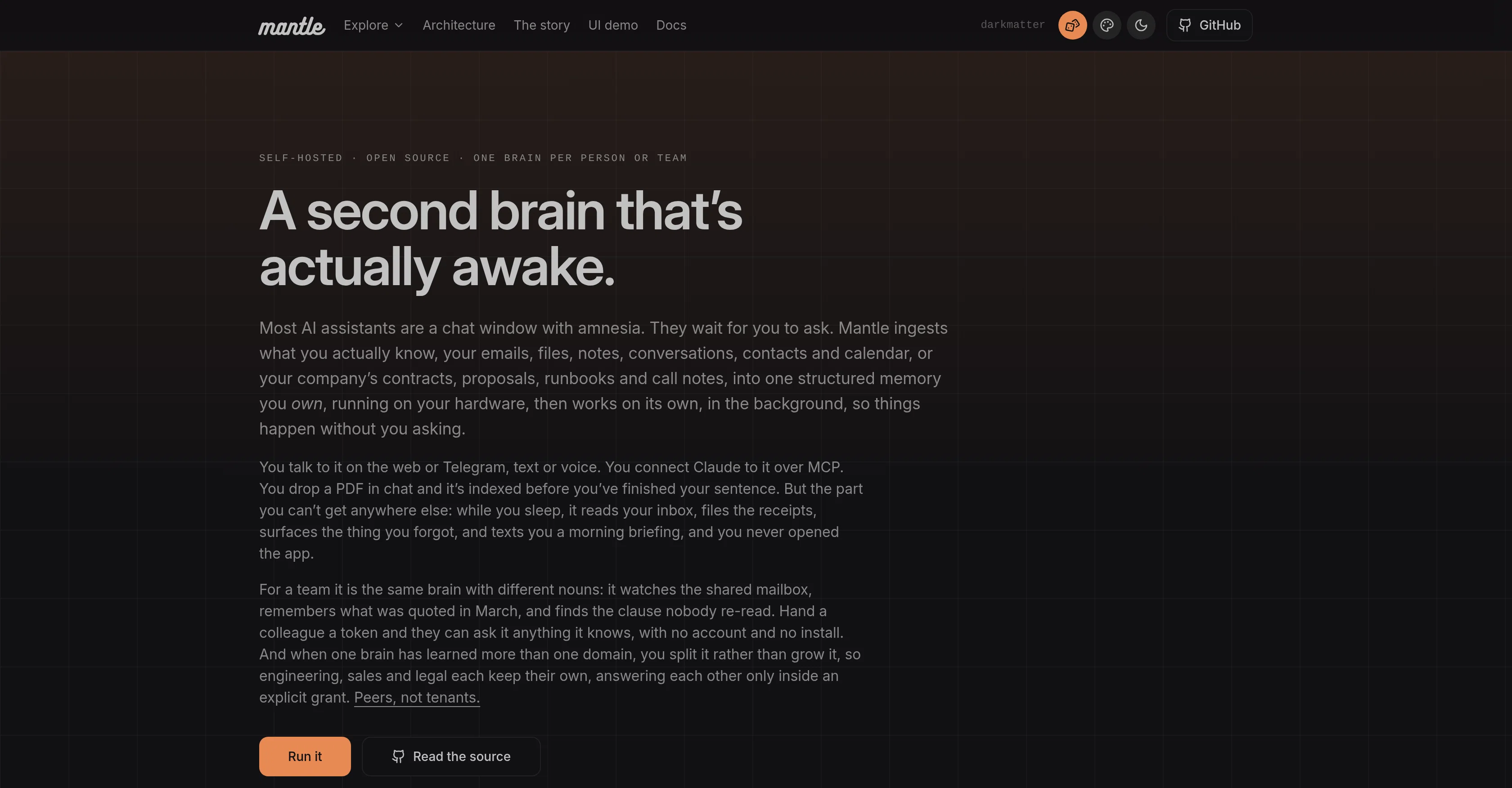
A second brain that's actually awake.
Verdict
A quick read before you dig into the full page.
- Best if
- A second brain that's actually awake
- Skip if
- Complex installation for non-techies
- Pick this when
- Open-source tool
Considering remio: Your Personal ChatGPT instead? Compare side by side
Overview
Mantle is an open-source self-hosted AI tool designed to consolidate and organize your or your team's knowledge. Its primary function is to transform various information resources - emails, files, notes, conversations, projects, contacts, calendar, etc., into an AI-queryable memory.
It runs on your own hardware and operates autonomously in the background, indexing data almost in real time and responding to your queries on web or Telegram, via text or voice.
Mantle has a proactive approach; it doesn't wait for tasks but conducts them on its own. For instance, it reads your inbox, files the necessary documents, brings to light forgotten information, and delivers a daily morning briefing, all without you having to interact with the app.
For teams, Mantle offers similar services while allowing for permission-based access to information. The tool is built for safety, treating every ingested piece of data as such and not instruction.
Mantle has a personality, adapting to the user's needs, and ensuring all relevant information is always available to the user. This tool also demonstrates affordability by using frontier models only where necessary and economy models or local embeddings elsewhere.
It is engineered for quality, with a large number of automated tests and a measured evaluation number behind every ranking knob.
Access & connections
Where you can use Mantle, and what it plugs into.
Platforms
Integrations
Capabilities
What this tool accepts, produces, and is strongest at.
Input
- API
- Tabular
- Text
- Audio
Output
- Audio
- Tabular
- API
- Text
Pros & cons
Pros
- Open-source tool
- Transforms various resources
- Runs on user's hardware
- Real time data indexing
- Morning briefings
- Permission-based access
- Data Security
- Quality Engineering
Show 37 more
- Local Embeddings
- Team Collaboration
- Database Querying
- Support via Telegram
- Voice Query support
- Automated task completion
- Large number of tests
- Structured memory system
- Brain per person/team
- Tool ingests knowledge
- Comprehensive consolidation
- Built for safety
- Safe to leave running
- Autonomous function
- Real-time data indexing
- Ingests variety of data
- Structured data form
- Text or voice query
- Built-in API console
- Agent graph visualization
- Notion-style documents
- Autonomous agents feature
- Effective memory management
- Ingests various documents
- Live brain watching
- Durable running mechanism
- Real time token display
- Automated mini-apps
- Task list creation
- Email, Documents, Voice indexing
- Raw data storage
- Rich knowledge graph
- Large data ingestion
- Real time agent collaboration
- Knowledge base that acts
- Searchable indexed content
- Multiple chat channels
Cons
- Requires self-hosting
- Dependent on own hardware
- No dedicated mobile app
- Complex installation for non-techies
- May raise data privacy concerns
- Only communicates via Telegram/Web
- Potential overload from autonomous tasks
- No multi-language support mentioned
Show 2 more
- Requires permission management
- No integration with popular tools except Microsoft 365
Compare alternatives
Similar tools in the catalog — with a clear reason to open each one.

remio: Your Personal ChatGPT ✓
FreemiumGet Tailored Answer with Your Personal ChatGPT
Why look Offers a public API
Full comparison
Sensay ✓
Free TrialAI Offboarding that keeps knowledge inside your company.
Why look Higher community rating
Full comparison
Nouswise ✓
FreemiumYour personal search engine for trusted information.
Free + from $9.98/mo
Full comparison
Saner.ai ✓
FreemiumOrganized knowledge for business and info management.
Why look Higher community rating
Full comparison
Releases 1
FAQ 12
What is Mantle?
How does Mantle work?
Can Mantle really run autonomously without any interaction?
What sort of data does Mantle index?
How quickly does Mantle index the data?
Can I interact with Mantle via voice command?
How does Mantle specifically help teams?
What does it mean that Mantle operates on 'permission-based access'?
How safe is it to use Mantle?
Is Mantle adaptive?
How does Mantle ensure affordability?
Can Mantle be trusted for data security?
Related tools
Recommended

DeepSeek ✓
FreeUnravel the mystery of AGI with curiosity

ChatPlayground AI ✓
PaidThe #1 Platform for Comparing AI Models

Humanize AI Text.io ✓
FreeMake AI text sound human.

Morable ✓
FreeAI for ambitious goals, from long-term strategy to daily high impact action

SnaptaleAI ✓
FreemiumOne prompt. A whole tale.

Promer AI: AI Ads Generator & Maker - Create Ads With... ✓
FreemiumTurn any product URL into winning ads.