

Layercode ✓
Build low-latency voice AI agents effortlessly.
Trial; then from $250/mo
Verdict
A quick read before you dig into the full page.
- Best if
- Build low-latency voice AI agents effortlessly
- Skip if
- Multiple languages but limited voices
- Pick this when
- Cloud-based platform
Considering Speechmatics | AI Voice Agents instead? Compare side by side
Overview
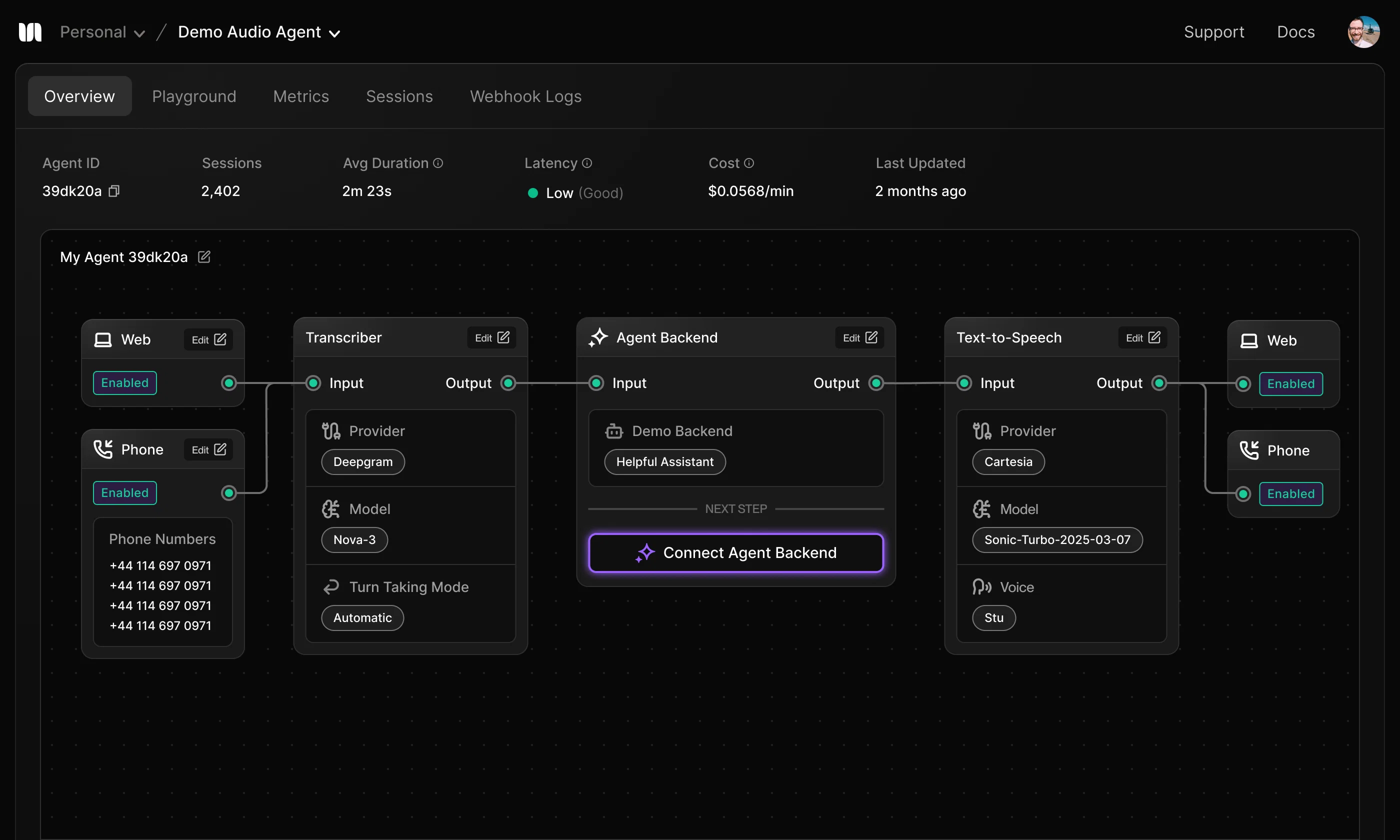
We provide the real‑time infrastructure required to turn any LLM or existing text-based agent into a reliable, conversational voice AI agent that speaks to users via the web, mobile, or phone.
Build reliable, low-latency voice agents that are ready for production
Our cloud platform offers everything you need to give your agent a voice: audio streaming, multilingual speech-to-text, text-to-speech in over 100 voices, and intelligent turn-taking, delivered through a simple webhook integration that works with the LLMs and agent libraries you already know and love.
Get started quickly, straight from the command line
Developers can get started with a single CLI command, connect any LLM, agent framework, or custom logic via a single webhook, and use our frontend SDKs or connect a phone number to let users speak to their agent.
Full control over your agent’s backend
Unlike WYSIWYG voice agent builders, Layercode gives developers complete control over their agent logic — without needing to wrestle with the complexity of a DIY solution: building, maintaining and managing every component of a real-time voice system.
Hot-swap leading voice model providers
By supporting different voice model providers, Layercode helps developers avoid vendor lock-in by retaining the ability to test, evaluate and swap the best voice models for their use case.
Track latency, record and replay voice sessions
Latency analytics and recordings let developers measure an agent’s latency, review any conversation and replay, review logs, or download the recording.
The first voice AI platform built for true global performance
Layercode’s cloud is powered by 330+ edge locations, helping ensure rock-solid performance and reliability for voice agents speaking to users anywhere on Earth.
True, usage-based pricing
True, usage-based pricing that only charges per-second when a user or agent is speaking — silence is always free.
By handling all of the complex, real-time audio infrastructure required to deliver reliable voice AI to production, Layercode lets developers focus on building their core application while delivering conversational voice AI experiences that feel human, scale with demand, avoid vendor lock-in, and remain affordable at scale.
Best for
Short scenarios where Layercode tends to shine.
-
Build low-latency voice AI agents effortlessly.
Example outputs 1
Sample generations and before/after results for Layercode.
Access & connections
Where you can use Layercode.
Platforms
Capabilities
What this tool accepts, produces, and is strongest at.
Input
- API
- Audio
Output
- Audio
- API
Highlights
- Agents
Supported features
- Speech API
- Agents
- TTS
- STT
- Transcription
- Integrations
Pros & cons
Pros
- Cloud-based platform
- High customization
- Advanced turn-taking algorithms
- Multiple language support
- 100+ different voices
- Scalable from demo to production
- Unique pricing for voice interactions
- Silence does not incur costs
Show 34 more
- Switch between voice model providers
- No vendor lock-in
- Complete backend control
- Integration capability
- CLI and SDKs provided
- Supports over 32 languages
- Offers multiple voice options
- Natural turn taking
- Voiced conversation builder
- Efficient session reviewing system
- Latency analytics availability
- Simplified billing for multiple vendors
- Transparency in voice agents' conversations
- Offers templates for common use-cases
- Global edge voice infrastructure
- Easy configuration of STT and TTS models
- No noisy neighbors in sessions
- Instant scalability and no cold starts
- Per-call isolation
- 330+ independent locations
- Avoids performance degradation
- Frontend and backend integration
- Compatible with known LLM and Agent libraries
- Facilitates distributed network design
- Voice agent monitoring and debugging tools
- Avoids single point of failure
- Audio pipelines configurability
- Hot-swap voice and transcription model providers
- Analytics and observability
- Supports browser-based and phone agents
- Sub 50ms voice data processing
- Compatibility with mobile or phone
- Startup program available
- Audio visualization example code provided
Cons
- Charges for voiced interactions
- Limited to certain languages
- Possible complexity for under-experienced developers
- Multiple languages but limited voices
- Requires knowledge of Command Line Interfaces and SDKs
- Dependency on vendor product quality
Compare alternatives
Similar tools in the catalog — with a clear reason to open each one.

Speechmatics | AI Voice Agents ✓
FreemiumBuild smarter AI voice agents with the best speech recognition technology
Why look Typically cheaper
Full comparison
Calldock ✓
Free TrialAdd AI voice agents to your website in minutes.
Why look Typically cheaper
Full comparison
Vozexo - Dental Answering Service | 24/7 AI for Denti... ✓
PaidThe AI voice agent that closes deals.
Why look Typically cheaper
Full comparison
VoiceAIWrapper ✓
Free TrialConnect any Voice AI under your brand
Why look Typically cheaper
Full comparisonPeople also view
Tools that often show up alongside Layercode in collections and comparisons.
Vozexo - Dental Answering Service | 24/7 AI for Denti... ✓
PaidThe AI voice agent that closes deals.

CloudTalk | AI Voice Agents ✓
Free TrialHuman-like AI voice agents for calls, follow-ups, and support
VoiceAIWrapper ✓
Free TrialConnect any Voice AI under your brand
Speechmatics | AI Voice Agents ✓
FreemiumBuild smarter AI voice agents with the best speech recognition technology

Monobot ✓
PaidAI voice agents that automate BPO tasks.
Calldock ✓
Free TrialAdd AI voice agents to your website in minutes.

WidgetVox ✓
Free TrialAI voice agents that talk to your website visitors.

Voice Agents by smallest.ai ✓
FreemiumFrom idea to voice agents in minutes
Releases 1
FAQ 12
What is Layercode primarily used for?
What customization options does Layercode offer?
How does the turn-taking algorithm on Layercode enhance conversational experience?
How does Layercode ensure smooth conversations?
What languages does Layercode support?
How many different voices does Layercode provide?
What are the scaling capabilities of Layercode?
What is unique about Layercode's pricing model?
Is it easy to switch between different voice and transcription model providers on Layercode?
How does Layercode prevent vendor lock-in?
What kind of control does Layercode allow over my agent's backend?
What does Layercode's integrative capability entail?
Related tools
Recommended

Notis ✓
Free TrialThe first WhatsApp assistant that runs on your ChatGPT and Claude subscriptions

remio: Your Personal ChatGPT ✓
FreemiumGet Tailored Answer with Your Personal ChatGPT

MemSync ✓
UnknownUnified Memory for all of your AI apps

Automateed ✓
Free TrialCreate eBooks effortlessly with Automateed, the AI-powered writing tool.

SEOJuice ✓
FreemiumSEO Made Simple — AI-driven Optimizations

OnSpace.AI - No Code App Builder ✓
FreemiumBuild Apps with AI, No Code