

AI memory 2026 Rank: #2532
Jade Note ✓
Give your AI a persistent, editable memory.
Verdict
A quick read before you dig into the full page.
- Best if
- Give your AI a persistent, editable memory
- Skip if
- Oauth 2.0 only
- Pick this when
- Integrated MCP server
Considering Alma by Olivares.AI instead? Compare side by side
Overview
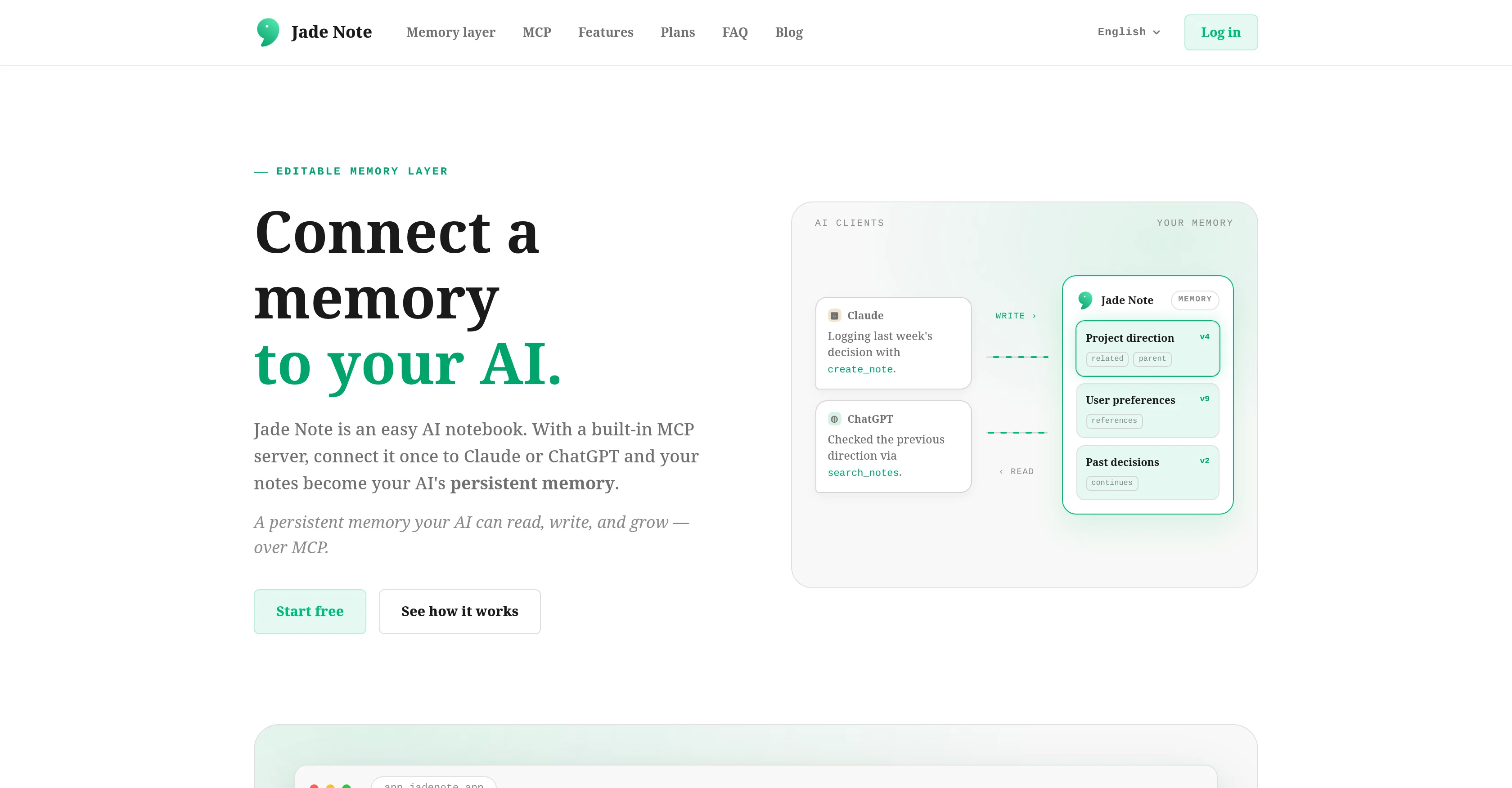
Jade Note is an AI notebook tool that acts as a memory layer for your AI. It is equipped with an integrated MCP (Memory Control Program) server. Once connected with AI systems like Claude or ChatGPT, the notes you make in Jade Note become your AI's accessible and modifiable memory.
This provides the AI with a persistent memory that can read, write, and grow. Jade Note enables users to create and manage notes that can be processed by the AI, providing it with context to carry out tasks more cognitively.
The tool's memory structure consists of categories, typed links, and category wikis that manage memory as a related knowledge graph, not as an unstructured text blob.
Each entry is versioned, allowing verifiable changes. Jade Note includes an autonomous self-maintenance feature checking for staleness, conflicts, importance, and link health.
Utilizing MCP, Jade Note's notes serve as your AI's persistent memory pool. It permits AI agents capable of MCP to securely read and write with authentication.
Additional tool features include safe writes with change previews, automatic versioning, rollback, and per-note write protection, tracking of note origin, and multiple-agent secure connections facilitated via OAuth 2.0.
Jade Note can also facilitate memory sharing between multiple MCP clients, making the memory accessible for reading and writing at once. Jade Note is designed to be used in various contexts such as personal usage, project management, research and learning, journaling, and knowledge base creation.
Access & connections
Where you can use Jade Note, and what it plugs into.
Platforms
Capabilities
What this tool accepts, produces, and is strongest at.
Input
- Text
Output
- Text
Pros & cons
Pros
- Integrated MCP server
- Notes serve as memory
- Secure authentication features
- Memory management as knowledge graph
- Typed links within memory
- Categories for note organization
- Autonomous self-maintenance
- Checks for stale content
Show 36 more
- Importance checks for information
- Link health evaluation
- Safe write with change preview
- Automatic versioning
- Rollback function
- Per-note write protection
- Tracking note origins
- OAuth 2.0 for secure connection
- Shared memory among multiple clients
- Accessible for reading and writing
- Multiple application contexts
- Memory modification capability
- Structured memory organization
- Conflicts resolution
- Memory pool creation
- Provenance tracking
- Notes version history
- Markdown editor
- Semantic search capability
- Applications in project management
- Knowledge base creation
- Learning and research aid
- Tool for journaling
- Supports personal usage
- Supports multi-agent connection
- Memory trigger features
- Automatically generates insights
- Allows link suggestions
- Memory can grow
- Communication via RAG chat
- Self-cleaning maintenance
- Refresh Wiki feature
- Allows link suggestions
- Allows note creation and editing
- Connects notes with five relations
- Per-client auth via OAuth 2.0
Cons
- Oauth 2.0 only
- No offline version
- No mobile apps
- Trial version limitations
- Relies heavily on categorization
- Lacks advanced text formatting
- Dependent on secure connections
- No stated cross-platform compatibility
Show 1 more
- Versioning may complicate usage
Compare alternatives
Similar tools in the catalog — with a clear reason to open each one.

Alma by Olivares.AI ✓
PaidThe workspace where memory, agents and creative studios share one canvas.
Why look Higher community rating
Full comparison
Octopoda ✓
FreemiumPersistent memory infrastructure for AI agents with Real Time Analytics
Why look Higher community rating
Full comparison
Aiqbee ✓
Free TrialGive any AI tool persistent organizational context.
Why look Higher community rating
Full comparison

MemoryPlugin ✓
PaidCure AI amnesia: Remember everything you tell it.
Why look Higher community rating
Full comparison
Memdex ✓
FreemiumShared memory for all your AI tools.
Why look Higher community rating
Full comparisonReleases 1
FAQ 12
What is Jade Note?
How does the MCP (Memory Control Program) server integrate with Jade Note?
Can Jade Note connect with AI systems like Claude or ChatGPT?
What exactly does the phrase 'notes become your AI's accessible and modifiable memory' mean?
How does Jade Note enable the processing of notes by AI?
How does Jade Note aid in task execution?
What kind of memory structure is used in Jade Note?
What role do categories, typed links, and category wikis play in Jade Note?
How is each entry in Jade Note versioned?
What is the autonomous self-maintenance feature in Jade Note?
What does 'safe writes with change previews' mean in the context of Jade Note?
What is the functionality of the tracking note origin feature?
Related tools
Recommended

MagicSlides.app AI PPT Maker ✓
FreemiumCreate Stunning PPTs in Seconds with the AI PPT Maker

GetLogit ✓
FreemiumArtificial intelligence, available for everyone.

ChatGPT ✓
FreemiumAsk anything, create anything, and move from idea to action.

Automateed ✓
Free TrialCreate eBooks effortlessly with Automateed, the AI-powered writing tool.

Kin - Personal AI Advisors ✓
FreePrivacy-first & designed your for mind, and life at work

Aiter.io | Paste a URL. Ship a Campaign That Sounds L... ✓
FreemiumAI marketing that sounds like you, not everyone else.