
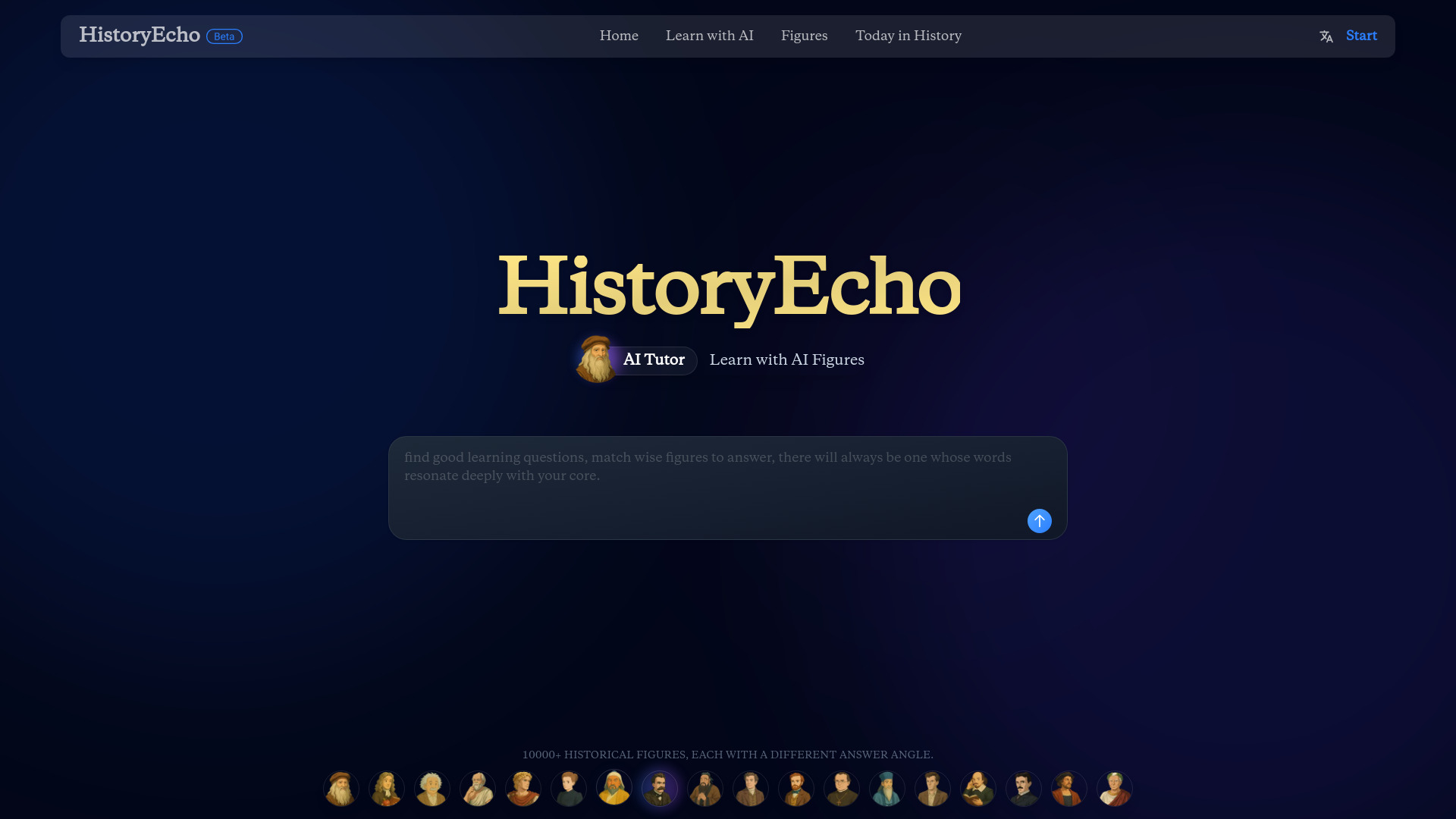
HistoryEcho AI
Learn with AI Historical Figures: Question, Chat & History Timeline
Source rating 5.0
(58)
390 views
390/mo traffic
0 saves
Freemium
Free + from 20$
Verdict
A quick read before you dig into the full page.
- Best if
- Learn with AI Historical Figures: Question, Chat & History Timeline
- Skip if
- You need enterprise SLAs or a fully managed team plan right away
- Pick this when
- Freemium · Free + from 20$
Overview
We seek to transport these historical figures back into the context of their own era, experiencing their lives dynamically, year by year.
We are exploring a new learning way: using the first-person perspective of historical figures, AI chat, and interactive timelines to recreate humanity's journey of world exploration.
Access & connections
Where you can use HistoryEcho AI.
Platforms
Capabilities
What this tool accepts, produces, and is strongest at.
Highlights
- Dynamic Age Progression of Historical FiguresCompare people from the same era across different ages (with video generation).
- AI Character ConversationsLearn subject knowledge through first-person dialogues with historical figures.
- “Today in History” & Interactive MapsView historical events visually through a browser extension.
FAQ 8
What is HistoryEcho AI?
We seek to transport these historical figures back into the context of their own era, experiencing their lives dynamically, year by year.
We are exploring a new learning way: using the first-person perspective of historical figures, AI chat, and interactive timelines to recreate humanity's journey of world exploration.
We are exploring a new learning way: using the first-person perspective of historical figures, AI chat, and interactive timelines to recreate humanity's journey of world exploration.
How to use HistoryEcho AI?
1. Drag the timeline to experience the life of historical figures.
2. Chat with historical figures to learn key facts from a first-person perspective.
3. Install the "Today in History" extension to see what happened on the map.
2. Chat with historical figures to learn key facts from a first-person perspective.
3. Install the "Today in History" extension to see what happened on the map.
Why use AI Figure make AI Study Tools?
Connecting Knowledge to Life: Knowledge in books comes from the exploration and discovery of ordinary people, just like us, within the context of their own lives. Therefore, either the knowledge point itself is significant, or the method of their exploration is worth learning from. Enhancing Empathy and Values: Because there are many historical figures, the same problem can have different interpretations from different perspectives. This naturally aligns with modern pluralistic values and, at the same time, enhances empathy. Boosting Initiative: Using a figure's first-person perspective to showcase their life narrows the distance between the learner and the pioneer. This idea—(Learning is Exploration - Exploration is Learning)—subtly suggests that the learner is also an explorer of the unknown world. This provides an invisible form of recognition and encouragement, thus boosting the learner's initiative.
What is the difference between us and general-purpose large models?
Guiding the Questions: General-purpose large models are good, but users often think, "I don't know what to ask it." Asking a good question requires effort and a certain cognitive standard. We are here to construct good questions systematically and structurally for the learner. Building a Cognitive Map: The Q&A from large models is discrete and independent, going from fragmented information to fragmented information. We, however, are constructing a structured cognitive map through every single answer we provide. Context and Relevance: As a vertical education product, we introduce more context to knowledge, closing the distance between knowledge points and real life, which makes it easier for learners to identify with and understand the material. Empathy and Encouragement: We also focus on cultivating empathy and serve as the cheerleading squad for future explorers.
Why did we develop the Dynamic Historical Timeline Tool?
Traditional history often presents figures in isolation. We created this tool to immerse learners in the lives of historical figures, placing them directly within their authentic living context and among their contemporaries. The core objective is to allow students to feel the figure's personal journey dynamically, year by year.
Why need AI Tutor?
The greatest disparity in education is not the quality of schools, but the educational capacity of parents. As AI's intelligence surpasses individual human capability, leveraging AI study tools can effectively bridge this gap and even forge new advantages for those who utilize them. In the traditional growth framework, the over-reliance on emphasizing mere attitude (perseverance, hard work) often reflects a challenging inability to articulate the concrete pathways of why and how growth happens. Our goal is to use this AI-powered product to clearly chart the often abstract world of personal growth. This journey is not a flat plain; individual limitations and the early stage of civil development present "mountains" everywhere. While the current version of our product offers early, incomplete insights—a reflection of our initial findings, beliefs, and biases—we are committed to utilizing advanced AI to uncover more complex growth pathways and present them in a smarter, truly adaptive learning framework.
Why is asking good questions important?
This skill is the equivalent of looking up to see the road. Often, we focus solely on effort ("pull the cart with our heads down"), which leads to inefficient efforts in isolated areas and internal friction (mental strain). Continuous questioning allows you to gradually build a sense of cognitive structure and learning rhythm (knowing priorities and avoiding unnecessary detours). The ability to decompose a large problem into multiple small problems, evaluate their distribution, and prioritize which small problem to focus on first, is precisely the method of finding the most critical point (the "Achilles' heel") for effective problem-solving.
How do we discover good questions?
Our AI system is designed to move beyond simple assessment and actively assist learners in strategic questioning and deep cognitive diagnostics. Our methods and focus areas include: Clarifying Cognitive Misconceptions: Identifying and correcting common learning errors and faulty reasoning patterns. Restoring True Difficulty and Distribution: Providing the learner with an accurate statistical view of a topic's actual challenge level and frequency, promoting realistic expectations. Dissipating Growth Uncertainty: Reducing the internal friction and hesitation (mental burnout) that arises from developmental uncertainty, fostering a smoother learning trajectory. Leveraging Human Factors: Integrating insights into human instincts and the critical thinking (思辨) that arises from human limitations, all built upon a comprehensive synthesis of knowledge points across various academic disciplines.
Related tools
Recommended



HistoryEcho AI
Free + from 20$