

Voice 2026 Rank: #2669
Gradium ✓
Ultra low-latency voice AI for developers.
Verdict
A quick read before you dig into the full page.
- Best if
- Ultra low-latency voice AI for developers
- Skip if
- Limited offline feature info
- Pick this when
- Ultra low latency
Considering smallest.ai instead? Compare side by side
Overview
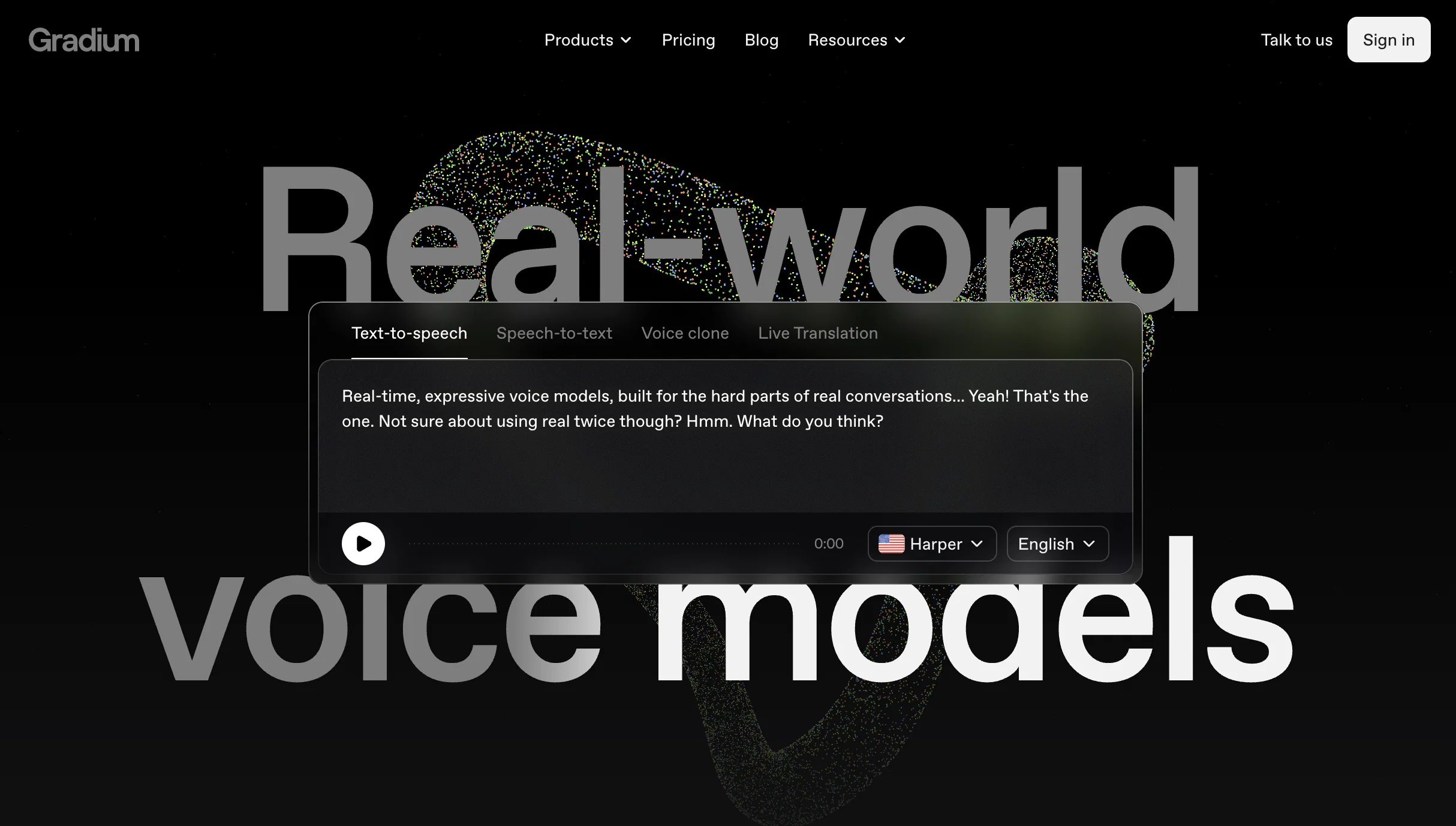
Gradium is an advanced voice AI tool specifically designed for developers. It focuses on creating ultra low latency voice AI models providing a range of services including expressive text to speech, accurate speech to text, and high fidelity voice cloning.
These are achieved through a unified API. Gradium's text-to-speech model converts text into a natural sounding voice, while the speech-to-text model allows for an instant transcription of audio into text.
The AI tool also offers a voice cloning feature, enabling users to create either instance or professional voice clones. It incorporates live translation that converts voice-to-voice in real time and is catered for multiple languages and regional accents, enhancing its global appeal and usability.
Capable of operating in offline mode, Gradium's on-device text-to-speech feature offers real-time natural voice output. Furthermore, the company provides resources for app development through Gradbot, where voice agents can be built with a single prompt.
As Gradium is in active development, the company also updates its users through release notes allowing users to stay updated on the latest improvements and additions to the tool.
Access & connections
Where you can use Gradium.
Platforms
Capabilities
What this tool accepts, produces, and is strongest at.
Input
- Text
- Audio
- API
Output
- Audio
- Text
- API
Pros & cons
Pros
- Ultra low latency
- Expressive text to speech
- Accurate speech to text
- High fidelity voice cloning
- Unified API
- Live translation
- Supports multiple languages
- Caters to regional accents
Show 10 more
- Offline mode capabilities
- Real-time natural voice output
- Voice-to-voice conversion
- App development resources
- Voice agents through Gradbot
- Instance or pro voice clones
- Active tool development
- User updates through release notes
- TTS feature on-device
- Real time voice conversion
Cons
- Limited to developers
- Only unified API
- Unclear voice cloning legality
- No specific language list
- Updates may disrupt service
- Potential latency in live translation
- In 'active' development
- Limited offline feature info
Show 1 more
- No specific regional accent list
Compare alternatives
Similar tools in the catalog — with a clear reason to open each one.

smallest.ai ✓
FreemiumReal-time voice AI built to scale
Why look Offers a public API
Full comparison
Speechify Voice AI ✓
UnknownYour voice becomes your keyboard and reading assistant.
Why look Higher community rating
Full comparison
Animaker Voice Generator ✓
FreemiumConvert text into ultra realistic human-like voiceovers.
Free + from $45/mo
Full comparison
Sarvam AI Content Studio ✓
Free TrialDub and clone voices across Indian languages.
Why look Typically cheaper
Full comparisonReleases 1
FAQ 12
What is Gradium?
How does Gradium's text-to-speech feature work?
Can Gradium convert speech into text?
What is the voice cloning feature in Gradium?
Does Gradium offer live voice-to-voice translation?
How does Gradium cater to multiple languages and regional accents?
Can Gradium operate in offline mode?
What is Gradbot?
How can I use Gradium for app development?
Where can I access the latest updates and improvements in Gradium?
Is Gradium's voice AI low latency?
What does a unified API in Gradium mean?
Related tools
Recommended

Clawi.ai ✓
PaidYour AI assistant, always on, everywhere you message.

Huntli ✓
FreeResearch that ends in a decision.

MagicSlides.app AI PPT Maker ✓
FreemiumCreate Stunning PPTs in Seconds with the AI PPT Maker

GetLogit ✓
FreemiumArtificial intelligence, available for everyone.

ChatGPT ✓
FreemiumAsk anything, create anything, and move from idea to action.

Automateed ✓
Free TrialCreate eBooks effortlessly with Automateed, the AI-powered writing tool.