

DrugCard Simple Search ✓
Streamline pharmacovigilance with AI-powered drug safety monitoring.
Verdict
A quick read before you dig into the full page.
- Best if
- Streamline pharmacovigilance with AI-powered drug safety monitoring
- Skip if
- Limited to text data
- Pick this when
- Comprehensive drug data availability
Considering DrugCard instead? Compare side by side
Overview
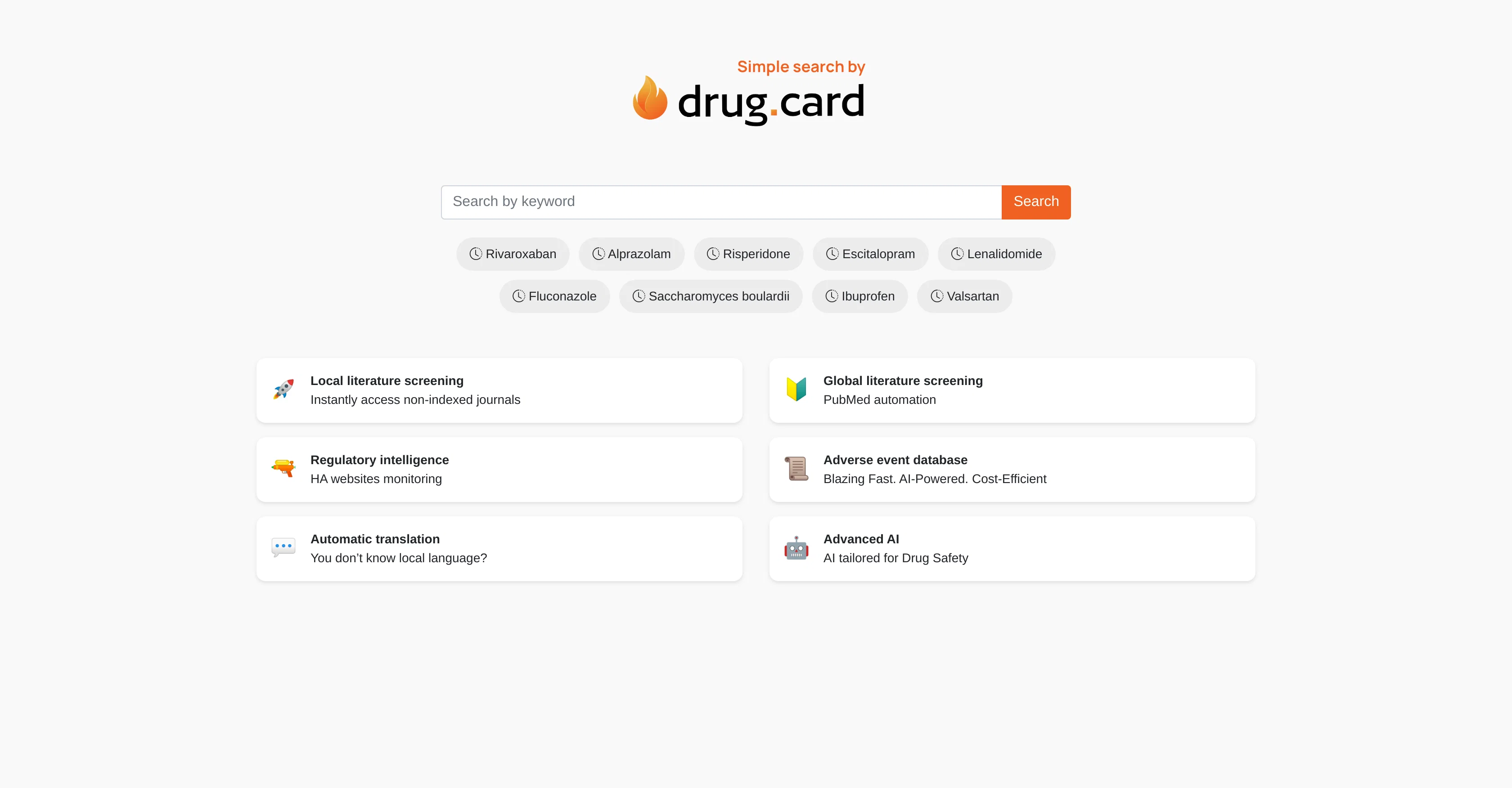
DrugCard is an electronic pharmacovigilance system designed to provide a comprehensive suite of capabilities for the pharmaceutical domain. It is centered on providing automation tools and AI-based methods to screen, analyze, and monitor pertinent data and intelligence from diverse sources.Key features of DrugCard include facilitating local and global literature screening.
It taps into a wide range of journals, including those not indexed, to offer comprehensive data on drugs, pharmaceutical substances, and their impact.
Similarly, DrugCard performs automated PubMed searches to aggregate globally available literature. Moreover, DrugCard actively performs regulatory intelligence by vigilantly monitoring Health Authority websites.
This enables users to stay updated about changes in regulations, approvals, and market trends, ensuring compliance and speeding market entry.One of the core functions of DrugCard is the AI-powered Adverse Event Database.
It delivers swift, cost-efficient access to vital data about possible adverse effects of drugs. This information underpins drug safety, patient care, and helps make better-informed decisions.Apart from this, DrugCard accommodates users with different language competencies by providing an automatic translation feature.
This ensures that the system is universally accessible, overcoming language barriers that often impede efficient global data exchange.Finally, the advanced AI in DrugCard is specifically tailored for drug safety, making the system more flexible and useful for users dealing with drug safety measures and actions.
Access & connections
Where you can use DrugCard Simple Search, and what it plugs into.
Platforms
Integrations
Capabilities
What this tool accepts, produces, and is strongest at.
Input
- Text
Output
- Text
Pros & cons
Pros
- Comprehensive drug data availability
- Local and global literature screening
- Includes non-indexed journals
- Automated PubMed searches
- Regulatory intelligence feature
- Monitoring of Health Authority websites
- Real-time regulation updates
- Speeds market entry
Show 10 more
- Cost-efficient data access
- Underpins patient care
- Multilingual translation feature
- Tailored for drug safety
- Automated drug safety monitoring
- Pharmaceutical domain focused
- Streamlined pharmacovigilance
- Better-informed decisions support
- Universally accessible system
- Flexible usage
Cons
- No specified user interface
- Possibly inaccurate automatic translations
- Data source variety undefined
- Unstated update frequency
- No API access mentioned
- Lack of customer support
- Undefined security measures
- Unmentioned pricing model
Show 1 more
- Limited to text data
Compare alternatives
Similar tools in the catalog — with a clear reason to open each one.

DrugCard ✓
UnknownLocal literature screening for pharmaceutical companies.
Why look More privacy-focused
Full comparison

Releases 1
FAQ 12
What is the role of AI in DrugCard?
How does the local literature screening feature work in DrugCard?
Does DrugCard work with non-indexed journals?
How does DrugCard gather global literature?
What is the 'Adverse Event Database' in DrugCard?
How does DrugCard assist in regulatory intelligence?
How does DrugCard ensure compliance and speed up market entry?
Can DrugCard facilitate users with different language competencies?
What is the importance of the automatic translation feature in DrugCard?
Is DrugCard capable of monitoring Health Authority websites?
Does DrugCard provide data on potential adverse effects of drugs?
How does DrugCard enhance drug safety and patient care?
Related tools
Recommended

TheLibrarian.io ✓
Free TrialYour WhatsApp AI assistant for instant productivity.

Kin - Personal AI Advisors ✓
FreePrivacy-first & designed your for mind, and life at work

Thea ✓
FreemiumAI study tools to master material, not just memorize it.

Mind Map Wizard ✓
FreemiumGenerate mind maps with AI: free, no sign-up, no ads

Noiz - AI PDF Summarizer ✓
FreeSummarize any PDF quickly and for free.

Notis ✓
Free TrialThe first WhatsApp assistant that runs on your ChatGPT and Claude subscriptions