

Dexter ✓
Autonomous agent for deep financial research.
Verdict
A quick read before you dig into the full page.
- Best if
- Autonomous agent for deep financial research
- Skip if
- Complex multi-agent architecture
- Pick this when
- Intelligent task planning
Considering Alphawatch instead? Compare side by side
Overview
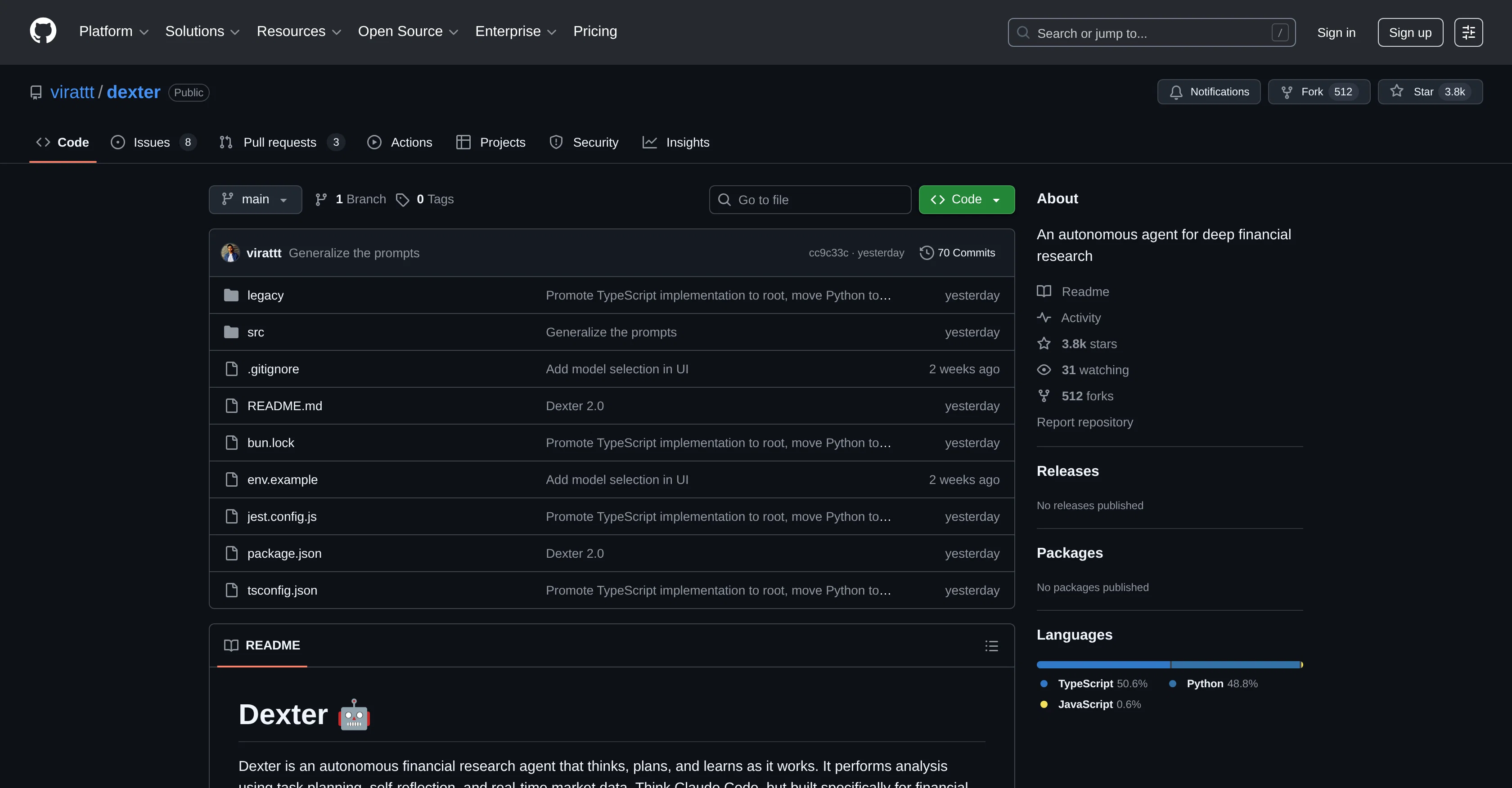
Virattt/Dexter is an autonomous agent specifically designed for conducting deep financial research. It is equipped with numerous capabilities including intelligent task planning, autonomous execution, self-validation, and access to real-time financial data.
Dexter's intelligent task planning capability enables it to break down complex financial queries into structured research steps. It automatically selects and executes the right tools to gather financial data, performs calculations and analysis, and synthesizes the findings into comprehensive responses.
Dexter also has self-validation capabilities where it checks its own work and continuously refines results until tasks are thoroughly completed. Additionally, it can access live market data, including balance sheets, income statements, and cash flow statements.
The tool ensures safety during its operations through features like built-in loop detection and step limits to avoid runaway execution. Dexter is built upon a multi-agent architecture with specialized components organized into four key agents: Planning, Action, Validation, and Answer.
Each agent follows a respective task of analyzing queries, selecting and executing research steps, verifying task completion and sufficiency of data, and synthesizing responses.
Dexter operates on 'Bun' runtime and leverages the React and the Ink terminal UI in its tech stack. It also integrates 'LangChain.js' to support providers like OpenAI, Anthropic, and Google.
Access & connections
Where you can use Dexter.
Platforms
Capabilities
What this tool accepts, produces, and is strongest at.
Input
- API
- Tabular
- Text
Output
- API
- Text
Highlights
- Agents
- Open Source
Supported features
- Agents
- Open Source
- Deep Research
- Finance & Accounting
- Search
- Integrations
- Text Generation
- CLI
Pros & cons
Pros
- Intelligent task planning
- Autonomous execution
- Self-validation capabilities
- Real-time financial data access
- In-depth financial analysis
- Automated complex query resolution
- Adaptive financial data gathering
- Synthesized findings generation
Show 26 more
- Multi-agent architecture
- Built-in loop detection
- Limitation on execution steps
- Bun runtime dependent
- React Tech Stack used
- Ink Terminal UI integrated
- LangChain.js integration
- Anthropic support
- Google service integration
- Automated calculation and analysis
- Self-check and refinement
- Specific agents for tasks
- Live market data access
- Customized research step selection
- Structured research steps creation
- Financial safety features
- Runaway execution prevention
- Automatic tool selection
- Real-time balance sheet access
- Real-time income statement access
- Real-time cash flow statement access
- Comprehensive results synthesis
- Enhanced task verification
- Effective data sufficiency check
- Real-time market data utilization
- Leverages terminal UI
Cons
- Dependent on 'Bun' runtime
- Reliance on LangChain.js integration
- Specific to financial research
- Requires manual API key setup
- Complex multi-agent architecture
- Limited by step limits
- Ink terminal UI constraining
- Needs real-time financial data
Show 2 more
- Not user-friendly installation
- No web-based UI
Compare alternatives
Similar tools in the catalog.




Releases 1
FAQ 12
What type of tasks is Dexter specifically designed for?
How does Dexter's intelligent task planning work?
What features enable Dexter's autonomous operation?
What does Dexter's self-validation capability do?
What types of real-time financial data can Dexter access?
What is the purpose of Dexter's built-in loop detection and step limits?
Can you explain Dexter's multi-agent architecture?
What roles do the four key agents in Dexter's architecture perform?
What is 'Bun' runtime that Dexter operates on?
Which technologies are included in the Dexter's tech stack?
How does Dexter incorporate 'LangChain.js' into its operation?
Which external providers does Dexter support through 'LangChain.js' integration?
Related tools
Recommended

Scispace ✓
FreemiumPlatform for exploring and publishing research papers.

Notis ✓
Free TrialThe first WhatsApp assistant that runs on your ChatGPT and Claude subscriptions

MarketAlerts.ai ✓
FreemiumInvest smarter with AI on your side

Lessie AI ✓
Free TrialFind anyone instantly with agentic AI search.

Scholarcy ✓
FreemiumConvert long articles into summary flashcards.

Elicit ✓
Free TrialAI-powered research assistant for literature reviews and analysis.