

Brand protection 2026 Rank: #1887
Clone Detector ✓
Detect clone websites before they harm your brand.
Trial; then from $13.50
Verdict
A quick read before you dig into the full page.
- Best if
- Detect clone websites before they harm your brand
- Skip if
- Fixed 100 requests/minute API limit
- Pick this when
- 38+ detection methods
Considering Bustem instead? Compare side by side
Overview
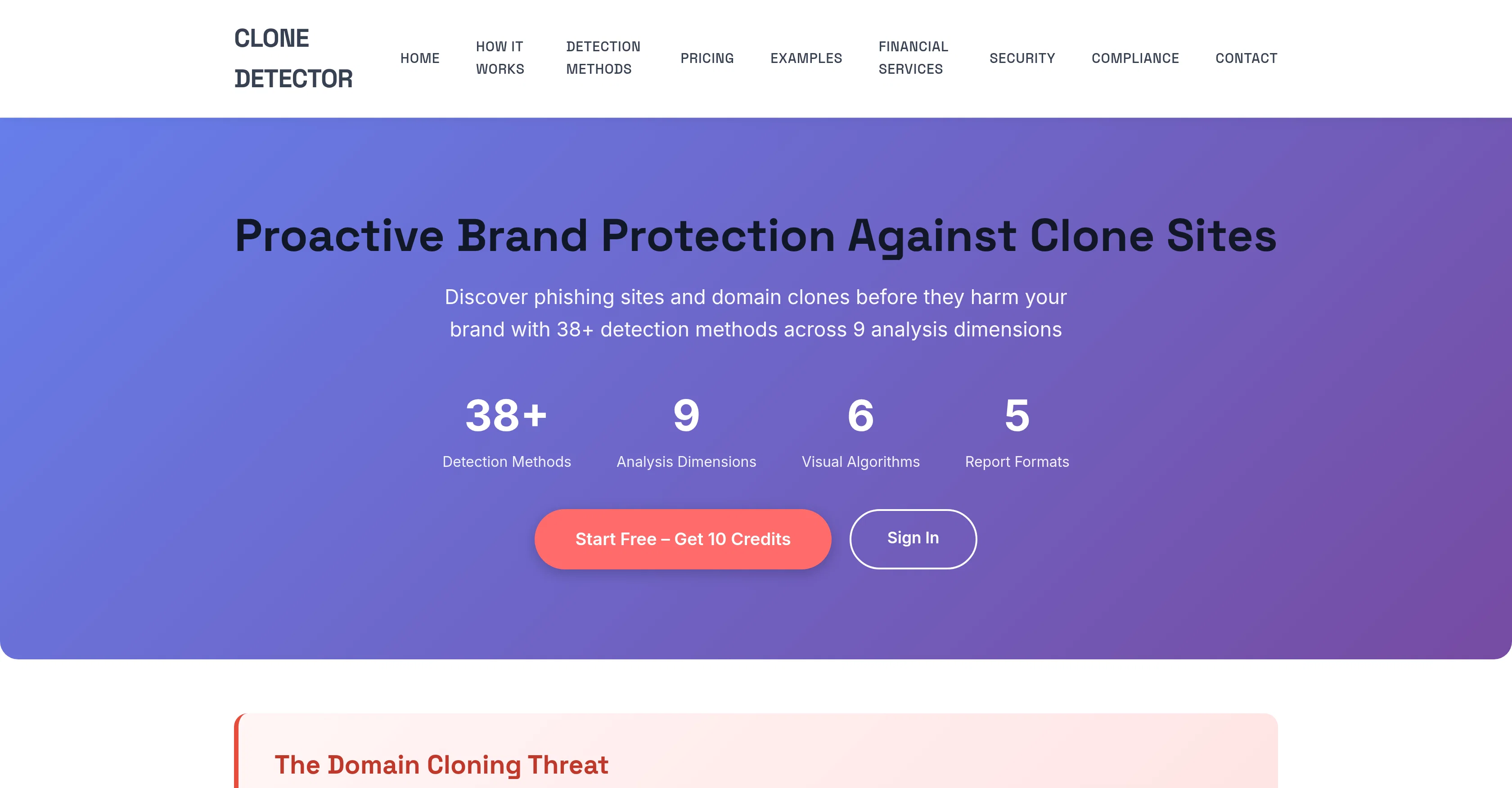
Clone Detector is a brand protection and phishing site detection tool designed to discover clone websites and phishing domains before any harm can be dealt to your customer base or brand reputation.
It employs over 38 detection methods, spanning across 9 distinct analysis dimensions, to identify possible domain variations that could potentially be used to impersonate your brand.
Among these methods are character substitution, TLD manipulation, homoglyphs, bitsquatting, and more. Visual similarity is also taken into account by performing SSDeep, pHash, wHash, aHash, SIFT, and Color Histogram analysis to compare screenshots and detect visual resemblance even when the code differs.
Additional aspects, such as domain intelligence, certificate analysis, content inspection, behavioural indicators, and threat intelligence, also contribute to comprehensive risk scoring.
The tool offers real-time scanning with options for scheduling automated scans and provides professional, comprehensive reports in HTML, PDF, JSON, CSV, and XML formats.
It also boasts an API for integrating into existing security workflows. Moreover, a unique feature of the tool is its Domain Fuzzing capability which generates thousands of domain variations to maximize detection reach.
As a whole, the Clone Detector serves as a proactive measure against brand impersonation, fraud, and phishing attacks and helps businesses in strategic intelligence and regulatory compliance.
Access & connections
Where you can use Clone Detector.
Platforms
Capabilities
What this tool accepts, produces, and is strongest at.
Input
- Text
- API
Output
- Text
- API
Highlights
- API
Supported features
- Cybersecurity
- Image Understanding
- Automation
- Integrations
- API
- Code Review
Pros & cons
Pros
- 38+ detection methods
- 9 distinct analysis dimensions
- Character substitution detection
- TLD manipulation detection
- Homoglyphs detection
- Bitsquatting detection
- SSDeep visual analysis
- pHash visual analysis
Show 40 more
- wHash visual analysis
- aHash visual analysis
- SIFT visual analysis
- Color Histogram visual analysis
- Domain intelligence feature
- Certificate analysis feature
- Content inspection feature
- Behavioural indicators analysis
- Threat intelligence feature
- Real-time scanning
- Automated scan scheduling
- Comprehensive report formats
- API for workflow integration
- Domain Fuzzing capability
- Brand impersonation prevention
- Fraud prevention
- Phishing attack prevention
- Strategic intelligence assistance
- Regulatory Compliance support
- Prevents harm to customer base
- Proactive brand reputation defense
- WHOIS & DNS record analysis
- Multi-dimensional threat analysis
- Automated monitoring
- Visual evidence provision
- Risk scores, actionable recommendations
- High request rate limit
- Variety of scan depths
- Registration check for domains
- Online portal for monitoring
- Credit-based Pricing
- Free trial credits
- Real-time scan progress status
- Detailed threat report
- Transparency in pricing
- Mobile and desktop captures
- Generates 50-500+ variations
- Proactive legal action support
- Brand market defence
- Clone sites identification
Cons
- Limited to domain-based threats
- No mobile application
- Lacks user-friendly interface
- Fixed 100 requests/minute API limit
- Not ideal for small brands
- No multi-language support
- Doesn't provide remediation advice
- Relies on user-driven scans
Show 2 more
- Lacks real-time threat alerts
- Limited threat intelligence sources
Compare alternatives
Similar tools in the catalog — with a clear reason to open each one.



AI Aware ✓
Free TrialDetect AI-generated content across text, video, images and audio.
Why look Typically cheaper
Full comparison
RYPL ✓
Free TrialAI Facebook automation that converts comments into sales.
Why look Better for writing
Full comparison

Lasso Moderation ✓
PaidAI-powered content moderation to protect brands and users.
Why look Better for writing
Full comparisonReleases 1
FAQ 12
What is Clone Detector?
What type of detection methods does Clone Detector use?
What is Domain Fuzzing?
How does the Visual Similarity Analysis feature work in Clone Detector?
What are the analysis dimensions in Clone Detector?
Can Clone Detector provide real-time scanning?
Can I schedule automated scans in Clone Detector?
In what formats can Clone Detector generate reports?
How can Clone Detector be integrated into my existing security workflows using its API?
How does Clone Detector assist in brand protection and phishing site detection?
What role does Clone Detector play in fraud prevention?
How does Clone Detector contribute to strategic intelligence?
Related tools
Recommended

Where to Eat? ✓
Free TrialAI-powered restaurant picks so that everyone in the group can agree !

MagicSlides.app AI PPT Maker ✓
FreemiumCreate Stunning PPTs in Seconds with the AI PPT Maker

GetLogit ✓
FreemiumArtificial intelligence, available for everyone.

ChatGPT ✓
FreemiumAsk anything, create anything, and move from idea to action.

Automateed ✓
Free TrialCreate eBooks effortlessly with Automateed, the AI-powered writing tool.

Kin - Personal AI Advisors ✓
FreePrivacy-first & designed your for mind, and life at work