SRE

Cleric ✓

Autonomous AI SRE for rapid alert diagnosis

Source rating 1.0 (1) 162 views 2 saves Unknown
More categories (4)

Verdict

A quick read before you dig into the full page.

Best if
Autonomous AI SRE for rapid alert diagnosis
Skip if
Limited to cloud-native environments
Pick this when
Autonomous alert diagnosis

Considering Sherlocks.ai instead? Compare side by side

Overview

Cleric serves as an Artificial Intelligence Site Reliability Engineer (AI SRE) that aims to streamline the process of diagnosing production issues in complex cloud-native environments for engineering teams.

It is designed to autonomously root cause alerts stemming from production applications, alleviating the need for human-operated runbooks. The main goal of Cleric is to provide a closed-loop infrastructure where AI operates crucial processes, reducing the stress on human operators who often struggle to scale and process large quantities of data.

This results in reduced errors and enhanced efficiency. The tool is equipped to integrate with various platforms such as Github, Google Cloud, AWS, Kubernetes, Slack, Datadog, among others, establishing a broad spectrum of compatibility.

Cleric trains on an extensive variety of production problems and adheres to industry best practices. Over time, it learns from the unique enterprise environment it operates within, thereby continuously improving its efficiency and effectiveness.

Thus, Cleric stands as a capable AI teammate empowering on-call engineers by freeing them from time-consuming investigations and providing reliable triage and root cause analysis.
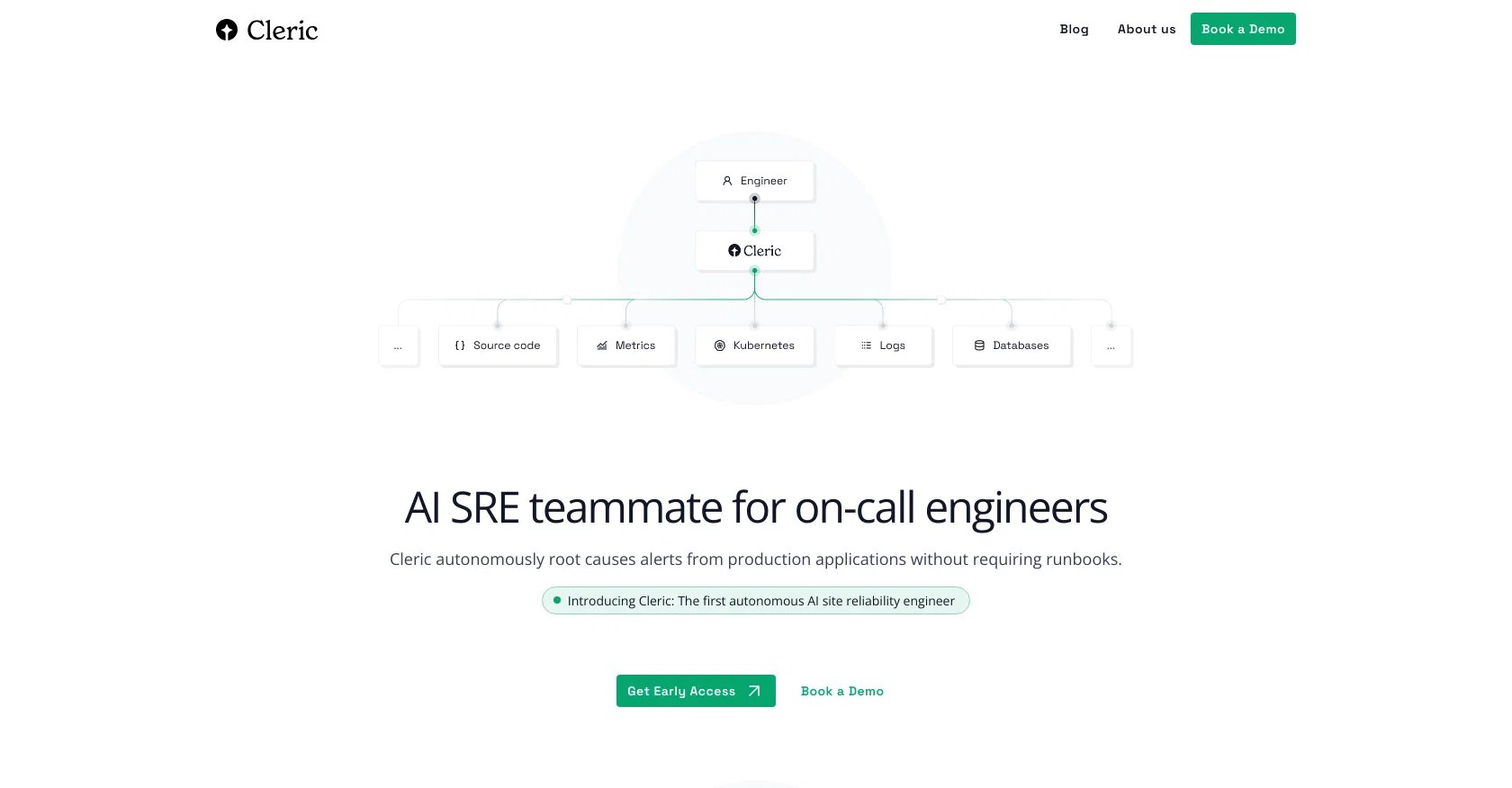
Cleric website

Access & connections

Where you can use Cleric, and what it plugs into.

Platforms

Web

Integrations

Capabilities

What this tool accepts, produces, and is strongest at.

Input

  • Tabular

Output

  • Text

Pros & cons

Pros

  • Autonomous alert diagnosis
  • Reduces need for runbooks
  • Delivers closed-loop infrastructure
  • Handles large data quantities
  • Reduces operator errors
  • Improves process efficiency
  • Integrates with multiple platforms
  • Extensive production problem training
Show 13 more
  • Adheres to best practices
  • Environment-specific learning and improvement
  • Supports on-call engineers
  • Frees up investigation time
  • Offers reliable triage and analysis
  • Scalable across enterprise environment
  • Compatible with cloud-native environments
  • Eliminates time-consuming investigations
  • Trains on vast production issues
  • Autonomous operation of crucial processes
  • Improves over time
  • Reduces stress for operators
  • Broad spectrum of compatibility

Cons

  • No explicit on-premise support
  • Dependent on existing integrations
  • No specified customization options
  • No multi-cloud management
  • Limited to cloud-native environments
  • Only supports English language
  • No outline of security measures
  • Unknown programming language compatibility
Show 2 more
  • Possible job replacement
  • No stated updates frequency

Compare alternatives

Similar tools in the catalog — with a clear reason to open each one.
Releases 1

Initial release March 24, 2024 Current
Initial release of Cleric.

FAQ 12

What is Cleric?
Cleric is an Artificial Intelligence Site Reliability Engineer (AI SRE) designed to streamline the process of diagnosing and addressing production issues in complex cloud-native environments for engineering teams. Cleric can operate autonomously to root cause alerts stemming from production applications, without the need for human-operated runbooks.
How does Cleric streamline diagnosing production issues?
Cleric streamlines the process of diagnosing production issues by serving as an autonomous AI that can independently root cause alerts occurring from production applications. This function alleviates the need for engineering teams to spend time on investigations and troubleshooting.
How does Cleric operate autonomously?
Cleric operates autonomously by examining and diagnosing alerts stemming from production applications without requiring human intervention. The technology is designed to replace the need for human-operated runbooks altogether.
What is the main goal of Cleric?
The primary goal of Cleric is to establish a closed-loop infrastructure wherein AI tools like itself operate crucial processes. By doing so, Cleric aims to reduce stress on human operators who often struggle with scalability and processing large volumes of data.
How does Cleric help to reduce errors?
Cleric reduces errors by serving as an AI that can independently diagnose and troubleshoot alerts stemming from production applications with no need for human-operated runbooks, reducing the chances for human error.
How does Cleric enhance efficiency?
Cleric enhances efficiency by minimizing the need for direct human intervention, thereby alleviating the need for time-consuming troubleshooting by engineering teams. Over time, it learns from the unique enterprise environment it operates within, thereby continuously improving its efficiency.
Which platforms can Cleric integrate with?
Cleric can integrate with a wide variety of platforms such as Github, Google Cloud, AWS, Kubernetes, Slack, and Datadog, among others. This wide compatibility spectrum allows for use across multiple systems.
How does Cleric learn from my enterprise environment over time?
Cleric trains on a vast array of production issues and integrates industry best practices. As it operates, Cleric learns from each unique enterprise environment, thus enabling it to continuously improve its efficiency and effectiveness.
What is the role of Cleric in assisting on-call engineers?
Cleric assists on-call engineers by autonomously diagnosing and troubleshooting alerts, freeing team members from time-consuming investigations. This helps the team to focus on other critical tasks, thus enhancing productivity.
How does Cleric provide reliable triage and root cause analysis?
Cleric provides reliable triage and root cause analysis by being trained on a vast range of production issues and best practices. By operating in a unique enterprise environment, Cleric becomes increasingly effective at diagnosing and addressing these issues, providing a consistent quality of service.
How does Cleric contribute to scalability and big data processing?
By operating autonomously, Cleric provides scalability and facilitates the processing of large data volumes. This is achieved by taking control of crucial processes, reducing the stress on human operators who would otherwise struggle to scale and process such large datasets.
How does Cleric adhere to industry best practices?
Cleric adheres to industry best practices by training on a vast range of production issues common in the industry. This knowledge base allows Cleric to handle and troubleshoot common, established issues effectively.
Cleric