
Cybersecurity 2026 Rank: #3184
C1 ✓
AI-powered access management with intelligent policy-driven controls.
Verdict
A quick read before you dig into the full page.
- Best if
- AI-powered access management with intelligent policy-driven controls
- Skip if
- Limited to enterprise-level usage
- Pick this when
- Policy-driven control
Considering Polymer Runtime Data Security instead? Compare side by side
Overview
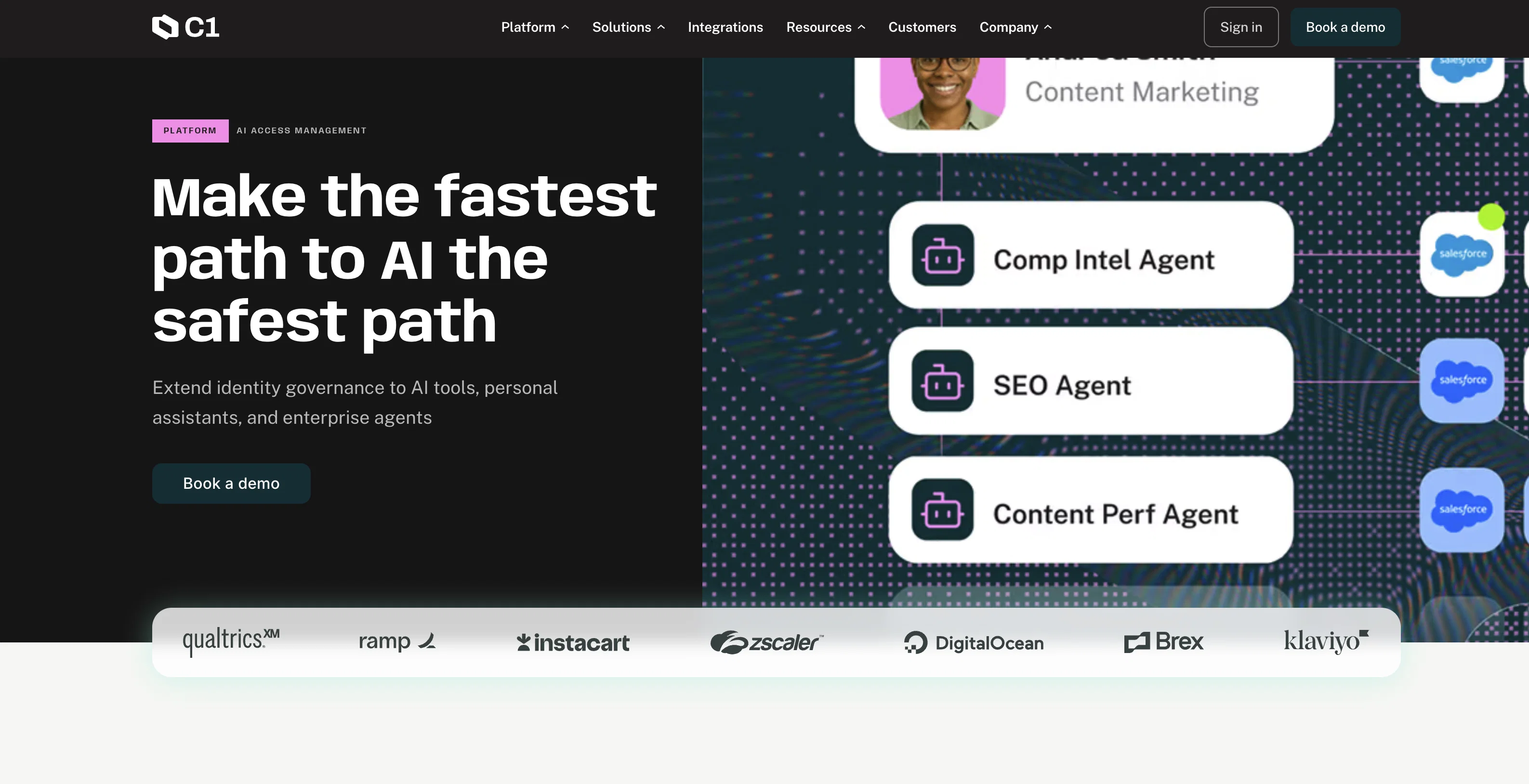
The C1 AI Access Management tool, formerly known as ConductorOne, extends enterprise identity governance to AI tools, personal assistants, and enterprise agents, providing policy-driven control over who and what can access MCP-connected tools, data, and actions.
It engages in self-service AI tool provisioning where end users can request access to AI tools and get provisioned rapidly. Policy-based auto-approval or routed human approval is used, eliminating the need for tickets, wait times, or workarounds.
The tool also employs an identity-aware MCP gateway that acts as a policy-aware proxy. This checks permissions, filters sensitive inputs and outputs, and emits full audits while ensuring data protection at the tool-call level.
The C1 tool features agent identity management where AI agents are treated as first-class identities with their own credentials, lifecycle states, and ownership.
Credentials are managed centrally, doing away with potential credential sprawl across devices and AI clients. Fine-grained policy enforcement allows for defining which tools an agent can call, what parameters are allowed, output redaction rules, and approval requirements for privileged operations.
Real-time audit and compliance ensure all tool calls are logged with full identity context. The C1 AI Access Management tool adapts policies to role, department and context, aligning with various identity use cases.
Access & connections
Where you can use C1, and what it plugs into.
Platforms
Integrations
Capabilities
What this tool accepts, produces, and is strongest at.
Input
- Tabular
Output
- API
Supported features
- Cybersecurity
Pros & cons
Pros
- Policy-driven control
- Rapid provisioning of access
- Identity-aware MCP gateway
- Agent identity management
- Fine-grained policy enforcement
- Real-time audit and compliance
- Adapts policies to role
- Data protection at tool-call level
Show 27 more
- Central credential management
- Limits credential sprawl
- Defines allowable agent operations
- Output redaction rules
- Approval for privileged operations
- Contextual policies
- Role-based policies
- Department-based policies
- Integrates with enterprise agents
- Sensitive input/output filter
- Provisioning without tickets or waits
- Automated access decisions
- Enforces least privilege
- Covers all tool calls
- Policies adapt to context
- Personal assistants as identities
- Managed secret credentials
- Instant credential revocation
- Automated evidence generation
- Contextual, policy-driven provisioning
- Reduced standing privileges
- Custom identity workflow automations
- Identity at scale management
- Single platform for identity use-cases
- Evidence for GDPR, HIPAA compliance
- Shared agents governance
- Automatic credential rotation
Cons
- No local deployment option
- Potential latency in provisioning
- Limited fine-grained policy options
- No direct user management
- Restricted to MCP environment
- Rigid context-based policies
- Lack of integrated single sign-on
- Limited to enterprise-level usage
Show 1 more
- Requires prior identity governance
Compare alternatives
Similar tools in the catalog — with a clear reason to open each one.

Polymer Runtime Data Security ✓
Free TrialPrevent AI data breaches with real-time risk management.
Why look Higher community rating
Full comparison
Claude Security ✓
FreemiumAI that finds security vulnerabilities scanners miss.
Free
Full comparison
Ethiack ✓
FreemiumAutonomous ethical hacking to identify vulnerabilities first.
Free + from $1790/yr
Full comparison
Securitybulldog ✓
UnknownAI-powered cybersecurity intel to speed up remediation.
Why look Higher community rating
Full comparison
Microsoft Security Copilot ✓
PaidBoost defense speed with AI-powered insights
Why look Higher community rating
Full comparison