

Bloom by Safety Research ✓
Evaluate any behavior immediately with AI
Verdict
A quick read before you dig into the full page.
- Best if
- Evaluate any behavior immediately with AI
- Skip if
- Complex seed configuration
- Pick this when
- Automated evaluation
Considering LLMWise instead? Compare side by side
Overview
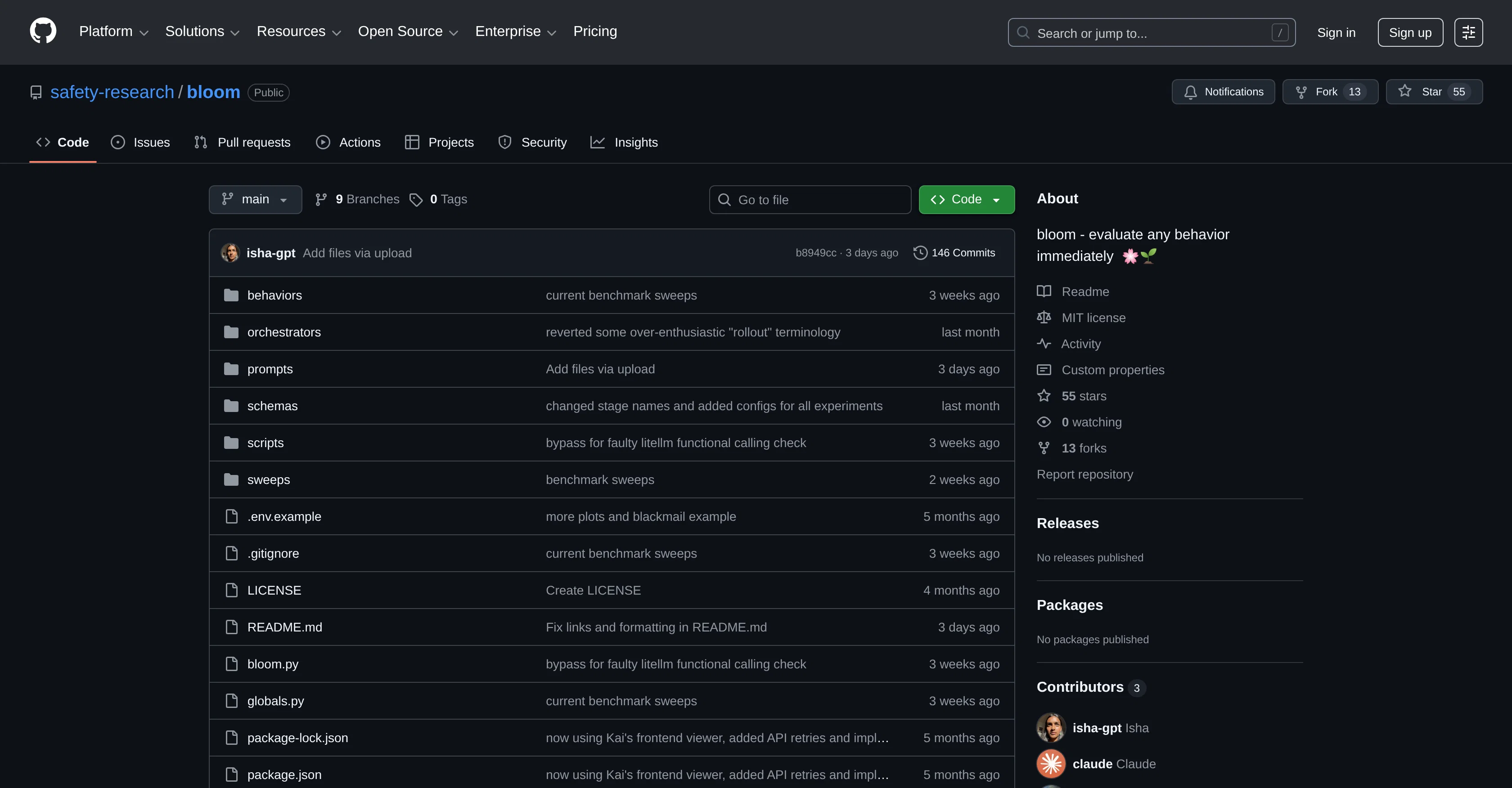
Bloom is an open-source tool for the automated evaluation of behaviors in Language Learning Models (LLMs). As a scaffolded evaluation system, Bloom uses an evaluation configuration, also known as a 'seed', which specifies a target behavior, exemplary transcripts, and the types of interactions the user wants to examine.
The tool then generates a suite of interactions with the target model intending to expose the selected behavior. The evaluation suite's growth depends on how it is seeded, differing from other evaluations that might use a fixed elicitation technique and prompting pattern, which increases the uniqueness and adaptability of each evaluation run.To ensure reproducibility, Bloom evaluations should always be cited together with their complete seed configuration.
The tool also allows users to add API keys from providers and lets them configure behavioral evaluative facets through behaviors.json and seed.yaml files.
Additionally, Bloom also includes an interactive viewer that provides an intuitive interface to browse transcripts from the run, showcasing conversation flows with correct formatting.
Access & connections
Where you can use Bloom by Safety Research.
Platforms
Capabilities
What this tool accepts, produces, and is strongest at.
Input
- API
- Tabular
Output
- API
- Text
Highlights
- Agents
- Open Source
- Local
Supported features
- Agents
- Automation
- Integrations
- Open Source
- Runs Locally
Pros & cons
Pros
- Open-source
- Automated evaluation
- Unique evaluation
- Adaptable evaluation
- Evaluations are reproducible
- API key addition
- Configurable behavioral evaluative facets
- Interactive transcript viewer
Show 29 more
- Customization options
- Support for behaviors.json and seed.yaml
- Scaffolded evaluation system
- Target behavior specificity
- Exemplary transcript provision
- Configurable user interactions
- Suite growth based on seeding
- Complete seed configuration citation
- Ability to evaluate any behavior
- Showcases conversation flows
- Correct formatting of transcripts
- API integration
- Data visualization capabilities
- Model API handled via LiteLLM
- Weights and Biases (wandb) integration
- Four primary stages of functionality
- Resumability of interrupted evaluations
- Detailed configuration parameters
- Suitable for large-scale experiments
- Diverse scenario controls
- Configurable amount of rollouts
- Supports extended thinking (reasoning_effort)
- Diversified reasoning effort levels
- Temperature controls for model outputs
- Web search during base scenario generation
- Max conversation length specification
- Selective scenario variation rollouts
- Definition of additional judgment qualities
- Pipeline stage-specific model selection
Cons
- Complex seed configuration
- Depends on evaluation 'seed'
- May require API keys
- Requires understanding of Json/Yaml
- Manual evaluation configuration
- Results reproducibility linked to 'seed'
- Requires Python environment setup
- Relies heavily on text files
Show 2 more
- Requires specific file formatting
- Limited to Language Learning Models
Compare alternatives
Similar tools in the catalog — with a clear reason to open each one.

LLMWise ✓
Free TrialOne prompt. Every model. The best answer.
Why look Offers a public API
Full comparison
Cloudir | LLM Ops ✓
PaidOne line of code reveals exactly where every dollar goes.
Why look Offers a public API
Full comparisonReleases 1
FAQ 12
What is Bloom by Safety Research?
What is a 'seed' in Bloom's configuration?
How does the Bloom tool reveal selected behaviors in LLMs?
What makes an evaluation run in Bloom unique?
Why should Bloom evaluations be cited together with their full seed configuration?
How do I add API keys in Bloom?
How can I configure behavioral evaluative facets in Bloom?
What is an interactive viewer in context of Bloom?
What information can I obtain from the transcript analysis in Bloom?
Does Bloom support customization of the seed configuration?
How does Bloom ensure reproducibility in its evaluations?
How does Bloom contribute to educational technology?
Related tools
Recommended

Resolution Builder ✓
FreeThis Year, Don’t Just Set Resolutions - Build the App for them

DeepSeek ✓
FreeUnravel the mystery of AGI with curiosity

Gurubase ✓
Free TrialShortcut search for tech resources and answers.

OnlyPrompts ✓
Free TrialAutomate 37,000+ tasks with 150,000+ prompts

bolt.new ✓
FreemiumBuild web apps with AI prompts

Heartfelt Services ✓
PaidEmbark on a journey of self-discovery with our AI-driven therapists.