Apptronik Apollo 2
Robotics solutions that outpace your competition.
Verdict
A quick read before you dig into the full page.
- Best if
- Robotics solutions that outpace your competition
- Skip if
- Limited to four-hour operation per charge
- Pick this when
- Versatile design
Considering Figure instead? Compare side by side
Overview
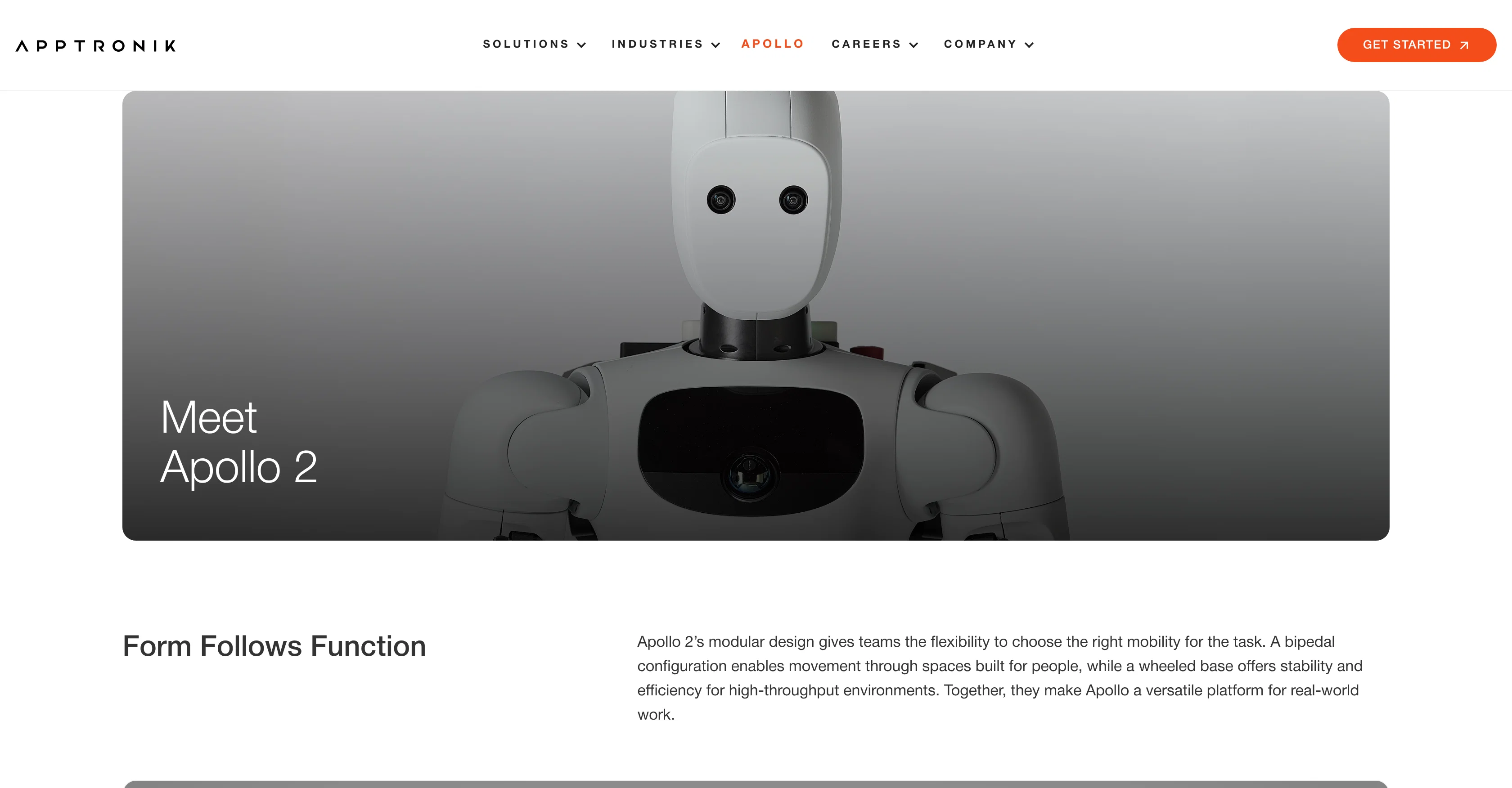
Apollo 2 is a versatile and capable tool designed for the intersection of advanced hardware and embodied AI systems, contributing to real-world work situations with its modular design allowing for either bipedal configuration or a wheeled base.
This advanced system enables movement through spaces built for people, while providing stability and efficiency in high-throughput environments. Developed to be a powerful platform for the upcoming generation of AI, its humanoid form, precise manipulation, and real-world mobility make it ideal for robotics foundation models that can perceive, think, and take action.
Apollo 2's functionality is further showcased in collaborations with Google DeepMind and Gemini Robotics, underpinning the opportunities presented when cutting-edge AI is combined with purpose-built robotics hardware.
These machines are more universal, more interactive, and better equipped to navigate the world around us, providing autonomous action, reasoning, human interaction, and dexterous manipulation.
Apollo 2 also focuses on human-robot interaction with features to communicate clearly with humans through expressive LED displays, coordinated lighting, speech and listening capabilities, and a built-in chest display providing necessary information.
Moreover, Apollo 2 uses Apptroniks patented actuator technology for high performing actuation and real-world strength.
Access & connections
Where you can use Apptronik Apollo 2, and what it plugs into.
Platforms
Integrations
Capabilities
What this tool accepts, produces, and is strongest at.
Input
- 3D
Output
- 3D
Pros & cons
Pros
- Versatile design
- Advanced hardware integration
- Capable in real-world situations
- Modular design
- Bipedal configuration
- Wheeled base option
- Humanoid form
- Precise manipulation capabilities
Show 41 more
- Real-world mobility
- Robotics foundation models
- Collaborates with Google DeepMind
- Collaborates with Gemini Robotics
- Universal application
- Interactive features
- Navigation capabilities
- Autonomous action
- Reasoning capabilities
- Human interaction
- Dexterous manipulation
- Expressive LED displays
- Coordinated lighting
- Speech capabilities
- Listening capabilities
- Chest display for information
- Apptroniks patented actuator technology
- Real-world strength
- High-throughput efficiency
- Construction and manufacturing applications
- Potential for extended industries
- Design for friendly interaction
- Manufacturable in mass quantities
- High payload capability
- Built-in safety measures
- Modular mounting options
- Intuitive interaction features
- Battery life efficiency
- Swappable battery packs
- Plug-in charge options
- Unbeaten safety
- Force control architecture
- Adjustable perimeter zones
- Impact detection
- Intuitive software suite
- Point-and-click control
- Trailer unloading capabilities
- Case picking capabilities
- Palletization capabilities
- Machine tending capabilities
- Workcell delivery capabilities
Cons
- Limited to bipedal or wheeled
- Targeted at high-throughput environments
- Depends on proprietary actuator technology
- Requires specific lighting for communication
- Limited to four-hour operation per charge
- Expected use in predefined industries
- Communication mainly via LED displays
- Designed with humanoid form limitations
Show 1 more
- Specific collaboration with DeepMind and Gemini
Compare alternatives
Similar tools in the catalog — with a clear reason to open each one.

Figure
UnknownBringing general purpose humanoid robots to life.
Why look Higher community rating
Full comparison

1X TECH NEO Home Robot
UnknownTransform your home with an autonomous helper robot.
Autonomous humanoids
Full comparison
UBTECH Walker S2
UnknownNavigate the world with comprehensive country data.
Autonomous humanoids
Full comparison
UBTECH Cruzr S2
UnknownGlobal connectivity meets intelligent automation.
Autonomous humanoids
Full comparison