

APIs 2026 Rank: #2393
APIPod ✓
One API, access all top AI models.
Verdict
A quick read before you dig into the full page.
- Best if
- One API, access all top AI models
- Skip if
- Complex multi-model workflows
- Pick this when
- Unified API for modalities
Considering Featherless - Serverless LLM Hosting instead? Compare side by side
Overview
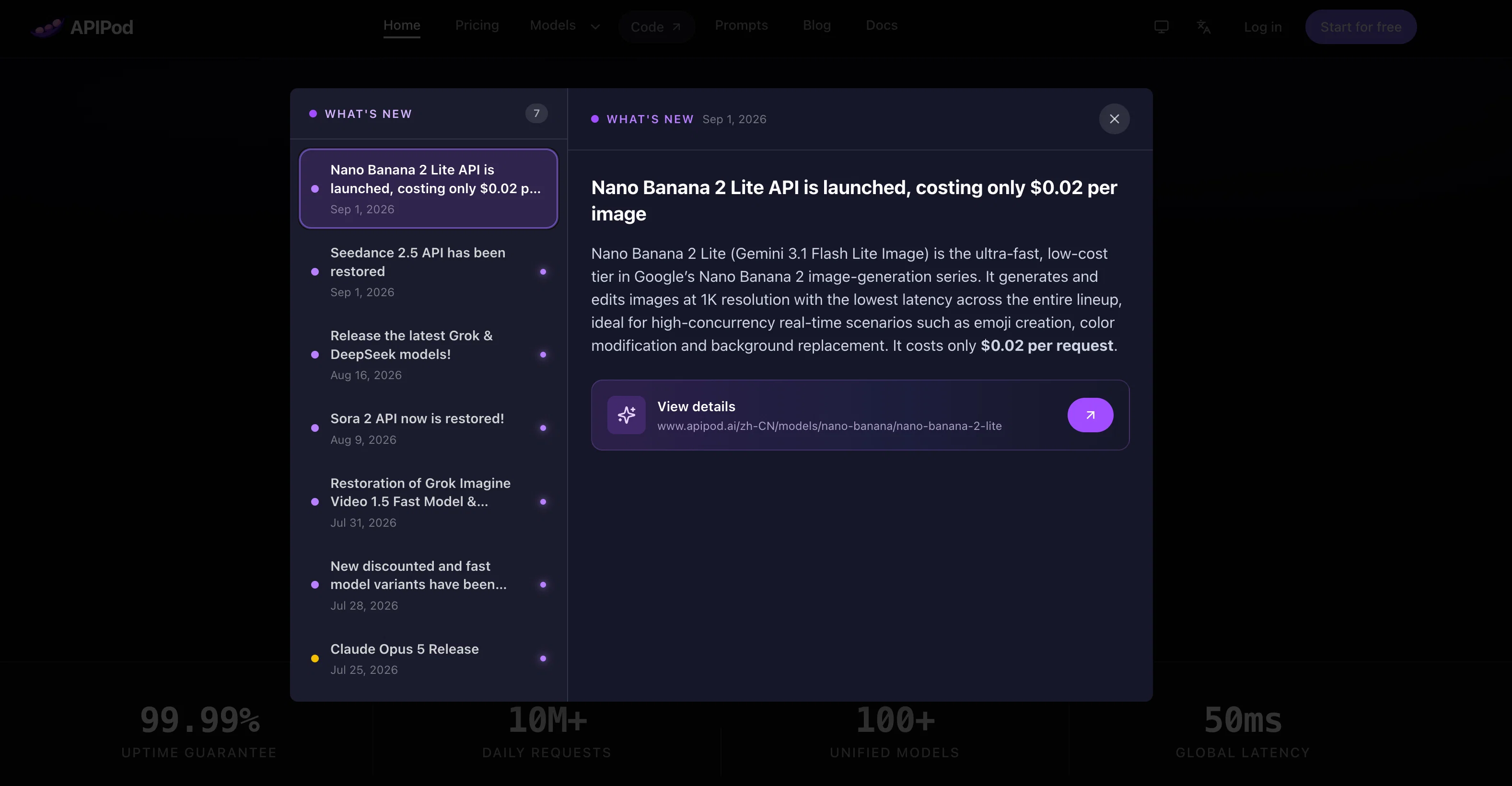
APIPod is an AI API aggregation platform that grants unified access to over 100 top AI models. These models cater to a range of AI functionalities from video and image generation to language models like GPT-5.4, Veo 3.1, and others.
Users can harness these models with ease thanks to APIPods support for multi-channel intelligent routing and automatic fault tolerance. Featured AI models include Anthropics Claude Opus 4.6 and Open AI's GPT-5.4 which handles complex professional tasks, and xAI's Grok Imagine which generates images and videos from text or images.
Other noteworthy models include ByteDance's Seedream 5.0 Lite which generates images and improves the timeliness of image generation, and OpenAIs Sora 2, a video creation engine.
APIPod also offers features geared towards large scale use, such as a 99.99% uptime guarantee, capacity for millions of daily requests, and low global latency.
For developers, it assures a real-time health monitoring with automatic fault isolation, real-time request logs, cost analysis dashboards, and it's fully compatible with OpenAI SDK with unified error handling and comprehensive monitoring metrics.
Access & connections
Where you can use APIPod.
Platforms
Capabilities
What this tool accepts, produces, and is strongest at.
Input
- API
Output
- API
Highlights
- Agents
- API
- Open Source
Supported features
- Agents
- API
- Integrations
- Open Source
Pros & cons
Pros
- Unified API for modalities
- 99.99% Uptime Guarantee
- 10M+ Daily Requests
- 50ms Global Latency
- Ease of multi-channel routing
- Automatic fault tolerance
- Real-Time Request Logs
- Cost Analysis Dashboards
Show 33 more
- Intelligent Multi-Channel Routing
- Circuit Breaker Protection
- Observability Platform
- Bulk User Compatibility
- Automated content production
- Unified error handling
- Rich debugging information
- Comprehensive Monitoring Metrics
- Large Scale Use
- Image And Video Generation
- Support for chat, video, image, and music generation
- Handles complex professional tasks
- Real-time health monitoring
- Automatic fault isolation
- Code compatibility
- Multi-modal workflows
- Low global latency
- Automatic channel selection for cost reduction
- Developer-first approach
- Protected circuit breaker
- Image to video capability
- Text to video capability
- Video creation engine
- Multi-modal video model
- Online retrieval function for image generation
- Accurate parsing of complex instructions
- Visual content enhancements
- Real-time network information integration
- Multi-backend channels configuration
- Auto circuit-break after 3 consecutive failures
- Flexible billing
- Supports Free API Key
- Cheaper than Replicate and Fal.ai
Cons
- Complex multi-model workflows
- No available models in categories
- Possibility of cascading failures
- Thirty seconds of downtime
- No given model specifics
- Unclear cost structure
- No support mentioned
- Fault tolerance may fail
Compare alternatives
Similar tools in the catalog — with a clear reason to open each one.

Featherless - Serverless LLM Hosting ✓
Free TrialDeploy any open AI model effortlessly.
Free + from $10/mo
Full comparison
ZEGOCLOUD ✓
FreemiumAPIs for real-time voice, video and chat.
Why look Typically cheaper
Full comparison



Releases 1
FAQ 12
What is APIPod?
What AI models are accessible through APIPod?
What is the purpose of the Circuit Breaker Protection feature in APIPod?
How does APIPod handle multi-modal workflows?
What is the average global latency of APIPod?
What advantages does intelligent multi-channel routing offer in APIPod?
Can APIPod be integrated with OpenAI SDK?
How can APIPod help with automated content production?
What is the maximum daily request handling capacity of APIPod?
How can APIPod's observability platform assist in optimizing AI app performance?
What is APIPod's policy for code compatibility?
How are cascading failures prevented in APIPod?
Related tools
Recommended

Clawdi ✓
FreemiumBest home for all AI agents

GPT4All ✓
FreemiumFree, local, privacy-aware chatbots without internet.

MelodAI ✓
FreemiumMake music, get the tabs instantly.
ASMR.so ✓
PaidTransform ideas into relaxing AI ASMR videos instantly.

SVG Maker AI ✓
Free TrialPrompt in. Clean, editable SVG out.