

Verdict
A quick read before you dig into the full page.
- Best if
- One API key for every AI model
- Skip if
- Depends on upstream provider reliability
- Pick this when
- Single API key access
Considering Featherless - Serverless LLM Hosting instead? Compare side by side
Overview
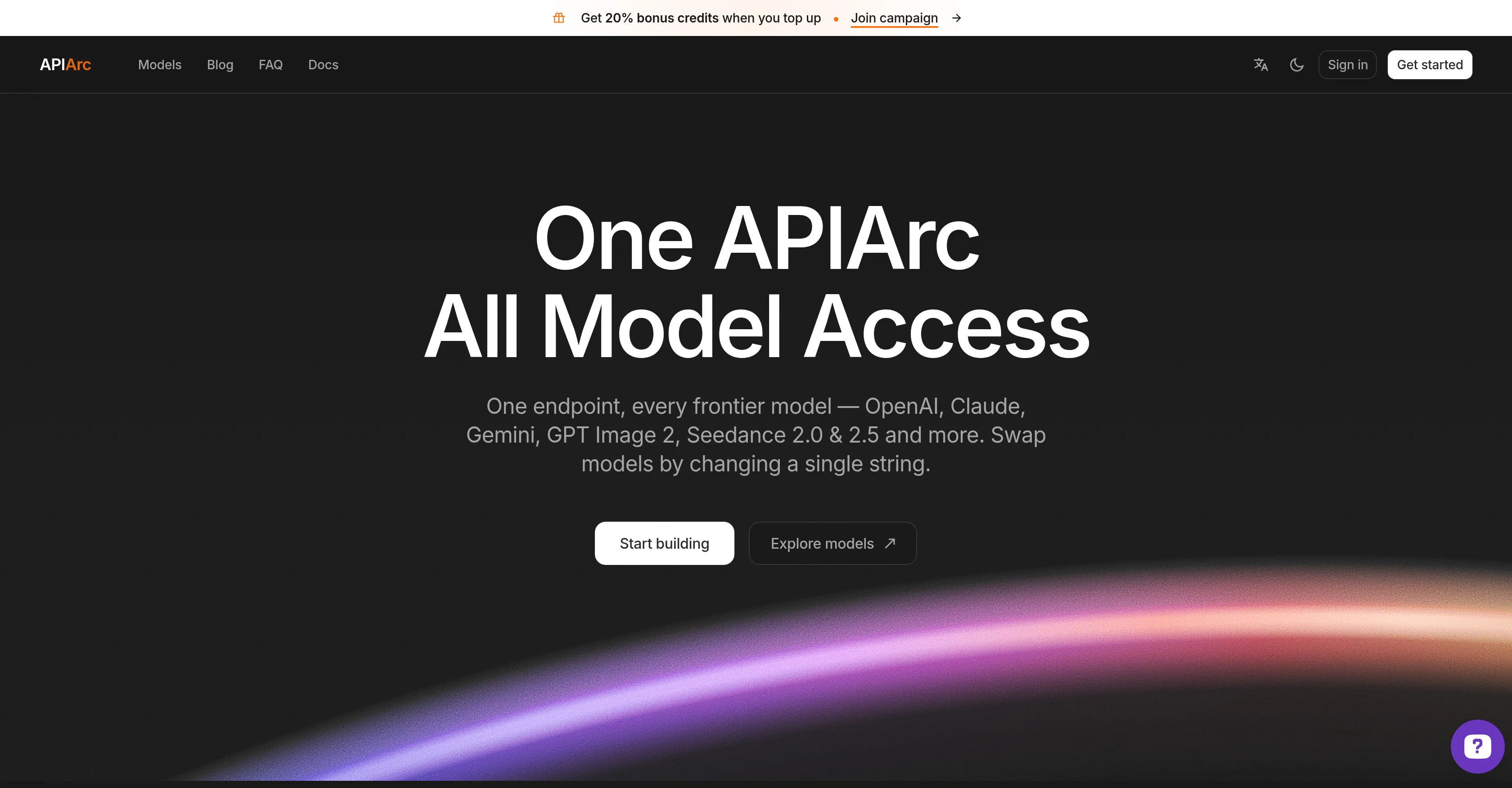
APIArc provides a unified gateway to various frontier AI models like OpenAI, Claude, Gemini, DeepSeek, Kimi, GLM and Seedance and more. The platform allows developers to access and seamlessly switch between these models through a single API key and endpoint.
APIArc acts as a mediator, routing, metering and managing failovers from these providers without any markup or lock-in. More importantly, all requests are run through official provider channels, avoiding gray-market relays or resold quotas.
The platform is built to ensure reliability with features like latency-aware routing that direct each call to the fastest, healthy upstream provider, effectively reducing latency.
Moreover, their protocols for health checks and automatic failover operates to handle provider incidents, thereby, preventing any service interruption arising from unreliable upstream providers.For developers, APIArc eliminates the need for multiple provider accounts, thereby reducing complexity as they can explore various model families using a single account, balance and API key.
It ensures hassle-free model provider switch where integration remains intact even when providers are changed. The process only requires updating the model string in the request, negating the need to rebuild applications for different models.
APIArc supports a range of AI models including text, reasoning and multimodal models and aims to offer a dependable, efficient platform suited for developers and businesses alike.
Access & connections
Where you can use APIArc.
Platforms
Capabilities
What this tool accepts, produces, and is strongest at.
Input
- API
Output
- Text
- Image
- Audio
- Video
Highlights
- API
Supported features
- API
Pros & cons
Pros
- Single API key access
- Latency-aware routing
- Routes to fastest provider
- Automatic failover management
- Handles provider incidents
- Reduces complexity for developers
- Hassle-free provider switch
- Supports text, reasoning, multimodal models
Show 17 more
- Official provider channels
- No gray-market relay
- No resold quotas
- Avoids service interruption
- No need for multiple accounts
- No model lock-in
- Updates without rebuilding application
- Streamed response
- Handles unhealthy upstream providers
- Simpler billing
- Reduces latency
- Multiple models, one key
- Effective API metering
- Prevents flaky upstream interruptions
- Wide range of models
- No markup for models
- Negates multiple key management
Cons
- Depends on upstream provider reliability
- Provider switching might cause inconsistencies
- Possible delay in new model implementation
- Potential discrepancies in usage metering
- Failover effectiveness dependent on providers
- Over-reliance on a single key
- Potential for provider compatibility issues
- Dependent on external model updates
Show 1 more
- Difficult to attribute performance issues
Compare alternatives
Similar tools in the catalog — with a clear reason to open each one.

Featherless - Serverless LLM Hosting ✓
Free TrialDeploy any open AI model effortlessly.
Why look Higher community rating
Full comparison
ZEGOCLOUD ✓
FreemiumAPIs for real-time voice, video and chat.
Why look Freemium alternative
Full comparison
CometAPI ✓
FreemiumOne API, 500+ AI models at your fingertips.
Why look Freemium alternative
Full comparison
Token Harbor ✓
Free TrialThe easiest way to access frontier AI models.
Why look Higher community rating
Full comparison
APIMart ✓
UnknownOne API for 500+ AI models at 70% less cost.
Why look Higher community rating
Full comparison
Roya ✓
FreemiumPlan APIs and frontend integrations in days, not weeks
Why look Freemium alternative
Full comparisonReleases 1
FAQ 12
What is APIArc?
What AI models are supported by APIArc?
Do I need separate accounts for each AI model when using APIArc?
How does APIArc prevent service interruptions?
What is the role of APIArc as a mediator?
What features does APIArc offer for reliability and efficiency?
Is there a lock-in when I choose a model provider through APIArc?
How does automatic failover work in APIArc?
What are the steps to switch AI models using APIArc?
How does APIArc ensure reduced latency?
How does APIArc manage failovers from different AI model providers?
Does APIArc run requests through official or gray-market relays?
Related tools
Recommended

MagicSlides.app AI PPT Maker ✓
FreemiumCreate Stunning PPTs in Seconds with the AI PPT Maker

GetLogit ✓
FreemiumArtificial intelligence, available for everyone.

ChatGPT ✓
FreemiumAsk anything, create anything, and move from idea to action.

Automateed ✓
Free TrialCreate eBooks effortlessly with Automateed, the AI-powered writing tool.

Kin - Personal AI Advisors ✓
FreePrivacy-first & designed your for mind, and life at work

Aiter.io | Paste a URL. Ship a Campaign That Sounds L... ✓
FreemiumAI marketing that sounds like you, not everyone else.