
Cybersecurity 2026 Rank: #3352

Alias Robotics Cybersecurity AI ✓

Six integrated layers. One automated security stack.

138 views 0 saves Unknown
More categories (3)

Verdict

A quick read before you dig into the full page.

Best if
Six integrated layers. One automated security stack
Skip if
Complex multiple-component system
Pick this when
High speed operation

Considering Polymer Runtime Data Security instead? Compare side by side

Overview

Alias Robotics offers a comprehensive cybersecurity AI stack composed of products and services that streamline the transition from manual to automated cybersecurity.

This suite of solutions is built by the leading EU Cybersecurity AI lab and operates at high speed, either on-premise or through cloud-hosted services.

The products include Language Learning Models (LLMs), scaffolds, and large datasets whilst the services involve agents, steering, and benchmarking. These components work together to automate cybersecurity functions.

The LLMs, marketed under the 'alias' name, are highly capable units designed for robust cybersecurity tasks. The scaffold system, called CSI, integrates different cybersecurity tools to establish a unified framework.

Large datasets, which comprise a vast corpus of cybersecurity trajectories, fuel the performance of the 'alias' models. As for the services, agents imitate core security roles, steering transforms general-purpose LLMs into specialized security experts, and benchmarking validates the functional efficacy of each layer of the system.

All components for this full-stack solution are independently operational but meant to be used together for a cohesive, more efficient security system.

The firm also engages in open research, continuously innovating and sharing knowledge in the field of AI cybersecurity.
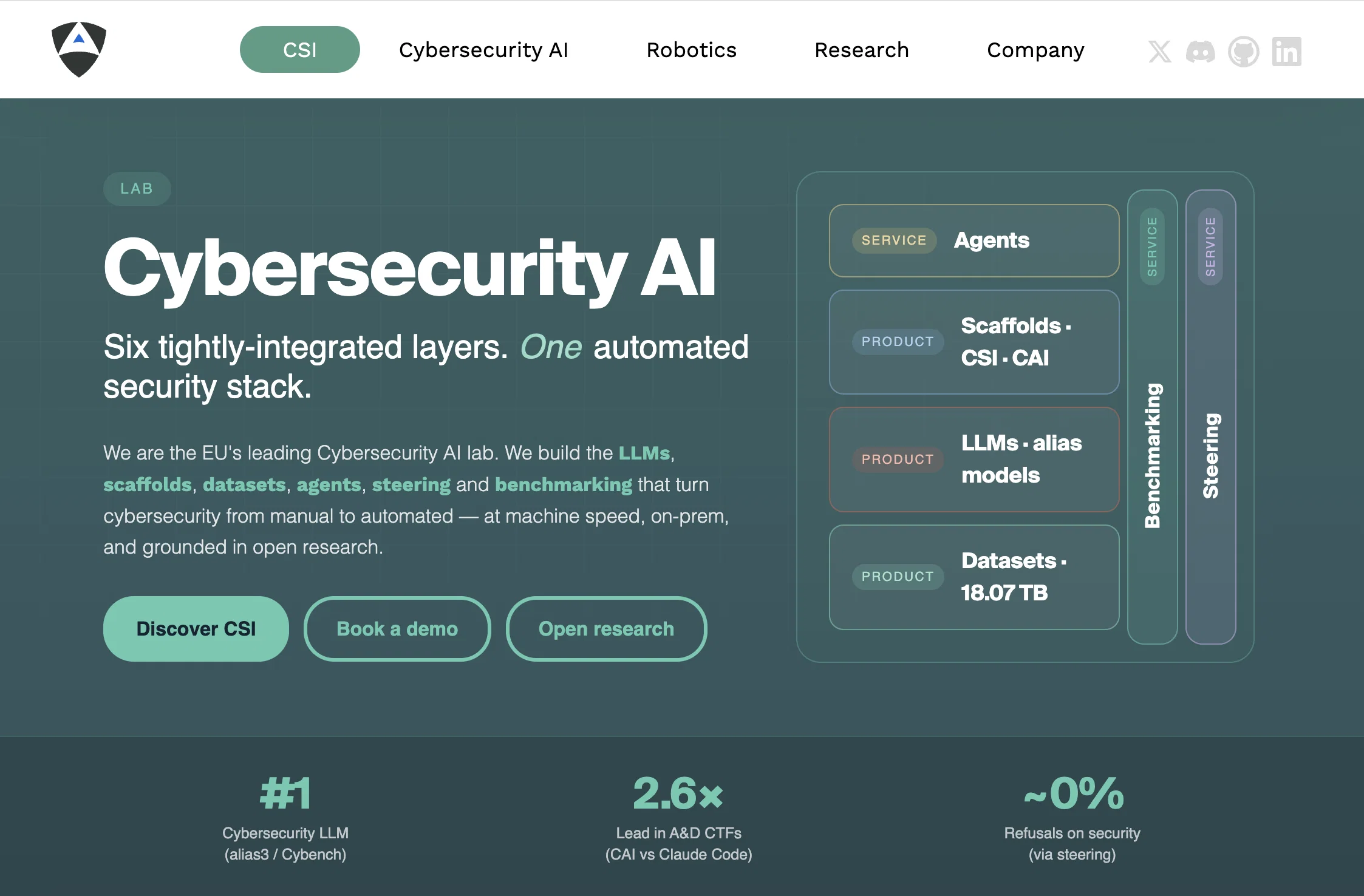
Alias Robotics Cybersecurity AI website

Access & connections

Where you can use Alias Robotics Cybersecurity AI.

Platforms

Web

Capabilities

What this tool accepts, produces, and is strongest at.

Input

  • Text
  • Structured data

Output

  • Text
  • API

Supported features

  • Cybersecurity

Pros & cons

Pros

  • High speed operation
  • On-premise or cloud-hosted
  • Language Learning Models
  • Varied scaffolding integration
  • Large cybersecurity trajectories datasets
  • Robust cybersecurity tasks capacity
  • Agents mimic security roles
  • Transforms LLMs into specialists
Show 38 more
  • Benchmarking for efficacy validation
  • Independently operational components
  • Open research engagement
  • Automates cybersecurity functions
  • Unified cybersecurity framework
  • Cohesive security system
  • Functional efficiency promotion
  • EU's leading Cybersecurity Lab
  • Manifests in products and services
  • Alias3 leads Cybench at 85%
  • 18.07 TB EU sovereign corpus
  • 224, 766 hacking session logs
  • 25+ Peer-reviewed papers
  • 15+ generations of specialized cybersecurity agents
  • Autonomous security role replication
  • Supports red team and APT simulation
  • Offers custom agents co-design
  • Allows for emotion engineering in LLMs
  • Implementation ensures fast responses
  • EU-hosted or on-premise LLMs
  • Functioning on-prem
  • Benchmarked against humans and other models
  • Designed for the cyber ranges and NATO exercises
  • Operates 11x faster, 156x cheaper than humans
  • CSI scaffold combiner
  • Blackboard mode on Cybench at 57.6%
  • Bespoke ablitiration
  • Refusals reduced to nearly 0%
  • Modifier steering activation
  • Unlimited tokens with PRO access
  • Complies with NDA & ATO
  • Open-source under commercial-friendly license
  • Air-gapped alias models for custom deployment
  • Fine tuning for custom domains
  • Critical infrastructure suitable
  • Ready for government and intelligence agencies
  • On-prem custom deployment option
  • Can replicate open research experiments

Cons

  • Requires high-speed operations
  • Tied to EU lab
  • Complex multiple-component system
  • Specialization via steering needed
  • Requires large datasets
  • Scaffold (CSI) system needed
  • Dependent on cloud/on-premise
  • Open research comparison challenge
Show 2 more
  • Potential overcomplexity with agents
  • Limited to cybersecurity trajectory data

Compare alternatives

Similar tools in the catalog — with a clear reason to open each one.
Releases 1

Initial release September 2, 2026 Current
Initial release of Alias Robotics Cybersecurity AI.

FAQ 12

What is Alias Robotics?
Alias Robotics is a robot cybersecurity firm specializing in delivering security solutions for robots and their components. It offers a comprehensive cybersecurity AI stack composed of various products and services to automate cybersecurity functions. The firm also engages in open research in the field of AI cybersecurity.
How does the Alias Robotics Cybersecurity AI work?
Alias Robotics' Cybersecurity AI works by providing a full-stack solution of products and services that transform manual cybersecurity practices into automated ones. Its primary components involve Language Learning Models (LLMs), scaffold systems, and large datasets. The LLMs, marketed under the 'alias' name, are designed for robust cybersecurity tasks. The scaffold system, named CSI, integrates different cybersecurity tools into a unified framework. The large datasets, comprising an enormous corpus of cybersecurity trajectories, fuel the performance of the 'alias' models. The AI services, including agents, steering, and benchmarking, play specific roles in automating, personalizing, and validating cybersecurity functions.
What does Alias Robotics Cybersecurity AI stack consist of?
Alias Robotics Cybersecurity AI stack consists of several products and services. The products include Language Learning Models (LLMs), scaffolds, and large datasets. The services offered involve agents, steering, and benchmarking. Each component is independently operational but is designed to work in sync with the others to ensure a unified, efficient security system.
How do the LLMs from Alias Robotics function?
The Language Learning Models (LLMs) from Alias Robotics are highly capable units designed for robust cybersecurity tasks. They are marketed under the 'alias' name and are used to automate numerous cybersecurity functions. The LLMs, when combined with general-purpose steering, can be transformed into specialized, unrestricted security experts.
What is the role of the scaffolds in Alias Robotics' system?
The scaffold systems of Alias Robotics, specifically the CSI system, operate as integrators of various cybersecurity tools to form a unified security framework. This integrated framework facilitates the smooth functioning of multiple AI security components together, leveraging their unique capabilities into a cohesive, more efficient security system.
How does Alias Robotics use large datasets for AI cybersecurity?
Alias Robotics uses extensive datasets, comprising of a vast corpus of cybersecurity trajectories, to fuel the performance of its 'alias' models. These large scale datasets assist in training the AI models to be more robust and effective in making cybersecurity predictions and taking actions.
What are the key services offered by Alias Robotics in AI cybersecurity?
Alias Robotics offers three key services for AI cybersecurity: agents, steering, and benchmarking. The agents imitate core security roles, automating critical tasks related to cybersecurity. Steering transforms general-purpose Language Learning Models into specialized security experts, customizing AI capabilities to meet unique security needs. Benchmarking validates the functional efficacy of each layer of the system, ensuring the AI system performs as expected.
What does the agent service in Alias Robotics' suite do?
The agent service in Alias Robotics' suite replicates core security roles such as defenders, forensic experts, red teams and even advanced persistent threat (APT) simulators. By automating these roles, Alias Robotics can enhance the speed and scale of cybersecurity operations, providing a vital multiplier in overall security effectiveness.
How do steering and benchmarking services from Alias Robotics contribute to AI cybersecurity?
Steering and benchmarking services from Alias Robotics contribute to AI cybersecurity by fine-tuning the performance of security systems and validating their efficacy. Steering transforms general-purpose Language Learning Models into specialized security experts, offering a customized AI capability for unique security requirements. Benchmarking, on the other hand, validates the functional efficacy of each layer of the security stack, ensuring deliverance of expected performance levels.
How can Alias Robotics' AI tools be used together for a unified cybersecurity solution?
Alias Robotics' AI tools, including Language Learning Models (LLMs), scaffolds (scaffold systems) and services (agents, steering, and benchmarking), can be used together to provide a unified cybersecurity solution. Each of these components is independently operational, but they are designed to work cohesively, leveraging their strengths in coordination with each other, thereby ensuring a more efficient and effective security system.
What kind of open research does Alias Robotics engage in?
Alias Robotics engages in open research by continuously innovating and sharing knowledge in the field of AI cybersecurity. This involves producing and documenting extensive research publications which explore current trends, challenges and advancements in AI-powered cybersecurity.
What is the significance of the 'alias' model in Alias Robotics Cybersecurity AI?
The 'alias' model, a vital constituent of Alias Robotics Cybersecurity AI, is a range of Language Learning Models (LLMs) used for automating an extensive range of cybersecurity tasks. These models, combined with other components of the AI stack, help in transitioning from manual to automated cybersecurity.
Alias Robotics Cybersecurity AI